Quotessence
Home / Authors / Charles Lindbergh
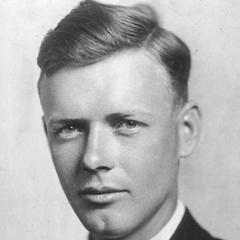
Charles Lindbergh

Charles Lindbergh Quotes

Aviator

Filter quotes by topic

Famous Charles Lindbergh Quotes

“Lying under an acacia tree with the sound of the dawn around me, I realized more clearly the facts that man should never overlook: that the construction of an airplane, for instance, is simple when compared [with] a bird; that airplanes depend on an advanced civilization, and that were civilization is most advanced, few birds exist. I realized that If I had to choose, I would rather have birds than airplanes.”

“The Jews are one of the principle forces attempting to lead the U.S. into the war. The Jews greatest danger to this country lies in their large ownership and influence in our motion pictures, our press, our radio and our Government. I am saying that the LEADERS of the Jewish race wish to involve us in the war for reasons that are NOT AMERICAN.”

“Possibly everyone will travel by air in another fifty years. I'm not sure I like the idea of millions of planes flying around overhead. I love the sky's unbroken solitude. I don't like to think of it cluttered up by aircraft, as roads are cluttered up by cars. I feel like the western pioneer when he saw barbed-wire fence lines encroaching on his open plains. The success of his venture brought the end of the life he loved.”

“Why does one want to walk wings? Why force one's body from a plane to make a parachute jump? Why should man want to fly at all? People often ask these questions. But what civilization was not founded on adventure, and how long could one exist without it? Some answer the attainment of knowledge. Some say wealth, or power, is sufficient cause. I believe the risks I take are justified y the sheer love of the life I lead.”

“Is civilization progress? The challenge, I think, is clear; and, as clearly, the final answer will be given not by our amassing of knowledge, or by the discoveries of our science, or by the speed of our aircraft, but by the effect of our civilized activities as a whole have upon the quality of our planet's life-the life of plants and animals as that of men.”

“While my hand is on the stick, my feet on the rudder, and my eyes on the compass, this consciousness, like a winged messenger, goes out to visit the waves below, testing the warmth of water, the speed of wind, the thickness of intervening clouds. It goes north to the glacial coasts of Greenland, over the horizon to the edge of dawn, ahead to Ireland, England, and the continent of Europe, away through space to the moon and stars, always returning, unwillingly, to the mortal duty of seeing that the limbs and muscles have attended their routine while it was gone.”

“I'm not bound to be in aviation at all. I'm here only because I love the sky and flying more than anything else on earth. Of course there's danger; but a certain amount of danger is essential to the quality of life. I don't believe in taking foolish chances' but nothing can be accomplished without taking any chance at all.”

“On a long flight, after periods of crisis and many hours of fatigue, mind and body may become disunited until at times they seem completely different elements, as though the body were only a home with which the mind has been associated but by no means bound. Consciousness grows independent of the ordinary senses. You see without assistance from the eyes, over distances beyond the visual horizon. There are moments when existence appears independent even of the mind. The importance of physical desire and immediate surroundings is submerged in the apprehension of universal values.”

“Then what am I - the body substance which I can see with my eyes and feel with my hands? Or am I this realization, this greater understanding which dwells within it, yet expands through the universe outside; a part of all existence, powerless but without need for power; immersed in solitude, yet in contact with all creation? There are moments when the two appear inseparable, and others when they could be cut apart by the merest flash of light.”

“It was that quality that led me into aviation in the first place — it was a love of the air and sky and flying, the lure of adventure, the appreciation of beauty. It lay beyond the descriptive words of man — where immortality is touched through danger, where life meets death on equal plane; where man is more than man, and existence both supreme and valueless at the same instant.”

“The life of an aviator seemed to me ideal. It involved skill. It brought adventure. It made use of the latest developments of science. Mechanical engineers were fettered to factories and drafting boards while pilots have the freedom of wind with the expanse of sky. There were times in an aeroplane when it seemed I had escaped mortality to look down on earth like a God.”