Quotessence
Home / Authors / Elizabeth Hardwick
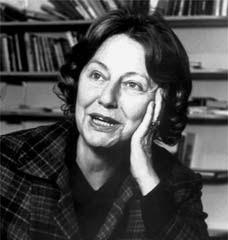
Elizabeth Hardwick

Elizabeth Hardwick Quotes

Novelist

Filter quotes by topic

Famous Elizabeth Hardwick Quotes

“In those years I did not care to enjoy sex, only to have it. That is what seeing Alex again on Fifth Avenue brought back to me - a youth of fascinated, passionless copulation. There they are, figures in a discoloured blur, young men and not so young, the nice ones with automobiles, the dull ones full of suspicions and stinginess. By asking a thousand questions of many heavy souls, I did not learn much. You receive biographies interesting mainly for their coherence. So many are children who from the day of their birth are growing up to be their parents. Look at the voting records, inherited like flat feet.”

“Nevertheless the severance is rather casual and it drops a stain on our admiration of Nora. Ibsen has put the leaving of her children on the same moral and emotional level as the leaving of her husband and we cannot, in our hearts, asssent to that. It is not only the leaving but the way the play does not have time for suffering, changes of heart. Ibsen has been too much a man in the end. He has taken the man's practice, if not his stated belief, that where self-realization is concerned children shall not be an impediment.”

“Leonard Woolf’s endurance of Virginia’s famous frigidity is, we must suppose after the fact, altogether to his credit. Their honeymoon did not bring the amelioration they had hoped for and it is incredibly innocent and moving to think of them discussing it with Vanessa. They wanted to know when she had first had an orgasm. She said she couldn’t remember but she knew she had been “sympathetic” from the age of two. Vita Sackville-West said about Virginia, “She dislikes the possessiveness and love of domination in men. In fact she dislikes the quality of masculinity.”

“The large, gaping flaws in the construction of the stories--mad wives in the attic, strange apparitions in Belgium--are a representation of the life she could not face; these gothic subterfuges represent the mind at a breaking point, frantic to find any way out. If the flaws are only to be attributed to the practicce of popular fiction of the time, we cannot then explain the large amount of genuine feeling that goes into them. They stand for the hidden wishes of an intolerable life.”

“The 'swapping' is interesting. This practice one had thought confined to certain earnest Americans in the smaller, more tedious cities, to those wives and husbands who had read sex manuals and radically wanted more of life even if it had to be, like pizza, brought in from around the corner--all of this was accomplished by Bloomsbury in the lightest, most spontaneous and good-natured manner.”

“Gertrude Stein, all courage and will, is a soldier of minimalism. Her work, unlike the resonating silences in the art of Samuel Beckett, embodies in its loquacity and verbosity the curious paradox of the minimalist form. This art of the nuance in repetition and placement she shares with the orchestral compositions of Philip Glass.”

“The private and serious drama of guilt is not often a useful one for fiction today and its disappearance, following perhaps the disappearance from life, appears as a natural, almost unnoticed relief, like some of the challenging illnesses wiped out by drug and vaccines.”

“Harvard (across the river in Cambridge) and Boston are two ends of one mustache. ... Without the faculty, the visitors, the events that Harvard brings to the life here, Boston would be intolerable to anyone except genealogists, antique dealers, and those who find repletion in a closed local society.”

“A letter is not a dialogue or even an omniscient exposition. It is a fabric of surfaces, a mask, a form as well suited to affectations as to the affections. The letter is, by its natural shape, self-justifying; it is one's own evidence, deposition, a self-serving testimony. In a letter the writer holds all the cards, controls everything about himself and about those assertions he wishes to make concerning events or the worth of others. For completely self-centered characters, the letter form is a complex and rewarding activity.”

“Many people believe letters the most personal and revealing form of communication. In them, we expect to find the charmer at his nap, slumped, open-mouthed, profoundly himself without thought for appearances. Yet, this is not quite true. Letters are above all useful as a means of expressing the ideal self; and no other method of communication is quite so good for this purpose. In conversation, those uneasy eyes upon you, those lips ready with an emendation before you have begun to speak, are a powerful deterrent to unreality, even to hope.”

“Letters are above all useful as a means of expressing the ideal self; and no other method of communication is quite so good for this purpose. In letters we can reform without practice, beg without humiliation, snip and shape embarrassing experiences to the measure of our own desires.”

“The language of the younger generation has the brutality of the city and an assertion of threatening power at hand, not to come. It is military, theatrical, and at its most coherent probably a lasting repudiation of empty courtesy and bureaucratic euphemism.”