Quotessence
Home / Authors / James Madison
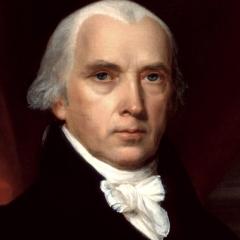
James Madison

James Madison Quotes

4th U.S. President

Filter quotes by topic

Famous James Madison Quotes

“Is there no virtue among us? If there be not, we are in a wretched situation. No theoretical checks-no form of government can render us secure. To suppose that any form of government will secure liberty or happiness without any virtue in the people, is a chimerical idea, if there be sufficient virtue and intelligence in the community, it will be exercised in the selection of these men. So that we do not depend on their virtue, or put confidence in our rulers, but in the people who are to choose them.”

“No man will subject himself to the ridicule of pretending that any natural connection subsists between the sun or the seasons, and the period within which human virtue can bear the temptations of power. Happily for mankind, liberty is not, in this respect, confined to any single point of time, but lies within extremes, which afford sufficient latitude for all the variations which may be required by the various situations and circumstances of civil society.”

“The people can never willfully betray their own interests: But they may possibly be betrayed by the representatives of the people; and the danger will be evidently greater where the whole legislative trust is lodged in the hands of one body of men, than where the concurrence of separate and dissimilar bodies is required in every public act.”

“Whatever may be the judgement pronounced on the competency of the architects of the Constitution, or whatever may be the destiny of the edifice prepared by them, I feel it a duty to express my profound and solemn conviction . . . that there never was an assembly of men, charged with a great and arduous trust, who were more pure in their motives, or more exclusively or anxiously devoted to the object committed to them.”

“In the latter sense, a man has a property in his opinions and the free communication of them. He has a property of peculiar value in his religious opinions, and in the profession and practice dictated by them. He has an equal property in the free use of his faculties and free choice of the objects on which to employ them. In a word, as a man is said to have a right to his property, he may be equally said to have a property in his rights.”

“When men exercise their reason coolly and freely, on a variety of distinct questions, they inevitably fall into different opinions, on some of them. When they are governed by a common passion, their opinions if they are so to be called, will be the same.”

“Place three individuals in a situation wherein the interest of each depends on the voice of the others, and give to two of them an interest opposed to the rights of the third. Will the latter be secure? The prudence of every man would shun the danger. The rules & forms of justice suppose & guard against it. Will two thousand in a like situation be less likely to encroach on the rights of one thousand?”

“Before any man can be considered as a member of Civil Society, he must be considered as a subject of the Governour of the Universe: And if a member of Civil Society, do it with a saving of his allegiance to the Universal Sovereign. We maintain therefore that in matters of Religion, no man's right is abridged by the institution of Civil Society and that Religion is wholly exempt from its cognizance.”

“The real wonder is that so many difficulties should have been surmounted [in the federal convention], and surmounted with a unanimity almost as unprecedented as it must have been unexpected. It is impossible for any man of candor to reflect on this circumstance without partaking of the astonishment. It is impossible for the man of pious reflection not to perceive in it a finger of that Almighty hand which has been so frequently and signally extended to our relief in the critical stages of the revolution.”

“Every answer he [President John Adams] gives to his addressers unmasks more and more his principles and views. His language to the young men at Philadelphia is the most abominable and degrading that could fall from the lips of the first magistrate of an independent people, and particularly from a Revolutionary patriot.”

“The diversity in the faculties of men, from which the rights of property originate, is not less an insuperable obstacle to a uniformity of interests. The protection of these faculties is the first object of government. From the protection of different and unequal faculties of acquiring property, the possession of different degrees and kinds of property immediately results; and from the influence of these on the sentiments and views of the respective proprietors, ensues a division of the society into different interests and parties.”