Quotessence
Home / Authors / James Madison
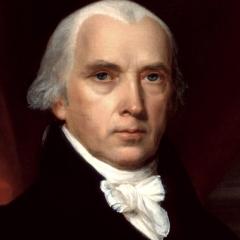
James Madison

James Madison Quotes

4th U.S. President

Filter quotes by topic

Famous James Madison Quotes

“Money cannot be applied to the *general welfare*, otherwise than by an application of it to some *particular* measure conducive to the general welfare. Whenever, therefore, money has been raised by the general authority, and is to be applied to a particular measure, a question arises whether the particular measure be within the enumerated authorities vested in Congress. If it be, the money requisite for it may be applied to it; if it be not, no such application can be made.”

“With regard to Banks, they have taken too deep and too wide a root in social transactions, to be got rid of altogether, if that were desirable. They have a hold on public opinion, which alone would make it expedient to aim rather at the improvement, than the suppression of them. As now generally constituted, their advantages whatever they be, are outweighed by the excesses of their paper emissions, and the partialities and corruption with which they are administered.”

“May it not be asked of every intelligent friend to the liberties of his country, whether the power exercised in such an act as this ought not to produce great and universal alarm? Whether a rigid execution of such an act, in time past, would not have repressed that information and communication among the people which is indispensable to the just exercise of their electoral rights? And whether such an act, if made perpetual, and enforced with rigor, would not, in time to come, either destroy our free system of government, or prepare a convulsion that might prove equally fatal to it?”

“Whilst we assert for ourselves a freedom to embrace, to profess and observe the Religion which we believe to be of divine origin, we cannot deny equal freedom to those whose minds have not yet yielded to the evidence which has convinced us. If this freedom be abused, it is an offense against God, not against man:To God, therefore, not to man, must an account of it be rendered.”

“Because the bill vests in the said incorporated church an authority to provide for the support of the poor and the education of poor children of the same, an authority which, being altogether superfluous if the provision is to be the result of pious charity, would be a precedent for giving to religious societies as such a legal agency in carrying into effect a public and civil duty.”

“If the public homage of a people can ever be worthy of the favorable regard of the Holy and Omniscient Being to Whom it is addressed, it must be that in which those who join in it are guided only be their free choice-by the impulse of their hearts and the dictates of their consciences.”

“If Tyranny and Oppression come to this land, it will be in the guise of fighting a foreign enemy.”

“It will be of little avail to the people that the laws are made by men of their own choice if the laws be so voluminous that they cannot be read, or so incoherent that they cannot be understood.”

“What is government itself but the greatest of all reflections on human nature? If men were angels, no government would be necessary. If angels were to govern men, neither external nor internal controls on government would be necessary.”

“If men were angels, no government would be necessary. If angels were to govern men, neither external nor internal controls on government would be necessary. In framing a government which is to be administered by men over men, the great difficulty lies in this: you must first enable the government to control the governed; and in the next place oblige it to control itself. A dependence on the people is, no doubt, the primary control on the government; but experience has taught mankind the necessity of auxiliary precautions.”

“If Congress can do whatever in their discretion can be done by money, and will promote the General Welfare, the Government is no longer a limited one, possessing enumerated powers, but an indefinite one.”

“If there be a principle that ought not to be questioned within the United States, it is that every man has a right to abolish an old government and establish a new one. This principle is not only recorded in every public archive, written in every American heart, and sealed with the blood of American martyrs, but is the only lawful tenure by which the United States hold their existence as a nation.”

“Each State, in ratifying the Constitution, is considered as a sovereign body, independent of all others, and only to be bound by its own voluntary act. In this relation, then, the new Constitution will, if established, be a FEDERAL, and not a NATIONAL constitution.”

“How could a readiness for war in time of peace be safely prohibited, unless we could prohibit, in like manner, the preparations and establishments of every hostile nation? The means of security can only be regulated by the means and the danger of attack. They will, in fact, be ever determined by these rules, and by no others . . . . If one nation maintains constantly a disciplined army, ready for service of ambition or revenge, it obliges the most pacific nations who may be within the reach of its enterprises to take corresponding precautions.”

“I own myself the friend to a very free system of commerce, and hold it as a truth, that commercial shackles are generally unjust, oppressive and impolitic - it is also a truth, that if industry and labour are left to take their own course, they will generally be directed to those objects which are the most productive, and this in a more certain and direct manner than the wisdom of the most enlightened legislature could point out.”

“Is there no virtue among us? If there be not, we are in a wretched situation. No theoretical checks-no form of government can render us secure. To suppose that any form of government will secure liberty or happiness without any virtue in the people, is a chimerical idea, if there be sufficient virtue and intelligence in the community, it will be exercised in the selection of these men. So that we do not depend on their virtue, or put confidence in our rulers, but in the people who are to choose them.”

“If justice, good faith, honor, gratitude and all the other qualities which enoble the character of a nation, and fulfill the ends of Government be the fruits of our establishments, the cause of liberty will acquire a dignity and lustre, which it has never yet enjoyed, and an example will be set, which can not but have the most favorable influence on the rights of Mankind.”

“If they are incorporated into the Constitution, independent tribunals of justice will consider themselves in a peculiar manner the guardians of those rights; they will be an impenetrable bulwark against every assumption of power in the legislative or executive; they will be naturally led to resist every encroachment upon rights expressly stipulated for in the Constitution by the declaration of rights.”

“But cool and candid people will at once reflect, that the purest of human blessings must have a portion of alloy in them, that the choice must always be made, if not of the lesser evil, at least of the GREATER, not the PERFECT good; and that in every political institution, a power to advance the public happiness, involves a discretion which may be misapplied and abused.”

“Attempts to enforce by legal sanctions, acts obnoxious to so great a proportion of Citizens, tend to enervate the laws in general, and to slacken the bands of Society. If it be difficult to execute any law which is not generally deemed necessary or salutary, what must be the case, where it is deemed invalid and dangerous? And what may be the effect of so striking an example of impotency in the Government, on its general authority?”

“When men exercise their reason coolly and freely, on a variety of distinct questions, they inevitably fall into different opinions, on some of them. When they are governed by a common passion, their opinions if they are so to be called, will be the same.”

“If we resort for a criterion to the different principles on which different forms of government are established, we may define a republic to be, or at least may bestow that name on, a government which derives all its powers directly or indirectly from the great body of the people, and is administered by persons holding their offices during pleasure for a limited period, or during good behavior.”

“What is to be the consequence, in case the Congress shall misconstrue this part [the necessary and proper clause] of the Constitution and exercise powers not warranted by its true meaning, I answer the same as if they should misconstrue or enlarge any other power vested in them . . . the success of the usurpation will depend on the executive and judiciary departments, which are to expound and give effect to the legislative acts; and in a last resort a remedy must be obtained from the people, who can by the elections of more faithful representatives, annul the acts of the usurpers.”

“Before any man can be considered as a member of Civil Society, he must be considered as a subject of the Governour of the Universe: And if a member of Civil Society, do it with a saving of his allegiance to the Universal Sovereign. We maintain therefore that in matters of Religion, no man's right is abridged by the institution of Civil Society and that Religion is wholly exempt from its cognizance.”

“I consider it…as subverting the fundamental and characteristic principle of the Government…and as bidding defiance to the sense in which the Constitution is known to have been proposed, advocated, and adopted. If Congress can do whatever in their discretion can be done by money, and will promote the General Welfare, the Government is no longer a limited one.”

“Let the influx of money be ever so great, if there be no confidence, property will sink in value... The circulation of confidence is better than the circulation of money.”

“If it be asked what is to restrain the House of Representatives from making legal discriminations in favor of themselves and a particular class of the society? I answer, the genius of the whole system, the nature of just and constitutional laws, and above all the vigilant and manly spirit which actuates the people of America, a spirit which nourishes freedom, and in return is nourished by it.”

“That the foundation of our national policy should be laid in private morality. If individuals be not influenced by moral principles, it is in vain to look for public virtue; it is, therefore, the duty of legislators to enforce, both by precept and example, the utility, as well as the necessity, of a strict adherence to the rules of distributive justice.”

“If Congress can employ money indefinitely to the general welfare... they may appoint teachers in every state... The powers of Congress would subvert the very foundation, the very nature of the limited government established by the people of America.”

“Because finally, 'the equal right of every citizen to the free exercise of his religion according to the dictates of conscience' is held by the same tenure with all his other rights. If we recur to its origin, it is equally the gift of nature; if we weigh its importance, it cannot be less dear to us; if we consider the 'Declaration of those rights which pertain to the good people of Virginia, as the basis and foundation of government,' it is enumerated with equal solemnity, or rather studied emphasis.”

“I think it absolutely necessary that the President should have the power of removing his subordinates from office; it will make him, in a peculiar manner, responsible for their conduct, and subject him to impeachment himself, if he suffers them to perpetrate with impunity high crimes or misdemeanors against the United States, or neglects to superintend their conduct, so as to check their excesses.”