Quotessence
Home / Authors / James Madison
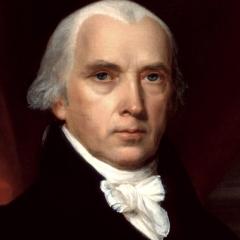
James Madison

James Madison Quotes

4th U.S. President

Filter quotes by topic

Famous James Madison Quotes

“I have sometimes thought there could be no stronger testimony in favor of Religion or against temporal Enjoyments even the most rational and manly than for men who occupy the most honorable and gainful departments and are rising in reputation and wealth, publicly to declare their unsatisfactoriness by becoming fervent Advocates in the cause of Christ, & I wish you may give in your Evidence in this way. Such instances have seldom occurred, therefore they would be more striking and would be instead of a "Cloud of Witnesses.”

“Whilst we assert for ourselves a freedom to embrace, to profess and observe the Religion which we believe to be of divine origin, we cannot deny equal freedom to those whose minds have not yet yielded to the evidence which has convinced us. If this freedom be abused, it is an offense against God, not against man:To God, therefore, not to man, must an account of it be rendered.”

“Although all men are born free, slavery has been the general lot of the human race. Ignorant--they have been cheated; asleep--they have been surprised; divided--the yoke has been forced upon them. But what is the lesson...? The people ought to be enlightened, to be awakened, to be united, that after establishing a government they should watch over it.... It is universally admitted that a well-instructed people alone can be permanently free.”

“The American people owe it to themselves, and to the cause of free Government, to prove by their establishments for the advancement and diffusion of knowledge, that their political Institutionsare as favorable to the intellectual and moral improvement of Man as they are conformable to his individual and social rights.”

“[The Republican Party] consists of those who, believing in the doctrine that mankind are capable of governing themselves and hating hereditary power as an insult to the reason and an outrage to the rights of men, are naturally offended at every public measure that does not appeal to the understanding and to the general interest of the community.”

“Conscience is the most sacred of all property; other property depending in part on positive law, the exercise of that being a natural and unalienable right. To guard a man's house as his castle, to pay public and enforce private debts with the most exact faith, can give no title to invade a man's conscience, which is more sacred than his castle, or to withhold from it that debt of protection for which the public faith is pledged by the very nature and original conditions of the social pact.”

“We maintain therefore that in matters of Religion, no man's right is abridged by the institution of Civil Society, and that Religion is wholly exempt from its cognizance.”

“Religion, or the duty we owe to our Creator, and manner of discharging it, can be directed only by reason and conviction, not by force or violence; and, therefore, that all men should enjoy the fullest toleration in the exercise of religion according to the dictates of conscience, unpunished and unrestrained by the magistrate, unless under color of religion any man disturb the peace, the happiness, or safety of society, and that it is the mutual duty of all to practice Christian forbearance, love and charity toward each other.”

“Besides the obscurity arising from the complexity of objects, and the imperfection of the human faculties, the medium through which the conceptions of men are conveyed to each other adds a fresh embarrassment.”

“It will be of little avail to the people that the laws are made by men of their own choice if the laws be so voluminous that they cannot be read, or so incoherent that they cannot be understood.”

“In framing a government which is to be administered by men over men you must first enable the government to control the governed; and in the next place oblige it to control itself.”

“What is government itself but the greatest of all reflections on human nature? If men were angels, no government would be necessary. If angels were to govern men, neither external nor internal controls on government would be necessary.”

“If men were angels, no government would be necessary. If angels were to govern men, neither external nor internal controls on government would be necessary. In framing a government which is to be administered by men over men, the great difficulty lies in this: you must first enable the government to control the governed; and in the next place oblige it to control itself. A dependence on the people is, no doubt, the primary control on the government; but experience has taught mankind the necessity of auxiliary precautions.”

“The interest of the man must be connected with the constitutional rights of the place. It may be a reflection on human nature, that such devices should be necessary to control the abuses of Government. But what is Government itself, but the greatest of all reflections on human nature?”

“If there be a principle that ought not to be questioned within the United States, it is that every man has a right to abolish an old government and establish a new one. This principle is not only recorded in every public archive, written in every American heart, and sealed with the blood of American martyrs, but is the only lawful tenure by which the United States hold their existence as a nation.”

“The aim of every political Constitution, is or ought to be first to obtain for rulers men who possess most wisdom to discern, and most virtue to pursue, the common good of society; and in the next place, to take the most effectual precautions for keeping them virtuous whilst they continue to hold their public trust.”

“The Convention thought it wrong to admit in the Constitution the idea that there could be property in men.”

“We have seen the mere distinction of color made in the most enlightened period of time, a ground of the most oppressive dominion ever exercised by man over man.”

“The rich man, when contributing to a permanent plan for the education of the poor, ought to reflect that he is providing for that of his own descendants; and the poor man who concurs in a provision for those who are not poor that at no distant day it may be enjoyed by descendants from himself. It does not require a long life to witness these vicissitudes of fortune.”

“The latent causes of faction are thus sown in the nature of man; and we see them everywhere brought into different degrees of activity, according to the different circumstances of civil society.”

“It is possible that these may all be insufficient to control the caprice and wickedness of man. But are they not all that government will admit, and all that human prudence can devise?”

“The smaller the number and the more permanent and conspicuous the station of men in power, the stronger must be the interest which they will individually feel in whatever concerns the government.”

“As long as the reason of man continues fallible, and he is at liberty to exercise it, different opinions will be formed. As long as the connection subsists between his reason and his self-love, his opinions and passions will have a reciprocal influence on each other, and the former will be objects to which the latter attach themselves.”

“Government is instituted to protect property of every sort; as well that which lies in the various rights of individuals, as that which the term particularly expresses. This being the end of government, that alone is a just government which impartially secures to every man whatever is his own.”

“Every man who loves peace, every man who loves his country, every man who loves liberty ought to have it ever before his eyes that he may cherish in his heart a due attachment to the Union of America and be able to set a due value on the means of preserving it.”

“It is impossible for the man of pious reflection not to perceive in it [the Constitution] a finger of that Almighty hand which has been so frequently and signally extended to our relief in the critical stages of the revolution.”

“The belief in a God All Powerful wise and good, is so essential to the moral order of the world and to the happiness of man, that arguments which enforce it cannot be drawn from too many sources nor adapted with too much solicitude to the different characters and capacities impressed with it.”