Quotessence
Home / Authors / James Madison
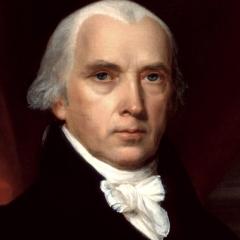
James Madison

James Madison Quotes

4th U.S. President

Filter quotes by topic

Famous James Madison Quotes

“Money cannot be applied to the *general welfare*, otherwise than by an application of it to some *particular* measure conducive to the general welfare. Whenever, therefore, money has been raised by the general authority, and is to be applied to a particular measure, a question arises whether the particular measure be within the enumerated authorities vested in Congress. If it be, the money requisite for it may be applied to it; if it be not, no such application can be made.”

“May it not be asked of every intelligent friend to the liberties of his country, whether the power exercised in such an act as this ought not to produce great and universal alarm? Whether a rigid execution of such an act, in time past, would not have repressed that information and communication among the people which is indispensable to the just exercise of their electoral rights? And whether such an act, if made perpetual, and enforced with rigor, would not, in time to come, either destroy our free system of government, or prepare a convulsion that might prove equally fatal to it?”

“I have sometimes thought there could be no stronger testimony in favor of Religion or against temporal Enjoyments even the most rational and manly than for men who occupy the most honorable and gainful departments and are rising in reputation and wealth, publicly to declare their unsatisfactoriness by becoming fervent Advocates in the cause of Christ, & I wish you may give in your Evidence in this way. Such instances have seldom occurred, therefore they would be more striking and would be instead of a "Cloud of Witnesses.”

“In a free Government, the security for civil rights must be the same as that for religious rights. It consists in the one case in the multiplicity of interests, and in the other in the multiplicity of sects. The degree of security in both cases, will depend on the number of interests and sects; and this may be presumed to depend on the extent of country and number of People comprehended under the same Government.”

“Rulers who wished to subvert the public liberty, may have found an established Clergy convenient auxiliaries. A just Government instituted to secure & perpetuate it needs them not.”

“And may I not be allowed to ... read in the character of the American people, in their devotion to true liberty and to the Constitution which is its palladium [protection], ... a Government which watches over ... the equal interdict [prohibition] against encroachments and compacts between religion and the state.”

“The two great points of difference between a democracy and a republic are: first, the delegation of the government, in the latter,to a small number of citizens elected by the rest; secondly, the greater number of citizens and greater sphere of country over which the latter may be extended.”

“The States then being the parties to the constitutional compact, and in their sovereign capacity, it follows of necessity, that there can be no tribunal above their authority, to decide in the last resort, whether the compact made by them be violated; and consequently that as the parties to it, they must themselves decide in the last resort, such questions as may be of sufficient magnitude to require their interposition.”

“In war, too, the discretionary power of the Executive is extended; its influence in dealing out offices, honors, and emoluments is multiplied; and all the meaning of seducing the minds, are added to those of subduing the force, of the people. The same malignant aspect in republicanism may be traced in the inequality of fortunes, and the opportunities of fraud, growing out of a state of war, and in the degeneracy of manners and morals, engendered by both. No nation could preserve its freedom in the midst of continual warfare.”

“The accumulation of all powers, legislative, executive, and judiciary, in the same hands, whether of one, a few, or many, and whether hereditary, selfappointed, or elective, may justly be pronounced the very definition of tyranny.”

“The interest of the man must be connected with the constitutional rights of the place. It may be a reflection on human nature, that such devices should be necessary to control the abuses of Government. But what is Government itself, but the greatest of all reflections on human nature?”

“Who does not see that the same authority which can establish Christianity, in exclusion of all other Religions, may establish with the same ease any particular sect of Christians, in exclusion of all other Sects?”

“It is due to justice; due to humanity; due to truth; due to the sympathies of our nature; in fine, to our character as a people, both abroad and at home, that they should be considered, as much as possible, in the light of human beings, and not as mere property. As such, they are acted on by our laws, and have an interest in our laws. They may be considered as making a part, though a degraded part, of the families to which they belong.”

“The rich man, when contributing to a permanent plan for the education of the poor, ought to reflect that he is providing for that of his own descendants; and the poor man who concurs in a provision for those who are not poor that at no distant day it may be enjoyed by descendants from himself. It does not require a long life to witness these vicissitudes of fortune.”

“Strongly guarded as is the separation between Religion and Government in the Constitution of the United States, the danger of encroachment by Ecclesiastical Bodies may be illustrated by precedents already furnished in their short history.”

“It is possible that these may all be insufficient to control the caprice and wickedness of man. But are they not all that government will admit, and all that human prudence can devise?”

“It may not be easy, in every possible case, to trace the line of separation between the rights of religion and the Civil authority with such distinctness as to avoid collisions and doubts on unessential points. The tendency to unsurpastion on one side or the other, or to a corrupting coalition or alliance between them, will be best guarded agst. by an entire abstinence of the Gov't from interfence in any way whatsoever, beyond the necessity of preserving public order, and protecting each sect agst. trespasses on its legal rights by others.”

“As the people are the only legitimate fountain of power, and it is from them that the constitutional charter, under which the several branches of government hold their power, is derived, it seems strictly consonant to the republican theory, to recur to the same original authority, not only whenever it may be necessary to enlarge, diminish, or new-model the powers of the government, but also whenever any one of the departments may commit encroachments on the chartered authorities of the others.”

“[T]he delegation of the government, in [a republic], to a small number of citizens elected by the rest . . . [is] to refine and enlarge the public views by passing them through the medium of a chosen body of citizens, whose wisdom may best discern the true interest of their country and whose patriotism and love of justice will be least likely to sacrifice it to temporary or partial considerations.”

“Every man who loves peace, every man who loves his country, every man who loves liberty ought to have it ever before his eyes that he may cherish in his heart a due attachment to the Union of America and be able to set a due value on the means of preserving it.”

“That useful alterations will be suggested by experience, could not but be foreseen . . . . It moreover equally enables the general and state governments to originate the amendment of errors as they may be pointed out by the experience on one side or on the other.”

“How could a readiness for war in time of peace be safely prohibited, unless we could prohibit, in like manner, the preparations and establishments of every hostile nation? The means of security can only be regulated by the means and the danger of attack. They will, in fact, be ever determined by these rules, and by no others . . . . If one nation maintains constantly a disciplined army, ready for service of ambition or revenge, it obliges the most pacific nations who may be within the reach of its enterprises to take corresponding precautions.”

“Every new regulation concerning commerce or revenue; or in any manner affecting the value of the different species of property, presents a new harvest to those who watch the change and can trace its consequences; a harvest reared not by themselves but by the toils and cares of the great body of their fellow citizens. This is a state of things in which it may be said with some truth that laws are made for the few not for the many.”

“It may be considered as an objection inherent in the principle, that as every appeal to the people would carry an implication of some defect in the government, frequent appeals would in great measure deprive the government of that veneration which time bestows on every thing, and without which perhaps the wisest and freest governments would not possess the requisite stability . . . a constitutional road to the decision of the people ought to be marked out and kept open, for certain great and extraordinary occasions”

“The most that the Convention could do in such a situation, was to avoid the errors suggested by the past experience of other countries, as well as of our own; and to provide a convenient mode of rectifying their own errors, as future experience may unfold them.”

“We may be assured by past experience, that such a practice [as some states charging high taxes on goods from other states] would be introduced by future contrivances; and both by that and a common knowledge of human affairs, that it would nourish unceasing animosities, and not improbably terminate in serious interruptions of the public tranquility.”

“Frequent elections are unquestionably the only policy by which this dependence and sympathy can be effectually secured. But what particular degree of frequency may be absolutely necessary for the purpose, does not appear to be susceptible of any precise calculation; and must depend on a variety of circumstances with which it may be connected. Let us consult experience, the guide that ought always to be followed, whenever it can be found.”

“In Europe, charters of liberty have been granted by power. America has set the example . . . of charters of power granted by liberty. This revolution in the practice of the world, may, with an honest praise, be pronounced the most triumphant epoch of its history, and the most consoling presage of its happiness.”

“No man will subject himself to the ridicule of pretending that any natural connection subsists between the sun or the seasons, and the period within which human virtue can bear the temptations of power. Happily for mankind, liberty is not, in this respect, confined to any single point of time, but lies within extremes, which afford sufficient latitude for all the variations which may be required by the various situations and circumstances of civil society.”

“But cool and candid people will at once reflect, that the purest of human blessings must have a portion of alloy in them, that the choice must always be made, if not of the lesser evil, at least of the GREATER, not the PERFECT good; and that in every political institution, a power to advance the public happiness, involves a discretion which may be misapplied and abused.”

“The people can never willfully betray their own interests: But they may possibly be betrayed by the representatives of the people; and the danger will be evidently greater where the whole legislative trust is lodged in the hands of one body of men, than where the concurrence of separate and dissimilar bodies is required in every public act.”

“Whatever may be the judgement pronounced on the competency of the architects of the Constitution, or whatever may be the destiny of the edifice prepared by them, I feel it a duty to express my profound and solemn conviction . . . that there never was an assembly of men, charged with a great and arduous trust, who were more pure in their motives, or more exclusively or anxiously devoted to the object committed to them.”