Quotessence
Home / Authors / James Madison
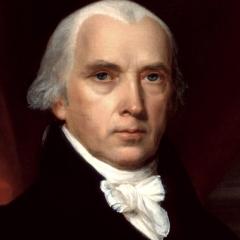
James Madison

James Madison Quotes

4th U.S. President

Filter quotes by topic

Famous James Madison Quotes

“The American people owe it to themselves, and to the cause of free Government, to prove by their establishments for the advancement and diffusion of knowledge, that their political Institutionsare as favorable to the intellectual and moral improvement of Man as they are conformable to his individual and social rights.”

“The house of representatives ... can make no law, which will not have its full operation on themselves and their friends, as well as the great mass of society. This has always been deemed one of the strongest bonds by which human policy can connect the rulers and the people together. It creates between them that communion of interest, and sympathy of sentiments, of which few governments have furnished examples; but without which every government degenerates into tyranny.”

“Hence it is that such democracies have ever been spectacles of turbulence and contention; have ever been found incompatible with personal security or the rights of property; and have in general been as short in their lives as they have been violent in their deaths. Theoretic politicians, who have patronized this species of government, have erroneously supposed that by reducing mankind to a perfect equality in their political rights, they would, at the same time, be perfectly equalized and assimilated in their possessions, their opinions, and their passions.”

“Knowledge will forever govern ignorance; and a people who mean to be their own governors must arm themselves with the power which knowledge gives.”

“I believe there are more instances of the abridgement of freedom of the people by gradual and silent encroachments by those in power than by violent and sudden usurpations.”

“No nation could preserve its freedom in the midst of continual warfare.”

“The accumulation of all powers, legislative, executive, and judiciary, in the same hands, whether of one, a few, or many, and whether hereditary, selfappointed, or elective, may justly be pronounced the very definition of tyranny.”

“We have staked the whole future of our new nation, not upon the power of government; far from it. We have staked the future of all our political constitutions upon the capacity of each of ourselves to govern ourselves according to the moral principles of the Ten Commandments.”

“The experience of the United States is a happy disproof of the error so long rooted in the unenlightened minds of well meaning Christians, as well as in the corrupt hearts of persecuting Usurpers, that without a legal incorporation of religious and civil polity, neither could be supported. A mutual independence is found most friendly to practical Religion, to social harmony, and to political prosperity.”

“The aim of every political Constitution, is or ought to be first to obtain for rulers men who possess most wisdom to discern, and most virtue to pursue, the common good of society; and in the next place, to take the most effectual precautions for keeping them virtuous whilst they continue to hold their public trust.”

“It is superfluous to try by the standards of theory, a part of the constitution which is allowed on all hands to be the result not of theory, but "of a spirit of amity, and that mutual deference and concession which the peculiarity of our political situation rendered indispensable" . . . the equal vote allowed to each state, is at once a constitutional recognition of the portion of sovereignty remaining in the individual states, and an instrument for preserving that residuary sovereignty.”

“Is there no virtue among us? If there be not, we are in a wretched situation. No theoretical checks-no form of government can render us secure. To suppose that any form of government will secure liberty or happiness without any virtue in the people, is a chimerical idea, if there be sufficient virtue and intelligence in the community, it will be exercised in the selection of these men. So that we do not depend on their virtue, or put confidence in our rulers, but in the people who are to choose them.”

“Liberty is to faction, what air is to fire, an aliment without which it instantly expires. But it could not be a less folly to abolish liberty, which is essential to political life, because it nourishes faction, than it would be to wish the annihilation of air, which is essential to animal life, because it imparts to fire its destructive agency.”

“But cool and candid people will at once reflect, that the purest of human blessings must have a portion of alloy in them, that the choice must always be made, if not of the lesser evil, at least of the GREATER, not the PERFECT good; and that in every political institution, a power to advance the public happiness, involves a discretion which may be misapplied and abused.”

“If we resort for a criterion to the different principles on which different forms of government are established, we may define a republic to be, or at least may bestow that name on, a government which derives all its powers directly or indirectly from the great body of the people, and is administered by persons holding their offices during pleasure for a limited period, or during good behavior.”

“The first question that offers itself is, whether the general form and aspect of the government be strictly republican? It is evident that no other form would be reconcileable with the genius of the people of America; with the fundamental principles of the revolution; or with that honourable determination which animates every votary of freedom, to rest all our political experiments on the capacity of mankind for self-government.”

“Enlightened statesmen will not always be at the helm.”

“Among the features peculiar to the political system of the United States is the perfect equality of rights which it secures to every religious sect. [...] Equal laws protecting equal rights, are found as they ought to be presumed, the best guarantee of loyalty, and love of country; as well as best calculated to cherish that mutual respect and good will among citizens of every religious denomination which are necessary to social harmony and most favorable to the advancement of truth.”

“In republican government the legislative authority necessarily predominates. The remedy for this . . . is to divide the legislature into different branches; and to render them by different modes of election, and different principles of action, as little connected with each other as the nature of their common functions, and their common dependence on the society, will admit.”

“[A] mere demarcation on parchment of the constitutional limits of the several departments is not a sufficient guard against those encroachments which lead to a tyrannical concentration of all the powers of government in the same hands.”

“The diversity in the faculties of men, from which the rights of property originate, is not less an insuperable obstacle to a uniformity of interests. The protection of these faculties is the first object of government. From the protection of different and unequal faculties of acquiring property, the possession of different degrees and kinds of property immediately results; and from the influence of these on the sentiments and views of the respective proprietors, ensues a division of the society into different interests and parties.”

“But the most deplorable effect of all, is that diminution of attachment and reverence, which steals into the hearts of the people, towards a political system which betrays so many marks of infirmity, and disappoints so many of their flattering hopes. No government, any more than an individual, will long be respected, without being truly respectable; nor be truly respectable, without possessing a certain portion of order and stability.”