Quotessence
Home / Authors / James Madison
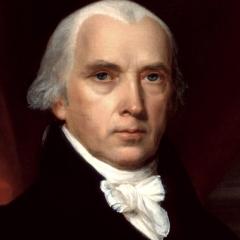
James Madison

James Madison Quotes

4th U.S. President

Filter quotes by topic

Famous James Madison Quotes

“The powers of the federal government are enumerated; it can only operate in certain cases; it has legislative powers on defined and limited objects, beyond which it cannot extend its jurisdiction.”

“Besides the obscurity arising from the complexity of objects, and the imperfection of the human faculties, the medium through which the conceptions of men are conveyed to each other adds a fresh embarrassment.”

“The powers delegated by the proposed Constitution to the federal government are few and defined. Those which are to remain in the State governments are numerous and indefinite. The former will be exercised principally on external objects, as war, peace, negotiation and foreign commerce. ... The powers reserved to the several States will extend to all the objects which in the ordinary course of affairs, concern the lives and liberties, and properties of the people, and the internal order, improvement and prosperity of the State.”

“I cannot undertake to lay my finger on that article of the Constitution which granted a right to Congress of expending, on objects of benevolence, the money of their constituents.”

“The liberal appropriations made by the legislature of Kentucky for a general system of education cannot be too much applauded . . . . Learned institutions ought to be the favorite objects with every free people. They throw that light over the public mind which is the best security against crafty and dangerous encroachments on the public liberty . . . . What spectacle can be more edifying or more seasonable than that of liberty and learning, each leaning on the other for their mutual and surest support?”

“Since it is impossible for the people spontaneously and universally, to move in concert towards their object; and it is therefore essential, that such changes be instituted by some informal and unauthorized propositions, made by some patriotic and respectable citizen or number of citizens.”

“As long as the reason of man continues fallible, and he is at liberty to exercise it, different opinions will be formed. As long as the connection subsists between his reason and his self-love, his opinions and passions will have a reciprocal influence on each other, and the former will be objects to which the latter attach themselves.”

“To refer the power in question to the clause "to provide for the common defense and general welfare" would be contrary to the established and consistent rules of interpretation, as rendering the special and careful enumeration of powers which follow the clause nugatory and improper. Such a view of the Constitution would have the effect of giving to Congress a general power of legislation instead of the defined and limited one hitherto understood to belong to them, the terms "common defense and general welfare" embracing every object and act within the purview of a legislative trust.”

“In the first place, it is to be remembered, that the general government is not to be charged with the whole power of making and administering laws. Its jurisdiction is limited to certain enumerated objects, which concern all the members of the republic, but which are not to be attained by the separate provisions of any.”

“In this relation, then, the proposed government cannot be deemed a national one; since its jurisdiction extends to certain enumerated objects only, and leaves to the several states, a residuary and inviolable sovereignty over all other objects.”

“I own myself the friend to a very free system of commerce, and hold it as a truth, that commercial shackles are generally unjust, oppressive and impolitic - it is also a truth, that if industry and labour are left to take their own course, they will generally be directed to those objects which are the most productive, and this in a more certain and direct manner than the wisdom of the most enlightened legislature could point out.”

“The defect of power in the existing confederacy, to regulate the commerce between its several members is in the number of those which have been clearly pointed out by experience . . . . A very material object of this power was the relief of the States which import and export through other States from the improper contributions levied on them by the latter.”

“In civilized communities, property as well as personal rights is an essential object of the laws, which encourage industry by securing the enjoyment of its fruits; that industry from which property results, and that enjoyment which consists not merely in its immediate use, but in its posthumous destination to objects of choice, and of kindred affection. In a just and free government, therefore, the rights both of property and of persons ought to be effectually guarded.”

“For the same reason that the members of the State legislatures will be unlikely to attach themselves sufficiently to national objects, the members of the federal legislature will be likely to attach themselves too much to local objects.”

“Whatever may be the judgement pronounced on the competency of the architects of the Constitution, or whatever may be the destiny of the edifice prepared by them, I feel it a duty to express my profound and solemn conviction . . . that there never was an assembly of men, charged with a great and arduous trust, who were more pure in their motives, or more exclusively or anxiously devoted to the object committed to them.”

“In the latter sense, a man has a property in his opinions and the free communication of them. He has a property of peculiar value in his religious opinions, and in the profession and practice dictated by them. He has an equal property in the free use of his faculties and free choice of the objects on which to employ them. In a word, as a man is said to have a right to his property, he may be equally said to have a property in his rights.”

“As the war was just in its origin and necessary and noble in its objects, we can reflect with a proud satisfaction that in carrying it on no principle of justice or honor, no usage of civilized nations, no precept of courtesy or humanity, have been infringed.”

“The government of the United States is a definite government, confined to specified objects. It is not like the state governments, whose powers are more general. Charity is no part of the legislative duty of the government.”

“I do not conceive that power is given to the President and Senate to dismember the empire, or to alienate any great, essential right. I do not think the whole legislative authority have this power. The exercise of the power must be consistent with the object of the delegation.”

“The great objects which presented themselves [to the Constitutional Convention] ... formed a task more difficult than can be well conceived by those who were not concerned in the execution of it. Adding to these considerations the natural diversity of human opinions on all new and complicated subjects, it is impossible to consider the degree of concord which ultimately prevailed as less than a miracle.”

“The diversity in the faculties of men, from which the rights of property originate, is not less an insuperable obstacle to a uniformity of interests. The protection of these faculties is the first object of government. From the protection of different and unequal faculties of acquiring property, the possession of different degrees and kinds of property immediately results; and from the influence of these on the sentiments and views of the respective proprietors, ensues a division of the society into different interests and parties.”

“It is too early for politicians to presume on our forgetting that the public good, the real welfare of the great body of the people, is the supreme object to be pursued; and that no form of government whatever has any other value than as it may be fitted for the attainment of this object.”