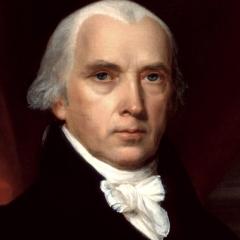
“Is the appointment of Chaplains to the two Houses of Congress consistent with the Constitution, and with the pure principle of religious freedom? In strictness the answer on both points must be in the negative. The Constitution of the U. S. forbids everything like an establishment of a national religion. The law appointing Chaplains establishes a religious worship for the national representatives, to be performed by Ministers of religion, elected by a majority of them, and these are to be paid out of the national taxes. Does this not involve the principle of a national establishment ... ?”
“May it not be asked of every intelligent friend to the liberties of his country, whether the power exercised in such an act as this ought not to produce great and universal alarm? Whether a rigid execution of such an act, in time past, would not have repressed that information and communication among the people which is indispensable to the just exercise of their electoral rights? And whether such an act, if made perpetual, and enforced with rigor, would not, in time to come, either destroy our free system of government, or prepare a convulsion that might prove equally fatal to it?”
Source: The Debates in the Several State Conventions on the Adoption of the Federal Constitution: As Recommended by the General Convention at Philadelphia in 1787. Together with the Journal of the Federal Convention, Luther Martin's Letter, Yates's Minutes, Congressional Opinions, Virginia and Kentucky Resolutions of '98-'99, and Other Illustrations of the Constitution
“[T]he powers granted by the proposed Constitution are the gift of the people, and may be resumed by them when perverted to their oppression, and every power not granted thereby remains with the people.”
Source: The Writings of James Madison: 1787-1790
“Resolved, That the General Assembly of Virginia, doth unequivocally express a firm resolution to maintain and defend the Constitution of the United States, and the Constitution of this State, against every aggression either foreign or domestic, and that they will support the Government of the United States in all measures warranted by the former.”
Source: Selected Writings of James Madison
“Because the bill in reserving a certain parcel of land in the United States for the use of said Baptist Church comprises a principle and a precedent for the appropriation of funds of the United States for the use and support of religious societies, contrary to the article of the Constitution which declares that "Congress shall make no law respecting a religious establishment."”
Source: The Writings of James Madison: 1808-1819
“To the Baptist Churches on Neal's Greek on Black Creek, North Carolina I have received, fellow-citizens, your address, approving my objection to the Bill containing a grant of public land to the Baptist Church at Salem Meeting House, Mississippi Territory. Having always regarded the practical distinction between Religion and Civil Government as essential to the purity of both, and as guaranteed by the Constitution of the United States, I could not have otherwise discharged my duty on the occasion which presented itself”
“[T]he bill exceeds the rightful authority to which governments are limited by the essential distinction between civil and religious functions, and violates in particular the article of the Constitution of the United States which declares that Congress shall make no law respecting a religious establishment.... This particular church, therefore, would so far be a religious establishment by law, a legal force and sanction being given to certain articles in its constitution and administration.”
“And may I not be allowed to ... read in the character of the American people, in their devotion to true liberty and to the Constitution which is its palladium [protection], ... a Government which watches over ... the equal interdict [prohibition] against encroachments and compacts between religion and the state.”
“No power over the freedom of religion [is] delegated to the United States by the Constitution.”
“A President is impeachable if he attempts to subvert the Constitution.”
“Those who proposed the Constitution knew, and those who ratified the Constitution also knew that this is...a limited government tied down to specified powers....It was never supposed or suspected that the old Congress could give away the money of the states to encourage agriculture or for any other purpose they pleased.”
“Our Constitution represents the work of the finger of Almighty God.”
“If men were angels, no government would be necessary.”
“The happy Union of these States is a wonder; their Constitution a miracle; their example the hope of Liberty throughout the world.”
Source: James Madison's
“The powers delegated by the proposed Constitution to the federal government are few and defined. Those which are to remain in the State governments are numerous and indefinite. The former will be exercised principally on external objects, as war, peace, negotiation and foreign commerce. ... The powers reserved to the several States will extend to all the objects which in the ordinary course of affairs, concern the lives and liberties, and properties of the people, and the internal order, improvement and prosperity of the State.”
“A well-regulated militia, being necessary to the security of a free state, the right of the people to keep and bear arms shall not be infringed.”
Source: The Debates in the Federal Convention of 1787: Which Framed the Constitution of the United States of America
“I cannot undertake to lay my finger on that article of the Constitution which granted a right to Congress of expending, on objects of benevolence, the money of their constituents.”
“Charity is no part of the legislative duty of the government.”
Source: The Debates in the Several State Conventions on the Adoption of the Federal Constitution: As Recommended by the General Convention at Philadelphia in 1787. Together with the Journal of the Federal Convention, Luther Martin's Letter, Yates's Minutes, Congressional Opinions, Virginia and Kentucky Resolutions of '98-'99, and Other Illustrations of the Constitution
“Religious bondage shackles and debilitates the mind and unfits it for every noble enterprise.... During almost fifteen centuries has the legal establishment of Christianity been on trial. What have been its fruits? More or less, in all places, pride and indolence in the clergy; ignorance and servility in laity; in both, superstition, bigotry, and persecution.”
“If Congress can do whatever in their discretion can be done by money, and will promote the General Welfare, the Government is no longer a limited one, possessing enumerated powers, but an indefinite one.”
Source: James Madison's
“The constitution supposes, what the History of all Governments demonstrates, that the Executive is the branch of power most interested in war, and most prone to it.”
Source: James Madison's
“The Constitution of the United States was created by the people of the United States composing the respective states, who alone had the right.”
Source: Selections from the Private Correspondence of James Madison, from 1813 to 1836
“We have staked the whole future of our new nation, not upon the power of government; far from it. We have staked the future of all our political constitutions upon the capacity of each of ourselves to govern ourselves according to the moral principles of the Ten Commandments.”
“[N]o religious Test shall ever be required as a Qualification to any Office or public Trust under the United States.”
Source: The Debates in the Several State Conventions on the Adoption of the Federal Constitution: As Recommended by the General Convention at Philadelphia in 1787. Together with the Journal of the Federal Convention, Luther Martin's Letter, Yates's Minutes, Congressional Opinions, Virginia and Kentucky Resolutions of '98-'99, and Other Illustrations of the Constitution
“The aim of every political Constitution, is or ought to be first to obtain for rulers men who possess most wisdom to discern, and most virtue to pursue, the common good of society; and in the next place, to take the most effectual precautions for keeping them virtuous whilst they continue to hold their public trust.”
Source: The Federalist: With Letters of Brutus
“With respect to the words "general welfare," I have always regarded them as qualified by the detail of powers connected with them. To take them in a literal and unlimited sense would be a metamorphosis of the Constitution into a character which there is a host of proofs was not contemplated by its creators.”
“The Convention thought it wrong to admit in the Constitution the idea that there could be property in men.”
Source: The Debates in the Several State Conventions on the Adoption of the Federal Constitution: As Recommended by the General Convention at Philadelphia, in 1787. Together with the Journal of the Federal Convention, Luther Martin's Letter, Yate's Minutes, Congressional Opinions, Virginia and Kentucky Resolutions of '98-'99, and Other Illustrations of the Constitution
“It will be remembered, that a frequent recurrence to fundamental principles is solemnly enjoined by most of the state constitutions, and particularly by our own, as a necessary safeguard against the danger of degeneracy, to which republics are liable, as well as other governments, though in a less degree than others.”
Source: The Debates in the Several State Conventions on the Adoption of the Federal Constitution: As Recommended by the General Convention at Philadelphia in 1787. Together with the Journal of the Federal Convention, Luther Martin's Letter, Yates's Minutes, Congressional Opinions, Virginia and Kentucky Resolutions of '98-'99, and Other Illustrations of the Constitution
“Strongly guarded as is the separation between Religion and Government in the Constitution of the United States, the danger of encroachment by Ecclesiastical Bodies may be illustrated by precedents already furnished in their short history.”
“...to support the Constitution, which is the cement of the Union, as well in its limitations as in its authorities; to respect the rights and authorities reserved to the States and to the people as equally incorporated with and essential to the success of the general system;... to keep within the requisite limits a standing military force, always remembering that an armed and trained militia is the firmest bulwark of republics-that without standing armies their liberty can never be in danger, nor with large ones safe.”
“The important distinction so well understood in America between a constitution established by the people, and unalterable by the government; and a law established by the government, and alterable by the government, seems to have been little understood and less observed in any other country. Wherever the supreme power of legislation has resided, has been supposed to reside also, a full power to change the form of government.”
Source: The Federalist, on the New Constitution, Written in 1788
“[A]s it must be admitted that the remedy under the Constitution lies where it has been marked out by the Constitution; and that no appeal can be consistently made from that remedy by those who were and still profess to be parties to it, but the appeal to the parties themselves having an authority above the Constitution or to the law of nature & of nature's God.”
Source: Selections from the Private Correspondence of James Madison: From 1813 to 1836
“Is there a Legislative power in fact, not expressly prohibited by the Constitution, which might not, according to the doctrine of the Court, be exercised as a means of carrying into effect some specified Power?”
Source: Selected Writings of James Madison
“To refer the power in question to the clause "to provide for the common defense and general welfare" would be contrary to the established and consistent rules of interpretation, as rendering the special and careful enumeration of powers which follow the clause nugatory and improper. Such a view of the Constitution would have the effect of giving to Congress a general power of legislation instead of the defined and limited one hitherto understood to belong to them, the terms "common defense and general welfare" embracing every object and act within the purview of a legislative trust.”
Source: The Writings of James Madison: 1808-1819
“On any other hypothesis, the delegation of judicial power would annul the authority delegating it; and the concurrence of this department with the others in usurped powers, might subvert forever, and beyond the possible reach of any rightful remedy, the very Constitution which all were instituted to preserve.”
Source: Selected Writings of James Madison
“I, sir, have always conceived - I believe those who proposed the constitution conceived,and it is still more fully known, and more material to observe, those who ratified the constitution conceived, that this is not an indefinite government deriving its powers from the general terms prefixed to the specified powers - but, a limited government tied down to the specified powers, which explain and define the general terms.”
Source: James Madison's
“It is impossible for the man of pious reflection not to perceive in it [the Constitution] a finger of that Almighty hand which has been so frequently and signally extended to our relief in the critical stages of the revolution.”
Source: The Federalist, on the New Constitution, Written in the Year 1788
“It is in vain to oppose constitutional barriers to the impulse of self-preservation. It is worse than in vain; because it plants in the Constitution itself necessary usurpations of power, every precedent of which is a germ of unnecessary and multiplied repetitions.”
Source: The Federalist, on the New Constitution: Written in 1788
“The Federal Constitution forms a happy combination in this respect; the great and aggregate interests being referred to the national, the local and particular, to the state legislatures.”
Source: The Federalist, on the New Constitution, Written in the Year 1788
“It is to be the assent and ratification of the several States, derived from the supreme authority in each State, the authority of the people themselves. The act, therefore establishing the Constitution, will not be a NATIONAL, but a FEDERAL act.”
Source: The Federalist, on the New Constitution, Written in the Year 1788
“The number of individuals employed under the Constitution of the United States will be much smaller than the number employed under the particular States.”
Source: The Federalist, on the New Constitution, Written in the Year 1788
“The express authority of the people alone could give validity to the Constitution.”
Source: The Federalist, on the New Constitution, Written in the Year 1788
“In all the co-temporary discussions and comments, which the Constitution underwent, it was constantly justified and recommended on the ground, that the powers not given to the government, were withheld from it.”
Source: The Virginia Report of 1799-1800: Touching the Alien and Sedition Laws; Together with the Virginia Resolutions of December 21, 1798, Including the Debate and Proceedings Thereon in the House of Delegates of Virginia and Other Documents Illustrative of the Report and Resolutions
“As the Legislative, Executive, and Judicial departments of the United States are co-ordinate, and each equally bound to support the Constitution, it follows that each must in the exercise of its functions be guided by the text of the Constitution according to its own interpretation of it.”
Source: 1829-1836
“Congress shall make no law respecting an establishment of religion, or prohibiting the free exercise thereof.”
Source: The Virginia Report of 1799-1800: Touching the Alien and Sedition Laws; Together with the Virginia Resolutions of December 21, 1798, Including the Debate and Proceedings Thereon in the House of Delegates of Virginia and Other Documents Illustrative of the Report and Resolutions
“This Constitution, and the Laws of the United States which shall be made in Pursuance thereof; and all Treaties made, or which shall be made, under the Authority of the United States, shall be the supreme Law of the Land.”
Source: The Debates in the Several State Conventions on the Adoption of the Federal Constitution: As Recommended by the General Convention at Philadelphia in 1787. Together with the Journal of the Federal Convention, Luther Martin's Letter, Yates's Minutes, Congressional Opinions, Virginia and Kentucky Resolutions of '98-'99, and Other Illustrations of the Constitution
“Each State, in ratifying the Constitution, is considered as a sovereign body, independent of all others, and only to be bound by its own voluntary act. In this relation, then, the new Constitution will, if established, be a FEDERAL, and not a NATIONAL constitution.”
Source: The Federalist, on the New Constitution, Written in the Year 1788
“It is superfluous to try by the standards of theory, a part of the constitution which is allowed on all hands to be the result not of theory, but "of a spirit of amity, and that mutual deference and concession which the peculiarity of our political situation rendered indispensable" . . . the equal vote allowed to each state, is at once a constitutional recognition of the portion of sovereignty remaining in the individual states, and an instrument for preserving that residuary sovereignty.”
“Another advantage accruing from this ingredient in the constitution of a senate, is the additional impediment it must prove against improper acts of legislation. No law or resolution can now be passed without the concurrence first of a majority of the people, and then of a majority of the states.”
Source: America's Founding Documents: The Declaration of Independence, the Articles of Confederation, the United States Constitution, the Federalist Papers, and the Bill of Rights
“The proposed constitution, therefore, even when tested by the rules laid down by its antagonists, is, in strictness, neither a national nor a federal constitution; but a composition of both. In its foundation it is federal, not national; in the sources from which the ordinary powers of the government are drawn, it is partly federal, and partly national; in the operation of these powers, it is national, not federal; in the extent of them again, it is federal, not national; and finally, in the authoritative mode of introducing amendments, it is neither wholly federal, nor wholly national.”
Source: The Federalist, on the New Constitution, Written in the Year 1788