Quotessence
Home / Authors / Jonathan Sacks
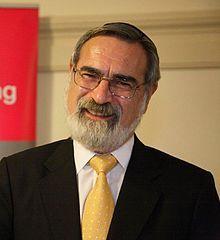
Jonathan Sacks

Jonathan Sacks Quotes

Rabbi

Filter quotes by topic

Famous Jonathan Sacks Quotes

“Nowadays… deals are transactional rather than personal. Instead of placing your faith in a person, you get lawyers to write safeguards into the contract. This is an historic shift from a trust economy to a risk economy. But trust is not a dispensable luxury. It is the very basis of our social life. Many scholars believe that capitalism had religious roots because people could trust other people who, feeling that they were answerable to God, could be relied on to be honest in business. A world without trust is a lonely and dangerous place.”

“In a world without forgiveness, evil begets evil, harm generates harm, and there is no way short of exhaustion or forgetfulness of breaking the sequence. Forgiveness breaks the chain. It introduces into the logic of interpersonal encounter the unpredictability of grace. It represents a decision not to do what instinct and passion urge us to do. It answers hate with a refusal to hate, animosity with generosity. Few more daring ideas have ever entered the human situation. Forgiveness means that we are not destined endlessly to replay the grievances of yesterday. It is the ability to live with the past without being held captive by the past. It would not be an exaggeration to say that forgiveness is the most compelling testimony to human freedom.”

“When my late father died — now I'm in mourning for my late mother — that sense of grief and bereavement suddenly taught me that so many things that I thought were important, externals, etc., all of that is irrelevant. You lose a parent, you suddenly realize what a slender thing life is, how easily you can lose those you love. Then out of that comes a new simplicity and that is why sometimes all the pain and the tears lift you to a much higher and deeper joy when you say to the bad times, "I will not let you go until you bless me.”

“Anti-Semitism is best understood as a virus. It has no logic. Jews were hated because they were rich and because they were poor; because they were capitalists and because they were communists; because they held tenaciously to an ancient faith and because they were rootless cosmopolitans, believing nothing. Hate needs no logic. It is a sickness of the soul.”

“There are hard texts in each tradition which we must confront and ask ourselves, 'Can we reinterpret those texts to allow us to live peaceably, and respectfully, with people of other faiths?' That is a job only Jews can do for Judaism, only Christians can do for Christianity, and only Muslims can do for Islam. But sometimes the sight of someone in one faith wrestling with that faith can empower you to wrestle with another faith.”

“Sometimes the sight of someone in one faith wrestling with that faith can empower you to wrestle with another faith. For me, it was reading about how the Catholic Church wrestled with itself in the 1960s. Pope John XXIII set Nostra Aetate - the Declaration on the Relation of the Church with Non-Christian Religions - in motion. It changed the relationship between Jews and Catholics. Today, Jews and Catholics meet as friends. If you can do that, after the longest history of hatred the world has known, that empowers you as a Jew or a Muslim to wrestle with your faith.”

“When you've got Jews and Christians, Muslims, Sikhs and Hindus removing graffiti from buildings, or getting drug dealers off the street, that's side by side. When you do that, you take it from the very elevated level of interfaith dialogue to the street level of neighbors. You get them working side by side, and they become friends. Friendship sometimes counts for more than interfaith agreement or understanding. Friendship is deeply human.”

“We are biological creatures. We are born, we live, we die. There is no transcendent purpose to existence. At best we are creatures of reason, and by using reason we can cure ourselves of emotional excess. Purged of both hope and fear, we find courage in the face of helplessness, insignificance and uncertainty.”

“Close to a billion people - one-eighth of the world's population - still live in hunger. Each year 2 million children die through malnutrition. This is happening at a time when doctors in Britain are warning of the spread of obesity. We are eating too much while others starve.”