Quotessence
Home / Authors / Paulo Freire
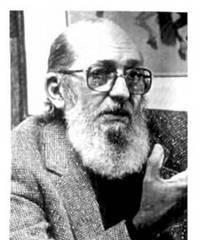
Paulo Freire

Paulo Freire Quotes

Educator

Filter quotes by topic

Famous Paulo Freire Quotes

“In sum: banking theory and practice, as immobilizing and fixating forces, fail to acknowledge men and women as historical beings; problem-posing theory and practice take the people's historicity as their starting point.”

“Indeed, some "revolutionaries" brand as "innocents," "dreamers," or even "reactionaries"; those who would challenge this educational practice. But one does not liberate people by alienating them. Authentic liberation - the process of humanization - is not another deposit to be made in men.”

“The object of a dialogical-liberterian action is not to 'dislodge' the oppressed from a mythological reality in order to 'bind' them to another reality. On the contrary, the object of dialogical action is to make it possible for the oppressed, by perceiving their adhesion, to opt to transform an unjust reality." "In order for the oppressed to unite they must first cut the umbilical cord of magic and myth which binds them to the world of oppression; the unity which links them to each other must be of a different nature.”

“Organization is not only directly linked to unity, but a natural development of that unity. Accordingly, the leaders' pursuit of that unity is also an attempt to organize the people, requiring witness to the fact that the struggle for liberation is a common task." "Leaders who do not act dialogically, but insist on imposing their decisions, do not organize the people--they manipulate them. They do not liberate, nor are they liberated: they oppress.”

“With the establishment of a relationship of oppression, violence has already begun. Never in history has violence been initiated by the oppressed. How could they be the initiators, if they themselves are the result of violence? How could they be the sponsors of something objective whose objective inauguration called forth their existence as oppressed? There would be no oppressed had there been no prior of violence to establish their subjugation.”

“In the banking concept of education, knowledge is a gift bestowed by those who consider themselves knowledgeable upon those whom they consider to know nothing... The teacher presents himself to his students as their necessary opposite; by considering their ignorance absolute, he justifies his own existence.”

“Whereas banking education anesthetizes and inhibits creative power, problem-posing education involves a constant unveiling of reality. The former attempts to maintain the submersion of consciousness; the latter strives for the emergence of consciousness and critical intervention in reality.”

“Every relationship of domination, of exploitation, of oppression is by definition violent, whether or not the violence is expressed by drastic means. In such a relationship, dominator and dominated alike are reduced to things- the former dehumanized by an excess of power, the latter by a lack of it. And things cannot love.”

“Welfare programs as instruments of manipulation ultimately serve the end of conquest. They act as an anesthetic, distracting the oppressed from the true causes of their problems and from the concrete solutions of these problems.”

“The more people participate in the process of their own education, and the more people participate in defining what kind of production to produce, and for what and why, the more people participate in the development of their selves. The more people become themselves, the better the democracy.”

“But almost always, during the initial stage of the struggle, the oppressed, instead of striving for liberation, tend themselves to become oppressors, or sub oppressors. The very structure of their thought has been conditioned by the contradiction of the concrete, existential situation by which they were shaped. Their ideal is to be men; but for them to be men is to be oppressors”

“Coherently democratic authority carries the conviction that true discipline does not exist in the muteness of those who have been silenced but in the stirrings of those who have been challenged, in the doubt of those who have been prodded, and in the hopes of those who have been awakened.”

“[T]he more radical the person is, the more fully he or she enters into reality so that, knowing it better, he or she can transform it. This individual is not afraid to confront, to listen, to see the world unveiled. This person is not afraid to meet the people or to enter into a dialogue with them. This person does not consider himself or herself the proprietor of history or of all people, or the liberator of the oppressed; but he or she does commit himself or herself, within history, to fight at their side.”