Quotessence
Home / Authors / Pico Iyer
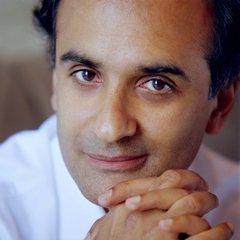
Pico Iyer

Pico Iyer Quotes

Essayist

Filter quotes by topic

Famous Pico Iyer Quotes

“I think America the symbol and America the notion are still very different from America the nation. What's touching and almost regenerative is that whatever is happening in the reality of America, where there is a murder rate worse than Lebanon's and where there is so much homelessness and poverty, still America will be a shorthand throughout the world for everything that is young and modern and free.”

“I like the way that American has become a kind of spiritual home even for people who have never seen it. American dreams are strongest of all in the hearts of people who have only seen America in their dreams. I think it's refreshing and reviving to go around the world and see how America still occupies this special place.”

“The reason I love travel is not just because it transports you in every sense, but because it confronts you with emotional and moral challenges that you would never have to confront at home. So I like going out in search of moral and emotional adventure which throws me back upon myself and forces me to reconsider my assumptions and the things I took for granted. It sends me back a different person.”

“Literally, when you wake up at 9 o'clock in the morning in Havana you don't know where you'll be at noon. But it's a safe guess that you'll either be married, arrested, or in the midst of some incredible transaction where somebody is stealing your passport or paying you in Dominican pesos for it, or whatever. It's a wild place.”

“I like California because it still has the glamour and romanticism and exoticism of a very foreign place. It was the place that when I was young, I was raised on "I Love Lucy" and listening to the Grateful Dead and reading Jack Kerouac. They, to me, were all symbols of this very foreign sense of promise and movement. After all this time here I'm glad I still have it.”

“What is fascinating about a place like Los Angeles airport is that it is lots and lots of people, many of whom have saved up all their lives and channeled all of their energies toward coming to the promised land of abundance and plenty - the American Dream. But as soon as they arrive here they get a crash course in the American reality.”

“One of the interesting things about Los Angeles is that it's still supplying the whole of the world with its dreams through movies and songs and TV - often of an all-American family at the same time as the real Los Angeles is peopled by souls from Vietnam, Guatemala, and Korea who look nothing like the images being beamed out. I think all that is going to have to change and illusion is going to have to catch up with reality in that regard.”

“From the beginning, I've stressed that home is something internal, invisible, portable, especially for those of us with roots in many physical places; we have to root ourselves in our passions, our values and our deepest friends. My home, I've always felt, lies in the songs and novels that I love, in the wife and mother that I'm never far away from, in the monastery to which I've been returning for 25 years.”

“Yes, we know more than ever before, and it's a wonder that we get to inhabit a world full of driverless cars and 3D printers. But that doesn't mean that we know any more about the essential things in life - love, faith, death - and it would be dangerous to assume we did. The only thing that gets us through sometimes is a proper, humbled sense that we don't have a clue, we can't be sure what's going to happen next and life will always be much larger than our ideas of it.”

“In terms of technology and science, tomorrow does know more than yesterday; but when it comes to emotions, living with uncertainty, terror, I'm not sure we know any more than Shakespeare did, or the Buddha. And the power of new things - the iPhone or Facebook - is so strong and intoxicating that we sometimes forget that none of them can fundamentally change our relation to ourselves and to what matters.”

“A lack of affiliation may mean a lack of accountability, and forming a sense of commitment can be hard without a sense of community. Displacement can encourage the wrong kinds of distance, and if the nationalism we see sparking up around the globe arises from too narrow and fixed a sense of loyalty, the internationalism that's coming to birth may reflect too roaming and undefined a sense of belonging.”

“We travel, initially, to lose ourselves; and we travel, next to find ourselves. We travel to open our hearts and eyes and learn more about the world than our newspapers will accommodate. We travel to bring what little we can, in our ignorance and knowledge, to those parts of the globe whose riches are differently dispersed. And we travel, in essence, to become young fools again- to slow time down and get taken in, and fall in love once more.”

“A comma . . . catches the gentle drift of the mind in thought, turning in on itself and back on itself, reversing, redoubling, and returning along the course of its own sweet river music; while the semicolon brings clauses and thoughts together with all the silent discretion of a hostess arranging guests around her dinner table.”

“What more could one ask of a companion? To be forever new and yet forever steady, to be strange and familiar all at once, with enough change to quicken my mind, enough steadiness to give sanctuary to my heart. The books on my shelf never asked to come together and they would not trust or want to listen to one another. But each is a piece of a stained-glass whole, without which I wouldn’t make sense to myself or to the world outside.”

“And if travel is like love, it is, in the end, mostly because it's a heightened state of awareness, in which we are mindful, receptive, undimmed by familiarity and ready to be transformed. That is why the best trips, like the best love affairs, never really end.”

“Silence is something more than just a pause; it is that enchanted place where space is cleared and time is stayed and the horizon itself expands. In silence, we often say, we can hear ourselves think; but what is truer to say is that in silence we can hear ourselves not think....In silence, we might better say, we can hear someone else think.”

“Perhaps the greatest danger of our global community is that the person in LA thinks he knows Cambodia because he's seen The Killing Fields on-screen, and the newcomer from Cambodia thinks he knows LA because he's seen City of Angels on video.”

“I loved the quiet places in Kyoto, the places that held the world within a windless moment. Inside the temples, Nature held her breath. All longing was put to sleep in the stillness, and all was distilled into a clean simplicity. The smell of woodsmoke, the drift of incense; a procession of monks in black-and-gold robes, one of them giggling in a voice yet unbroken; a touch of autumn in the air, a sense of gathering rain.”