Quotessence
Home / Authors / Sri Aurobindo
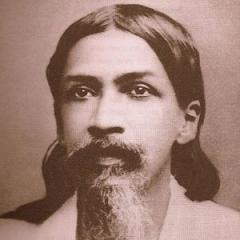
Sri Aurobindo

Sri Aurobindo Quotes

Philosopher

Filter quotes by topic

Famous Sri Aurobindo Quotes

“Spirituality is much wider than any particular religion, and in the larger ideas of it that are now coming on us even the greatest religion becomes no more than a broad sect or branch of the one universal religion, by which we shall understand in the future man's seeking for the eternal, the divine, the greater self, the source of unity and his attempt to arrive at some equation, some increasing approximation of the values of human life with the eternal and the divine values.”

“The seers of ancient India had, in their experiments and efforts at spiritual training and the conquest of the body, perfected a discovery which in its importance to the future of human knowledge dwarfs the divinations of Newton and Galileo , even the discovery of the inductive and experimental method in Science was not more momentous.”

“India of the ages is not dead nor has she spoken her last creative word; she lives and has still something to do for herself and the human peoples. And that which must seek now to awake is not an anglicised oriental people, docile pupil of the West and doomed to repeat the cycle of the occident's success and failure, but still the ancient immemorable Shakti recovering her deepest self, lifting her head higher towards the supreme source of light and strength and turning to discover the complete meaning and a vaster form of her Dharma.”

“Life is life - whether in a cat, or dog or man. There is no difference there between a cat or a man. The idea of difference is a human conception for man's own advantage.”

“The progressive growth of the finite consciousness of man towards this Self, towards the universal , the eternal, the infinite, in a word his growth into spiritual consciousness by the development of his ordinary ignorant natural being into an illumined divine nature, this is for Indian thinking the significance of life and the aim of human existance.”

“As often as Herman had witnessed the slaughter of animals and fish, he always had the same thought: in their behaviour toward creatures, all men were Nazis. The smugness with which man could do with other species as he pleased exemplified the most extreme racist theories, the principle that might is right.”

“As in all infant sciences, the universal habit of the human mind - to take a partial or local truth, generalise it unduly and try to explain a whole field of nature in its narrow terms - runs riot here (in psychoanalysis). Moreover, the exaggeration of the importance of suppressed sexual complexes is a dangerous falsehood.”

“The yoga we practice is not for ourselves alone, but for the Divine; its aim is to work out the will of the Divine in the world, to effect a spiritual transformation and to bring down a divine nature and a divine life into the mental, vital and physical nature and life of humanity. Its object is not personal Mukti, although Mukti is a necessary condition of the yoga, but the liberation and transformation of the human being. It is not personal Ananda, but the bringing down of the divine Ananda - Christ's kingdom of heaven, our Satyayuga - upon the earth.”

“Hinduism... gave itself no name, because it set itself no sectarian limits; it claimed no universal adhesion, asserted no sole infallible dogma, set up no single narrow path or gate of salvation; it was less a creed or cult than a continuously enlarging tradition of the Godward endeavour of the human spirit. An immense many-sided many-staged provision for a spiritual self-building and self-finding, it had some right to speak of itself by the only name it knew, the eternal religion, Sanatana Dharma.”

“The aggressive and quite illogical idea of a single religion for all mankind, a religion universal by the very force of its narrowness, one set of dogmas, one cult, one system of ceremonies, one ecclesiastical ordinance, one array of prohibitions and injunctions which all minds must accept on peril of persecution by men and spiritual rejection or eternal punishment by God, that grotesque creation of human unreason which has been the parent of so much intolerance, cruelty and obscurantism and aggressive fanaticism, has never been able to take firm hold of the Indian mentality.”

“The ascent to the divine Life is the human journey, the Work of works, the acceptable Sacrifice. This alone is man's real business in the world and the justification of his existence, without which he would only be an insect crawling among the ephemeral insects on a speck of surface mud and water which has managed to form itself amid the appalling immensities of the physical universe.”