Quotessence
Home / Authors / Thomas Jefferson
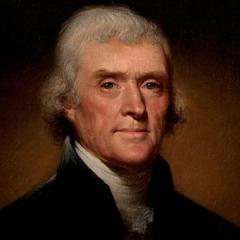
Thomas Jefferson

Thomas Jefferson Quotes

3rd U.S. President

Filter quotes by topic

Famous Thomas Jefferson Quotes

“Laws and institutions must go hand in hand with the progress of the human mind. . . . We might as well require a man to wear the coat which fitted him when a boy as civilized society to remain forever under the regimen of their barbarous ancestors.”

“It is too late in the day for men of sincerity to pretend they believe in the Platonic mysticisms that three are one, and one is three; and yet that the one is not three, and the three are not one.”

“History by apprising them [the people] of the past will enable them to judge of the future. . . . It will qualify them as judges of the actions and designs of men: it will enable them to know ambition under every disguise it may assume; and knowing it, to defeat its views.”

“The parties of Whig and Tory are those of nature. They exist in all countries, whether called by these names or by those of Aristocrats and Democrats, Cote Droite and Cote Gauche, Ultras and Radicals, Serviles and Liberals. The sickly, weakly, timid man fears the people, and is a Tory by nature. The healthy, strong and bold cherishes them, and is formed a Whig by nature.”

“The public school system: "Usually a twelve year sentence of mind control. Crushing creativity, smashing individualism, encouraging collectivism and compromise, destroying the exercise of intellectual inquiry, twisting it instead into meek subservience to authority." - Walter Karp, Editor Harper's Magazine The ground of liberty is to be gained by inches, and we must be contented to secure what we can get from time to time and eternally press forward for what is yet to get. It takes time to persuade men to do even what is for their own good.”

“No man shall be compelled to frequent or support any religious worship, place, or ministry whatsoever.”

“Morals were too essential to the happiness of man, to be risked on the uncertain combinations of the head. Nature laid their foundation, therefore, in sentiment, not in science.”

“The press is the best instrument for enlightening the mind of man, and improving him as a rational, moral and social being”

“Every man, and every body of men on earth, possesses the right of self-government. They receive it with their being from the hand of nature. Individuals exercise it by their single will; collections of men by that of their majority; for the law of the majority is the natural law of every society of men.”

“I have sworn upon the altar of God Eternal, hostility against every form of tyranny over the mind of man.”

“He [Washington] has often declared to me that he considered our new constitution as an experiment on the practicability of republican government, and with what dose of liberty man could be trusted for his own good; that he was determined the experiment should have a fair trial, and would lose the last drop of his blood in support of it. And these declarations he repeated to me the oftener and the more pointedly.”

“MORAL LAW, Evidence of.- Man has been subjected by his Creator to the moral law, of which his feelings, or conscience as it is sometimes called, are the evidence with which his Creator has furnished him. ... The moral duties which exist between individual and individual in a state of nature, accompany them into a state of society ... their Maker not having released them from those duties on their forming themselves into a nation.”

“It is comfortable to see the standard of reason at length erected, after so many ages, during which the human mind has been held in vassalage by kings, priests, and nobles; and it is honorable for us to have produced the first legislature who had the courage to declare that the reason of man may be trusted with the formation of his own opinions.”

“The God who gave us life, gave us liberty at the same time; the hand of force may destroy, but cannot disjoin them. ... Love your neighbor as yourself and your country more than yourself. ... The boisterous sea of liberty is never without a wave. ... I have sworn upon the altar of God, eternal hostility against every form of tyranny over the mind of man. ... The tree of liberty must be refreshed from time to time with the blood of patriots and tyrants. It is its natural manure.”

“I have never been able to conceive how any rational being could propose happiness to himself from the exercise of power over others... An honest man can feel no pleasure in the exercise of power over his fellow citizens.... Power is not alluring to pure minds and is not with them the primary principle of contest.”

“He who made us would have been a pitiful bungler, if he had made the rules of our moral conduct a matter of science. For one man of science, there are thousands who are not. What would have become of them? Man was destined for society. His morality, therefore, was to be formed to this object. He was endowed with a sense of right and wrong, merely relative to this.”

“In the fevered state of our country, no good can ever result from any attempt to set one of these fiery zealots to rights, either in fact or principle. They are determined as to the facts they will believe, and the opinions on which they will act. Get by them, therefore, as you would by an angry bull; it is not for a man of sense to dispute the road with such an animal.”

“An honest man can feel no pleasure in the exercise of power over his fellow citizens . . . There has never been a moment of my life in which I should have relinquished for it the enjoyments of my family, my farm, my friends and books.”

“I do believe that General Washington had not a firm confidence in the durability of our government. He was naturally distrustful of men, and inclined to gloomy apprehensions; and I was ever persuaded that a belief that we must at length end in something like a British constitution, had some weight in his adoption of the ceremonies of levees, birthdays, pompous meetings with Congress, and other forms of the same character, calculated to prepare us gradually for a change which he believed possible, and to let it come on with as little shock as might be to the public mind.”

“That ideas should freely spread from one to another over the globe, for the moral and mutual instruction of man, and improvement of his condition, seems to have been peculiarly and benevolently designed by nature, when she made them, like fire, expansible over all space, without lessening their density in any point, and like the air in which we breathe, move, and have our physical being, incapable of confinement or exclusive appropriation.”

“I recoil with horror at the ferociousness of man. Will nations never devise a more rational umpire of differences than force? Are there no means of coercing injustice more gratifying to our nature than a waste of the blood of thousands and of the labor of millions of our fellow creatures?”

“Where the principle of difference [between political parties] is as substantial and as strongly pronounced as between the republicans and the monocrats of our country, I hold it as honorable to take a firm and decided part and as immoral to pursue a middle line, as between the parties of honest men and rogues, into which every country is divided.”

“I have indeed two great measures at heart, without which no republic can maintain itself in strength: 1. That of general education, to enable every man to judge for himself what will secure or endanger his freedom. 2. To divide every county into hundreds, of such size that all the children of each will be within reach of a central school in it.”

“The earth belongs to the living. No man can, by natural right, oblige the lands he occupied or the persons who succeed him in that occupation, to the payment of debts contracted by him. For if he could, he might, during his own life, eat up the use of the lands for several generations to come, and then the lands would belong to the dead, and not to the living. No generation can contract debts greater than may be paid during the course of its own existence.”

“To compel a man to furnish contributions of money for the propagation of opinions which he disbelieves and abhors, is sinful and tyrannical; . . . even the forcing him to support this or that teacher of his own religious persuasion, is depriving him of the comfortable liberty of giving his contributions to the particular pastor whose morals he would make his pattern. . . .”

“The impious presumption of legislators and rulers, civil as well as ecclesiastical, who, being themselves but fallible and uninspired men, have assumed dominion over the faith of others, setting up their own opinions and modes of thinking as the only true and infallible, and as such endeavoring to impose them on others, hath established and maintained false religions over the greatest part of the world and through all time.”