Quotessence
Home / Authors / Thomas Jefferson
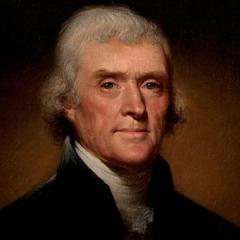
Thomas Jefferson

Thomas Jefferson Quotes

3rd U.S. President

Filter quotes by topic

Famous Thomas Jefferson Quotes

“The whole history of these books (i.e. the Gospels) is so defective and doubtful that it seems vain to attempt minute enquiry into it: and such tricks have been played with their text, and with the texts of other books relating to them, that we have a right, from that cause, to entertain much doubt what parts of them are genuine. In the New Testament there is internal evidence that parts of it have proceeded from an extraordinary man; and that other parts are of the fabric of very inferior minds. It is as easy to separate those parts, as to pick out diamonds from dunghills.”

“Well aware that the opinions and belief of men depend not on their own will, but follow involuntarily the evidence proposed to their minds; that Almighty God hath created the mind free, and manifested his supreme will that free it shall remain by making it altogether insusceptible of restraint; that all attempts to influence it by temporal punishments, or burthens, or by civil incapacitations, tend only to beget habits of hypocrisy and meanness, and are a departure from the plan of the holy author of our religion.”

“The opinions of men are not the object of civil government, nor under its jurisdiction; that to suffer the civil magistrate to intrude his powers into the field of opinion and to restrain the profession or propagation of principles on supposition of their ill tendency is a dangerous falacy, which at once destroys all religious liberty...”

“Subject opinion to coercion: whom will you make your inquisitors? Fallible men; men governed by bad passions, by private as well as public reasons. And why subject it to coercion? To produce uniformity. But is uniformity of opinion desirable? No more than of face and stature.”

“Even in Europe a change has sensibly taken place in the mind of man. Science has liberated the ideas of those who read and reflect, and the American example has kindled feelings of right in the people. An insurrection has consequently begun of science talents and courage against rank and birth, which have fallen into contempt. It has failed in its first effort, because the mobs of the cities, the instrument used for its accomplishment, debased by ignorance, poverty and vice, could not be restrained to rational action. But the world will soon recover from the panic of this first catastrophe.”

“Of the various executive abilities, no one excited more anxious concern than that of placing the interests of our fellow-citizens in the hands of honest men, with understanding sufficient for their stations. No duty is at the same time more difficult to fulfil. The knowledge of character possessed by a single individual is of necessity limited. To seek out the best through the whole Union, we must resort to the information which from the best of men, acting disinterestedly and with the purest motives, is sometimes incorrect.”

“I view great cities as pestilential to the morals, the health and the liberties of man. True, they nourish some of the elegant arts; but the useful ones can thrive elsewhere; and less perfection in the others, with more health, virtue and freedom, would be my choice.”

“In every country and every age, the priest has been hostile to liberty. He is always in alliance with the despot, abetting his abuses in return for protection to his own. It is easier to acquire wealth and power by this combination than by deserving them, and to effect this, they have perverted the purest religion ever preached to man into mystery and jargon, unintelligible to all mankind, and therefore the safer for their purposes.”

“The ground of liberty is to be gained by inches, and we must be contented to secure what we can get from time to time and eternally press forward for what is yet to get. It takes time to persuade men to do even what is for their own good.”

“It be urged that the wild and uncultivated tree, hitherto yielding sour and bitter fruit only, can never be made to yield better; yet we know that the grafting art implants a new tree on the savage stock, producing what is most estimable in kind and degree. Education, in like manner, engrafts a new man on the native stock, and improves what in his nature was vicious and perverse into qualities of virtue and social worth.”

“He has waged cruel war against human nature itself, violating it’s most sacred rights of life & liberty in the persons of a distant people who never offended him, captivating & carrying them into slavery in another hemisphere, or to incur miserable death in their transportation thither. this piratical warfare, the opprobrium of infidel powers, is the warfare of the christian king of Great Britain. determined to keep open a market where MEN should be bought & sold, he has prostituted his negative for suppressing every legislative attempt to prohibit or to restrain this execrable commerce...”

“The basis of our governments being the opinion of the people, the very first object should be to keep that right; and were it left to me to decide whether we should have a government without newspapers or newspapers without a government, I should not hesitate a moment to prefer the latter. But I should mean that every man should receive those papers and be capable of reading them.”

“To instruct the mass of our citizens in these, their rights, interests and duties, as men and citizens...this brings us to the point at which are to commence the higher branches of education . . . . To develop the reasoning faculties of our youth, enlarge their minds, cultivate their morals, and instill into them the precepts of virtue and order.”

“What is it men cannot be made to believe!”

“Indeed, we need not look back half a century to times which many now living remember well, and see the wonderful advances in the sciences and arts which have been made within that period. Some of these have rendered the elements themselves subservient to the purposes of man, have harnessed them to the yoke of his labors and effected the great blessings of moderating his own, of accomplishing what was beyond his feeble force, and extending the comforts of life to a much enlarged circle, to those who had before known its necessaries only.”

“What a stupendous, what an incomprehensible machine is man! Who can endure toil, famine, stripes, imprisonment & death itself in vindication of his own liberty, and the next moment ... inflict on his fellow men a bondage, one hour of which is fraught with more misery than ages of that which he rose in rebellion to oppose.”

“The Habeas Corpus secures every man here, alien or citizen, against everything which is not law, whatever shape it may assume.”

“[If a book were] very innocent, and one which might be confided to the reason of any man; not likely to be much read if let alone, but if persecuted, it will be generally read. Every man in the United States will think it a duty to buy a copy, in vindication of his right to buy and to read what he pleases.”

“By nature's law, every man has a right to seize and retake by force his own property taken from him by another, by force of fraud. Nor is this natural right among the first which is taken into the hands of regular government after it is instituted. It was long retained by our ancestors. It was a part of their common law, laid down in their books, recognized by all the authorities, and regulated as to circumstances of practice.”

“It is a moot question whether the origin of any kind of property is derived from nature at all. It is agreed by those who have seriously considered the subject that no individual has, of natural right, a separate property in an acre of land, for instance. By a universal law, indeed, whatever, whether fixed or movable, belongs to all men equally and in common is the property for the moment of him who occupies it; but when he relinquishes the occupation, the property goes with it. Stable ownership is the gift of social law, and is given late in the progress of society.”

“No experiment can be more interesting than that we are now trying, and which we trust will end in establishing the fact, that man may be governed by reason and truth. Our first object should therefore be, to leave open to him all the avenues to truth. The most effectual hitherto found, is the freedom of the press. It is, therefore, the first shut up by those who fear the investigation of their actions.”

“This formidable censor of the public functionaries [the press], by arraigning them at the tribunal of public opinion, produces reform peaceably, which must otherwise be done by revolution. It is also the best instrument for enlightening the mind of man and improving him as a rational, moral, and social being.”

“No government can be maintained without the principle of fear as well as duty. Good men will obey the last, but bad ones the former only. If our government ever fails, it will be from this weakness.”

“There is a debt of service due from every man to his country, proportioned to the bounties which nature and fortune have measured to him.”

“The man who loves his country on its own account, and not merely for its trappings of interest or power, can never be divorced for it, can never refuse to come forward when he finds that she is engaged in dangers which he has the means of warding off.”

“A first attempt to recover the right of self government may fail, so may a second, a third, etc. But as a younger and more instructed race comes on, the sentiment becomes more and more intuitive, and a fourth, a fifth, or some subsequent one of the ever renewed attempts will ultimately succeed... To attain all this, however, rivers of blood must yet flow, and years of desolation pass over; yet the object is worth rivers of blood and years of desolation. For what inheritance so valuable can man leave to his posterity?”

“May [our Declaration of Independence] be to the world, what I believe it will be (to some parts sooner, to others later, but finally to all), the signal of arousing men to burst the chains under which monkish ignorance and superstition had persuaded them to bind themselves, and to assume the blessings and security of self-government... All eyes are opened, or opening, to the rights of man.”

“The doctrines of Jesus are simple, and tend to all the happiness of man.”

“I never did, or countenanced, in public life, a single act inconsistent with the strictest good faith; having never believed there was one code of morality for a public, and another for a private man.”

“Man was destined for society. His morality therefore was to be formed to this object. He was endowed with a sense of right and wrong merely relative to this. This sense is as much a part of his nature as the sense of hearing, seeing, feeling; it is the true foundation of morality... The moral sense, or conscience, is as much a part of man as his leg or arm. It is given to all human beings in a stronger or weaker degree, as force of members is given them in a greater or less degree. It may be strengthened by exercise, as may any particular limb of the body.”