Quotessence
Home / Authors / Woodrow Wilson
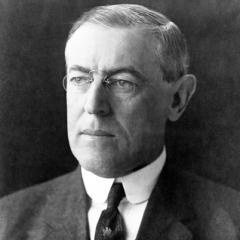
Woodrow Wilson

Woodrow Wilson Quotes

28th U.S. President

Filter quotes by topic

Famous Woodrow Wilson Quotes

“In the last analysis, my fellow country men, as we in America would be the first to claim, a people are responsible for the acts of their government.”

“The nature of men and of organized society dictates the maintenance in every field of action of the highest and purest standards of justice and of right dealing.... By justice the lawyer generally means the prompt, fair, and open application of impartial rules; but we call ours a Christian civilization, and a Christian conception of justice must be much higher. It must include sympathy and helpfulness and a willingness to forego self-interest in order to promote the welfare, happiness, and contentment of others and of the community as a whole.”

“The great war that broke so suddenly upon the world two years ago, and which has swept up within its flame so great a part of thecivilized world, has affected us very profoundly.... With its causes and its objects we are not concerned. The obscure fountains from which its stupendous flood has burst we are not interested to search for or explore.”

“There is a very holy and a very terrible isolation for the conscience of every man who seeks to read the destiny in affairs for others as well as for himself, for a nation as well as for individuals. That privacy no man can intrude upon. That lonely search of the spirit for the right perhaps no man can assist.”

“The welfare, the happiness, the energy and spirit of the men and women who do the daily workis the underlying necessity of all prosperity.... There can be nothing wholesome unless their life is wholesome; there can be no contentment unless they are contented.”

“Today, supremely, it behooves us to remember that a nation shall be saved by the power that sleeps in its own bosom; or by none; shall be renewed in hope, in confidence, in strength by waters welling up from its own sweet, perennial springs. Not from above; not by patronage of its aristocrats. The flower does not bear the root, but the root the flower.”

“I have had the accomplishment of something like this at heart ever since I was a boy.... So I feel tonight like the man who is lodging happily in the inn which lies half way along the journey and that in time, with a fresh impulse, we shall go the rest of the journey and sleep at the journey's end like men with a quiet conscience.”

“If young gentlemen get from their years in college only manliness, esprit de corps, a release of their social gifts, a training ingive and take, a catholic taste in men and the standards of true sportsmen, they have gained much but they have not gained what a college should give them. It should give them insight into the things of the mind and the spiritthe consciousness of having taken on them the vows of true enlightenment and of having undergone the discipline, never to be shaken off, of those who seek wisdom in candor, with faithful labor and travail of spirit.”

“An evident principleis the principle of justice to all peoples and nationalities, and their right to live on equal terms of liberty and safety with one another, whether they be strong or weak.”

“Leadership does not always wear the harness of compromise. Once and again one of those great influences which we call a Cause arises in the midst of a nation. Men of strenuous minds and high ideals come forward.... The attacks they sustain are more cruel than the collision of arms.... Friends desert and despise them.... They stand alone and oftentimes are made bitter by their isolation.... They are doing nothing less than defy public opinion, and shall they convert it by blows. Yes.”

“If you would be a leader of men you must lead your own generation, not the next. Your playing must be good now, while the play ison the boards and the audience in the seats.... It will not get you the repute of a good actor to have excellencies discovered in you afterwards.”

“Great statesmen seem to direct and rule by a sort of power to put themselves in the place of the nation over which they are set, and may thus be said to possess the souls of poets at the same time they display the coarser sense and the more vulgar sagacity of practical men of business.”