Quotessence
Home / Authors / Bertrand Russell
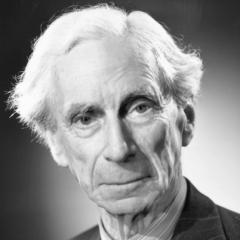
Bertrand Russell

Bertrand Russell Quotes

Philosopher

Filter quotes by topic

Famous Bertrand Russell Quotes

“Understanding human nature must be the basis of any real improvement in human life. Science has done wonders in mastering the laws of the physical world, but our own nature is much less understood, as yet, than the nature of stars and electrons. When science learns to understand human nature, it will be able to bring a happiness into our lives which machines and the physical sciences have failed to create.”

“No man treats a motorcar as foolishly as he treats another human being. When the car will not go, he does not attribute its annoying behavior to sin; he does not say, 'You are a wicked motorcar, and I shall not give you any more petrol until you go.' He attempts to find out what is wrong and to set it right.”

“I hate the world and almost all the people in it. I hate the Labour Congress and the journalists who send men to be slaughtered, and the fathers who feel a smug pride when their sons are killed, and even the pacifists who keep saying human nature is essentially good, in spite of all the daily proofs to the contrary. I hate the planet and the human race—I am ashamed to belong to such a species.”

“Love is wise; hatred is foolish. In this world, which is getting more and more closely interconnected, we have to learn to tolerate each other, we have to learn to put up with the fact that some people say things that we don't like. We can only live together in that way. But if we are to live together, and not die together, we must learn a kind of charity and a kind of tolerance, which is absolutely vital to the continuation of human life on this planet.”

“I believe myself that romantic love is the source of the most intense delights that life has to offer. In the relation of a man and woman who love each other with passion and imagination and tenderness, there is something of inestimable value, to be ignorant of which is a great misfortune to any human being.”

“Are you never afraid of God's judgement in denying him? Most certainly not. I also deny Zeus and Jupiter and Odin and Brahma, but this causes me no qualms. I observe that a very large portion of the human race does not believe in God and suffers no visible punishment in consequence. And if there were a God, I think it very unlikely that He would have such an uneasy vanity as to be offended by those who doubt His existence.”

“My own view on religion is that of Lucretius. I regard it as a disease born of fear and as a source of untold misery to the human race. I cannot, however, deny that it has made some contributions to civilisation. It helped in early days to fix the calendar, and it caused Egyptian priests to chronicle eclipses with such care that in time they became able to predict them. These two services I am prepared to acknowledge, but I do not know of any others.”

“An extra-terrestrial philosopher, who had watched a single youth up to the age of twenty-one and had never come across any other human being, might conclude that it is the nature of human beings to grow continually taller and wiser in an indefinite progress towards perfection; and this generalization would be just as well founded as the generalization which evolutionists base upon the previous history of this planet.”

“[Man] ... his origin, his growth, his hopes and fears, his loves and his beliefs are but the outcome of accidental collocations of atoms; that no fire, no heroism, no intensity of thought and feeling can preserve an individual life beyond the grave; that all the labour of the ages, all the devotion, all the inspiration, all the noonday brightness of human genius are destined to extinction in the vast death of the solar system, and that the whole temple of Man's achievement must inevitably be buried beneath the debris of a universe in ruins.”

“Science, by itself, cannot supply us with an ethic. It can show us how to achieve a given end, and it may show us that some ends cannot be achieved. But among ends that can be achieved our choice must be decided by other than purely scientific considerations. If a man were to say, "I hate the human race, and I think it would be a good thing if it were exterminated," we could say, "Well, my dear sir, let us begin the process with you." But this is hardly argument, and no amount of science could prove such a man mistaken.”

“Religion is based ... mainly upon fear ... fear of the mysterious, fear of defeat, fear of death. Fear is the parent of cruelty, and therefore it is no wonder if cruelty and religion have gone hand in hand. My own view on religion is that of Lucretius. I regard it as a disease born of fear and as a source of untold misery to the human race.”

“More and more people are becoming unable to accept traditional [religious] beliefs. If they think that, apart from these beliefs, there is no reason for kindly behaviour, the results may be needlessly unfortunate. That is why it is important to show that no supernatural reasons are needed to make [people] kind and to prove that only through kindness can the human race achieve happiness.”

“Ever since men became capable of free speculation, their actions, in innumerable important respects, have depended upon their theories as to the world and human life, as to what is good and what is evil. This is true in the present day as at any former time. To understand an age or a nation, we must understand its philosophy, and to understand its philosophy we must ourselves be in some degree philosophers. There is here a reciprocal causation: the circumstances of men s lives do much to determine their philosophy, but, conversely, their philosophy does much to determine their circumstances.”

“Every living thing is a sort of imperialist, seeking to transform as much as possible of its environment into itself . . . When we compare the (present) human population of the globe with . . . that of former times, we see that "chemical imperialism" has been . . . the main end to which human intelligence has been devoted.”

“He will see himself and life and the world as truly as our human limitations will permit; realizing the brevity and minuteness of human life, he will realize also that in individual minds is concentrated whatever of value the known universe contains. And he will see that the man whose mind mirrors the world becomes in a sense as great as the world. In emancipation from the fears that beset the slave of circumstance he will experience a profound joy, and through all the vicissitudes of his outward life he will remain in the depths of his being a happy man.”

“Love and knowledge, so far as they were possible, led upward toward the heavens. But always pity brought me back to earth. Echoes of cries of pain reverberate in my heart. Children in famine, victims tortured by oppressors, helpless old people a burden to their sons, and the whole world of loneliness, poverty, and pain make a mockery of what human life should be. I long to alleviate this evil, but I cannot, and I too suffer.”