Quotessence
Home / Authors / Italo Calvino Books
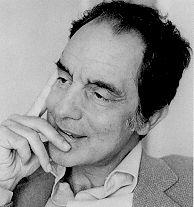
Italo Calvino

Italo Calvino Books

Journalist

Cosmicomics

A source page for quotes linked to Italo Calvino.
0 quotes

Mr Palomar

A source page for quotes linked to Italo Calvino.

0 quotes

Difficult Loves

A source page for quotes linked to Italo Calvino.

0 quotes

Marcovaldo

A source page for quotes linked to Italo Calvino.

0 quotes

Mr. Palomar

A source page for quotes linked to Italo Calvino.

0 quotes

Our Ancestors

A source page for quotes linked to Italo Calvino.

0 quotes

Palomar

A source page for quotes linked to Italo Calvino.

0 quotes

Related Quotes

“This he understood: that association makes people stronger and brings out each person's best gifts, and gives a joy which is rarely to be had by keeping to oneself, the joy of realizing how many honest decent capable people there are for whom it is worth giving one's best (while living just for oneself very often the opposite happens, of seeing people's other side, the side which makes one keep one's hand always on the hilt of one's sword).”

“Qualcosa che ci sfugge deve pur restare... Perche' il potere abbia un oggetto su cui esercitarsi, uno spazio in cui allungare le sue braccia... Finche' so che al mondo c'e' qualcuno che fa dei giochi di prestigio solo per amore del gioco, finche' so che c'e' una donna che ama la lettura per la lettura, posso convincermi che il mondo continua... E ogni sera m'abbandono alla lettura, come quella lontana lettrice sconosciuta.”

“But Ludmilla is always at least one step ahead of you. “I like to know that book exists that I will still be able to read…” she says, sure that existent objects, concrete albeit unknown, must correspond to the strength of her desire. How can you keep up with her, this woman who is always reading another book besides the one before her eyes, a book that does not yet exist, but which, since she wants it, cannot fail to exist?”

“I was living and dying in all the fibers of what is chewed and digested and in all the fibers that absorb the sun, consuming and digesting. Under the thatched arbor of a restaurant on a river-bank, where Olivia had waited for me, our teeth began to move slowly, with equal rhythm, and our eyes stared into each other's with the intensity of serpents'—serpents concentrated in the ecstasy of swallowing each other in turn, as we were aware, in our turn, of being swallowed by the serpent that digests us all, assimilated ceaselessly in the process of ingestion and digestion, in the universal cannibalism that leaves its imprint on every amorous relationship and erases the lines between our bodies and sopa de frijoles, huachinango a la vera cru-zana, and enchiladas.”

“…Marco’s answers and objections took their place in a discourse already proceeding on its own, in the Great Khan’s head. That is to say, between the two of them it did not matter whether questions and solutions were uttered aloud or whether each of the two went on pondering in silence. In fact, they were silent, their eyes half-closed, reclining on cushions, swaying in hammocks, smoking long amber pipes. Marco Polo imagined answering (or Kublai Khan imagined his answer) that the more one was lost in unfamiliar quarters of distant cities, the more one understood the other cities he had crossed to arrive there…”

“You only have to start saying of something : 'Ah, how beautiful ! We must photograph it !' and you are already close to the view of the person who thinks that everything that is not photographed is lost, as if it never existed, and therefore in order to really live you must photograph as much as you can, and to photograph as much as you can you must either live in the most photographable way possible, or else consider photographable every moment of your life.”

“Le cose che la letteratura può ricercare e insegnare sono poche ma insostituibili: il modo di guardare il prossimo e se stessi, di porre in relazione fatti personali e fatti generali, di attribuire valore a piccole cose o a grandi, di considerare i propri limiti e vizi e gli altrui, di trovare le proporzioni della vita, e il posto dell'amore in essa, e la sua forza e il suo ritmo, e il posto della morte, il modo di pensarci o non pensarci; la letteratura può insegnare la durezza, la pietà, la tristezza, l'ironia, l'umorismo, e tante altre di queste cose necessarie e difficili. Il resto lo si vada a imparare altrove, dalla scienza, dalla storia, dalla vita, come noi tutti dobbiamo continuamente andare ad impararlo.”

“This shell was a thing different from me but also the truest part of me, the explanation of who I was, my portrait translated into a rhythmic system of volumes and stripes and colors and hard matter, and it was the portrait of her as she was, because at the same time she was making herself a shell identical to mine and without knowing it I was copying what she was doing and she without knowing it was copying what I was doing, and all the others were copying all the others, so we would be back where we had been before except for the fact that in saying these shells were the same I was a bit hasty, because when you looked closer you discovered all sorts of little differences that later on might become enormous.”

“If I love order, it's not the mark of a character subjected to an inner discipline, a repression of the instincts. In me the idea of an absolutely regular world, symmetrical and methodical, is associated with that first impulse and burgeoning of nature. The rest of your images that associate passion with disorder, love with intemperate overflow - river fire whirlpool volcano - are for me memories of nothingness and listlessness and boredom.”

“The blackbirds peck on the lawn and no doubt consider the dialogue of the Palomars the equivalent of their own whistles. We might just as well confine ourselves to whistling, he thinks. Here a prospect that is very promising for Mr Palomar’s thinking opens out; for him the discrepancy between human behavior and the rest of the universe has always been a source of anguish. The equal whistle of man and blackbird now seems to him a bridge thrown over the abyss.”

“The segmentation of legs and tail into rings, the speckling of tiny granulous plates on his head and belly give the gecko the appearance of a mechanical device; a highly elaborate machine, its every microscopic detail carefully studied, so that you begin to wonder if all that perfection is not squandered, in view of the limited operations it performs. Or is this perhaps the secret: content to be, does he reduce his doing to the minimum? Can this be his lesson, the opposite of the morality that, in his youth, Mr Palomar wanted to make his: to strive always to do something a bit beyond one’s means?”

“Your house, being the place in which you read, can tell us the position books occupy in your life, if they are a defense you set up to keep the outside world at a distance, if they are a dream into which you sink as if into a drug, or bridges you cast toward the outside, toward the world that interests you so much that you want to multiply and extend its dimensions through books.”

“And, thinking of this judgment I would no longer be able to change, I suddenly felt a kind of relief, as if peace could come to me only after the moment when there would be nothing to add and nothing to remove in that arbitrary ledger of misunderstandings, and the galaxies which were gradually reduced to the last tail of the last luminous ray, winding from the sphere of darkness, seemed to bring with them the only possible truth about myself, and I couldn’t wait until all of them, one after the other, had followed this path.”

“Why d’you make me suffer?" “Because I love you.” Now it was his turn to get angry. “No, no, you don’t love me! People in love want happiness, not pain!” “People in love want only love, even at the cost of pain.” “Then you’re making people suffer on purpose.” “Yes, to see if you love me.” The Baron’s philosophy would not go any further. “Pain is a negative state of the soul.” “Love is all.” “Pain should always be fought against.” “Love refuses nothing.” “Some things I’ll never admit.” “Oh yes, you do, now, for you love me and you suffer.”

“In dealing with every person one should know where to place himself with regard to that person, should be sure of the reaction the presence of the other inspires in him – dislike or attraction, dominion or subjugation, discipleship or mastery, performance as actor or as spectator – and on the basis of these and their counterreactions one should then establish the rules of the game to be applied in their play, the moves and counter-moves to be made. But for all this, even before he starts observing the others, one should know well who he is himself. Knowledge of one’s fellow has this special aspect: it passes necessarily through knowledge of oneself; and this is precisely what Palomar is lacking. Not only knowledge is needed, but also comprehension, agreement with one’s own means and ends and impulses, which is like saying the possibility of exercising a mastery over one’s own inclinations and actions that will control them and direct them but not coerce them or stifle them. The people he admires for the rightness and naturalness of their every word and every action are not only at peace with the universe but, first of all, at peace with themselves. Palomar, who does not love himself, has always taken care not to encounter himself face to face; this is why he preferred to take refuge among the galaxies; now he understands that he should have begun by finding an inner peace. The universe can perhaps go tranquilly about its business; he surely cannot.”

“Think what it would be like to have a work conceived from outside the self, a work that would let us escape the limited perspective of the individual ego, not only to enter into selves like our own but to give speech to that which has no language, to the bird perching on the edge of the gutter, to the tree in spring and the tree in fall, to cement, to plastic.”

“And so I learned that there were *the others*, the element surrounding me was filled with traces of them, *others* hostile and different from me or else disgustingly similar. No, now I'm giving you a disagreeable idea of my character, which is all wrong. Naturally, each of us went about on his own business, but the presence of the *others* reassured me, created an inhabited zone around me, freed me from the fear of being an alarming exception, which I would have been if the fact of existing had been my fate alone, a kind of exile.”

“If the ancients had been able to see it as I see it now, Mr. Palomar thinks, they would have thought they had projected their gaze into the heaven of Plato's ideas, or in the immaterial space of the postulates of Euclid; but instead, thanks to some misdirection or other, this sight has been granted to me, who fear it is too beautiful to be true, too gratifying to my imaginary universe to belong to the real world. But perhaps it is this same distrust of our senses that prevents us from feeling comfortable in the universe. Perhaps the first rule I must impose on myself is this: stick to what I see.”

“What is more natural than that a solidity, a complicity, a bond should be established between Reader and Reader, thanks to the book? You can leave the bookshop content, you, a man who thought that the period where you could still expect something from life had ended. You are bearing with you two different expectations, and both promise days of pleasant hopes; the expectation contained in the book - of a reading experience you are impatient to resume - and the expectation contained in that telephone number - of hearing again the vibrations, a times treble and at times smoldering, of that voice, when it will answer your first phone call in a while, in fact tomorrow, with the fragile pretext of the book, to ask her if she likes it or not, to tell her how many pages you have read or not read, to suggest to her that you meet again...”

“ความสุขอันเกิดจากกล่องกลม ๆ แบน ๆ ที่เรียกว่า “กล่องอาหาร” นั้น ประการแรกอยู่ที่มันคลายเกลียวได้ เพียงชั่วขณะคลายเกลียวฝากล่องก็ทำให้น้ำลายสอแล้ว โดยเฉพาะอย่างยิ่งหากยังไม่รู้ว่าในกล่องมีอะไร เพราะเมียอาจเป็นคนเตรียมอาหารใส่กล่องให้ทุกเช้า พอเปิดฝากล่องออกก็จะเห็นอาหารอัดแน่นอยู่ในนั้น มีซาลามิกับถั่วเลนทิล หรือไข่ต้มกับหัวบีท หรือโปเลนตากับปลาค็อดแห้ง ทุกอย่างจัดเรียงอย่างดีอยู่ในพื้นที่จำกัดนั้น เหมือนทวีปกับทะเลในแผนที่โลก และแม้ว่าอาหารจะมีน้อยแต่ก็ให้ความรู้สึกว่าอุดมด้วยคุณประโยชน์ ส่วนฝาเมื่อหมุนออกแล้วก็ใช้ทำเป็นจาน ดังนั้นจึงมีภาชนะสองชิ้น และลงมือแยกสิ่งที่บรรจุอยู่ในนั้นได้”

“It was a hard blow for me. But, after all, what could I do about it? I went on my way, in the midst of the world's transformations, being transformed myself. Every now and then, among the many forms of living beings, I encountered one who 'was somebody' more than I was: one who announced the future, the duck-billed platypus who nurses its young, just hatched from the egg; or I might encounter another who bore witness to a past beyond all return, a dinosaur who had survived into the beginning of the Cenozoic, or else -- a crocodile -- part of the past that had discovered a way to remain immobile through the centuries. They all had something, I know, that made them somehow superior to me, sublime, something that made me, compared to them, mediocre. And yet I wouldn't have traded places with any of them.”

“Then, all of a sudden, those pea-green lawns where the first scarlet poppies were flowering, those canary-yellow fields which striped the tawny hills sloping down to a sea full of azure glints, all seemed so trivial to me, so banal, so false, so much in contrast with Ayl's person, with Ayl's world, with Ayl's idea of beauty, that I realized her place could never have been out here. And I realized, with grief and fear, that I had remained out here, that I would never again be able to escape those gilded and silvered gleams, those little clouds that turned from pale blue to pink, those green leaves that yellowed every autumn, and that Ayl's perfect world was lost forever, so lost I couldn't even imagine it any more, and nothing was left that could remind me of it, even remotely, nothing except perhaps that cold wall of gray stone.”

“I had started along a narrow channel beyond which events were piling up with multiplied density; I had only to seize them by the handful and throw them in the face of my competitor, who had never guessed at their existence. Once I happened to drop, almost absently, the question: 'Arsenal-Real Madrid, semifinals. Arsenal playing at home. Who wins?,' and in a moment I realized that with what seemed a casual jumble of words I had hit on an infinite reserve of new combinations among the signs which compact, opaque, uniform reality would use to disguise its monotony, and I realized that perhaps the race toward the future, the race I had been the first to foresee and desire, tended only -- through time and space -- toward a crumbling into alternatives like this, until it would dissolve in a geometry of invisible triangles and ricochets like the course of a football among the white lines of a field as I tried to imagine them, drawn at the bottom of the luminous vortex of the planetary system, deciphering the numbers marked on the chests and backs of the players at night, unrecognizable in the distance.”

“In the shop window you have promptly identified the cover with the title you were looking for. Following this visual trail, you have forced your way through the shop past the thick barricade of Books You Haven't Read, which are frowning at you from the tables and shelves, trying to cow you...And thus you pass the outer girdle of ramparts, but then you are attacked by the infantry of Books That If You Had More Than One Life You Would Certainly Also Read But Unfortunately Your Days Are Numbered. With a rapid maneuver you bypass them and move into the phalanxes of the Books You Mean To Read But There Are Others You Must Read First, the Books Too Expensive Now And You'll Wait Till They're Remaindered, the Books ditto When They Come Out in Paperback, Books You Can Borrow From Somebody, Books That Everybody's Read So It's As If You Had Read Them, Too.”

“In the shop window you have promptly identified the cover with the title you were looking for. Following this visual trail, you have forced your way through the shop past the thick barricade of Books You Haven't Read, which were frowning at you from the tables and shelves, trying to cow you. But you know you must never allow yourself to be awed, that among them there extend for acres and acres the Books You Needn't Read, the Books Made For Purposes Other Than Reading, Books Read Even Before You Open Them Since They Belong To The Category Of Books Read Before Being Written. And thus you pass the outer girdle of ramparts, but then you are attacked by the infantry of the Books That If You Had More Than One Life You Would Certainly Also Read But Unfortunately Your Days Are Numbered. With a rapid maneuver you bypass them and move into the phalanxes of the Books You Mean To Read But There Are Others You Must Read First, the Books Too Expensive Now And You'll Wait Till They're Remaindered, the Books ditto When They Come Out In Paperback, Books You Can Borrow From Somebody, Books That Everybody's Read So It's As If You Had Read Them, Too. Eluding these assaults, you come up beneath the towers of the fortress, where other troops are holding out: the Books You've Been Planning To Read For Ages, the Books You've Been Hunting For Years Without Success, the Books Dealing With Something You're Working On At The Moment, the Books You Want To Own So They'll Be Handy Just In Case, the Books You Could Put Aside Maybe To Read This Summer, the Books You Need To Go With Other Books On Your Shelves, the Books That Fill You With Sudden, Inexplicable Curiosity, Not Easily Justified, Now you have been able to reduce the countless embattled troops to an array that is, to be sure, very large but still calculable in a finite number; but this relative relief is then undermined by the ambush of the Books Read Long Ago Which It's Now Time To Reread and the Books You've Always Pretended To Have Read And Now It's Time To Sit Down And Really Read Them.”

“You turn the book over in your hands, you scan the sentences on the back of the jacket, generic phrases that don't say a great deal. So much the better, there is no message that indiscreetly outshouts the message that the book itself must communicate directly, that you must extract from the book, however much or little it may be. Of course, this circling of the book, too, this reading around it before reading inside it, is a part of the pleasure in a new book, but like all preliminary pleasures, it has its optimal duration if you want it to serve as a thrust toward the more substantial pleasure of the consummation of the act, namely the reading of the book.”

“I, too, feel the need to reread the books I have already read," a third reader says, "but at every rereading I seem to be reading a new book, for the first time. Is it I who keep changing and seeing new things of which I was not previously aware? Or is reading a construction that assumes form, assembling a great number of variables, and therefore something that cannot be repeated twice according to the same pattern? Every time I seek to relive the emotion of a previous reading, I experience different and unexpected impressions, and do not find again those of before. At certain moments it seems to me that between one reading and the next there is a progression: in the sense, for example, of penetrating further into the spirit of the text, or of increasing my critical detachment. At other moments, on the contrary, I seem to retain the memory of the readings of a single book one next to another, enthusiastic or cold or hostile, scattered in time without a perspective, without a thread that ties them together. The conclusion I have reached is that reading is an operation without object; or that its true object is itself. The book is an accessory aid, or even a pretext.”