Quotessence
Home / Authors / Nelson Mandela
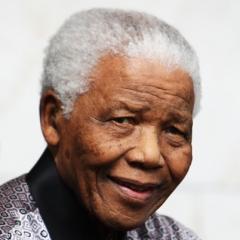
Nelson Mandela

Nelson Mandela Quotes

Former President of South Africa

Filter quotes by topic

Famous Nelson Mandela Quotes

“From its earliest days, the Cuban Revolution has also been a source of inspiration to all freedom-loving people. We admire the sacrifices of the Cuban people in maintaining their independence and sovereignty in the face of the vicious imperialist-orquestrated campaign to destroy the impressive gain made in the Cuban Revolution. Long live the Cuban Revolution. Long live comrade Fidel Castro.”

“How can I be expected to believe that this same racial discrimination which has been the cause of so much injustice and suffering right through the years, should now operate here to give me a fair and open trial?....consider myself neither morally nor legally obliged to obey laws made by a Parliament in which I am not represented. That the will of the people is the basis of the authority of government, is a principle universally acknowledged as sacred throughout the civilized world.”

“I cherish my own freedom dearly, but I care even more for your freedom. Too many have died since I went to prison. Too many have suffered for the love of freedom. I owe it to their widows, to their orphans, to their mothers and their fathers, who have grieved and wept for them ..... Not only have I suffered during these long lonely wasted years. I am no less life-loving than you are. But I cannot sell the birthright of the people to be free ....... Only free men can negotiate. Prisoners cannot enter into contracts. Your freedom and mine cannot be separated.”

“It is not a question of patronizing philanthropy towards disabled people. They do not need the patronage of the non-disabled. It is not for them to adapt to the dominant and dominating world of the so-called non-disabled. It is for us to adapt our understanding of a common humanity; to learn of the richness of how human life is diverse; to recognize the presence of disability in our human midst as an enrichment of our diversity.”

“The names of Dingane and Bambata, Hintsa and Makana, Squngthi and Dalasile, Moshoeshoe and Sekhukhuni, were praised as the glory of the entire African nation. I hoped then that life might offer me the opportunity to serve my people and make my own humble contribution to their freedom struggle.”

“I regard it as a duty which I owed, not just to my people, but also to my profession, to the practice of law, and to the justice for all mankind, to cry out against this discrimination which is essentially unjust and opposed to the whole basis of the attitude towards justice which is part of the tradition of legal training in this country. I believed that in taking up a stand against this injustice I was upholding the dignity of what should be an honorable profession.”

“The majority of South Africans, black and white, recognize that apartheid has no future. It has to be ended by our own decisive mass action in order to build peace and security. The mass campaign of defiance and other actions of our organization and people can only culminate in the establishment of democracy.”

“Sport has the power to inspire and unite people. In Africa, soccer enjoys great popularity and has a particular place in the hearts of people. That is why it is so important that the FIFA World Cup will, for the first time ever, be hosted on the African continent in 2010. We feel privileged and humbled that South Africa has been given this singular honour of being the African host country.”

“Our efforts to counter hatred, intolerance, and indifference must continue simultaneously at individual and structural levels. We must try to influence for good the minds and hearts of individual people through dialogue and confidence building. These efforts must be reinforced by our efforts to create just structures in society to support the ongoing work of negotiations in the human community. Only then will we have a chance to negate the terrible consequences of the tremendous conflicts facing humankind today.”

“Regarding African education in this country, there was a time when the government took no interest whatsoever in African education. It was the churches, that part of civil society, which bought land, built schools, and employed and paid teachers. People like myself, right from grade eight up to university, I was in missionary schools.”

“The first election in which all South Africans took part was in April, 1994. There were long queues [lines] of employers and employees, black and white. In the sense of Africans, Coloreds and Indians - when I talk about blacks, I mean those three. Blacks and whites mingled to vote without any hitches. Many people would have expected a great deal of tension, clashes and violence, but it did not occur.”

“I've found that South Africa has produced good leaders. These are people who realize that when there is danger, they should be in the forefront and when there is victory to be celebrated, they should be in the background, allowing their colleagues and the ordinary civilians - the man in the street - to rejoice and to celebrate that victory.”

“It is better to lead from behind and to put others in front, especially when you celebrate victory when nice things occur. You take the front line when there is danger. Then people will appreciate your leadership.”