Quotessence
Home / Authors / Peter Matthiessen
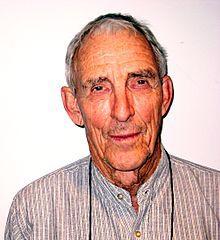
Peter Matthiessen

Peter Matthiessen Quotes

Novelist

Filter quotes by topic

Famous Peter Matthiessen Quotes

“Left alone, I am overtaken by the northern void-no wind, no cloud, no track, no bird, only the crystal crescents between peaks, the ringing monuments of rock that, freed from the talons of ice and snow, thrust an implacable being into the blue. In the early light, the rock shadows on the snow are sharp; in the tension between light and dark is the power of the universe. This stillness to which all returns, this is reality, and soul and sanity have no more meaning than a gust of snow; such transience and insignificance are exalting, terrifying, all at once…Snow mountains, more than sea or sky, serve as a mirror to one’s own true being, utterly still, utterly clear, a void, an Emptiness without life or sound that carries in Itself all life, all sound.”

“Indicating his twisted legs without a trace of self-pity or bitterness, as if they belonged to all of us, he casts his arms wide to the sky and the snow mountains, the high sun and dancing sheep, and cries, ’Of course I am happy here! It’s wonderful! Especially when I have no choice!’ In its wholehearted acceptance of what is;I feel as if he had struck me in the chest. Butter tea and wind pictures, the Crystal Mountain, and blue sheep dancing on the snow-it’s quite enough! Have you seen the snow leopard? No! Isn’t that wonderful?”

“Today most scientists would agree with the ancient Hindus that nothing exists or is destroyed, things merely change shape or form…the cosmic radiation that is thought to come from the explosion of creation strikes the earth with equal intensity from all directions, which suggests either that the earth is at the center of the universe, as in our innocence we once supposed, or that the known universe has no center.”

“I grow into these mountains like a moss. I am bewitched. The blinding snow peaks and the clarion air, the sound of earth and heaven in the silence, the requiem birds, the mythic beasts, the flags, great horns, and old carved stones, the silver ice in the black river, the Kang, the Crystal Mountain. Also, I love the common miracles-the murmur of my friends at evening, the clay fires of smudgy juniper, the coarse dull food, the hardship and simplicity, the contentment of doing one thing at a time… gradually my mind has cleared itself, and wind and sun pour through my head, as through a bell. Though we talk little here, I am never lonely; I am returned into myself. In another life-this isn’t what I know, but how I feel- these mountains were my home; there is a rising of forgotten knowledge, like a spring from hidden aquifers under the earth. To glimpse one’s own true nature is a kind of homegoing, to a place East of the Sun, West of the Moon- the homegoing that needs no home, like that waterfall on the supper Suli Gad that turns to mist before touching the earth and rises once again to the sky.”

“The central feature of the practice of meditation and hard work known as Zen is that, as Matthiessen says, it “has no patience with mysticism, far less the occult.” Nor does it have any time with moralism, the prescriptions or distortions we would impose on the world, obscuring it from our view. It asks, it insists rather, that we take this moment for what it is, undistracted, and not cloud it with needless worries of what might have been or fantasies of what might come to be. It is, essentially, a training in the real…”the Universe itself is the scripture of Zen." Pico Iyer from introduction.”

“I sit in meditation…and soon all sounds, and all one sees and feels, take on imminence, an immanence, as if the Universe were coming to attention, a Universe of which one is the center, a Universe that is not the same yet not different from oneself: within man as within mountains there are many parts of hydrogen and oxygen, of calcium, phosphorus, potassium, and other elements. ‘You never enjoy the world aright, till the Sea itself flows in your veins, till you are clothed with the heavens, and crowned with the stars…’(Thomas Traherne, Centuries of Meditation) The secret of the mountains is that the mountains simply exist, as I do myself: the mountains exist simply, which I do not. The mountains have no ‘meaning,’ they are meaning; the mountains are. The sun is round. I ring with life, and the mountains ring, and when I can hear it, there is a ringing that we share.”

“It is as if I have entered what the Tibetans call the Bardo-literally, between-two-existences- a dreamlike hallucination that precedes reincarnation, not necessarily in human form…In case I should need them, instructions for passage through the Bardo are contained in the Tibetan book of the dead- a guide for the living since it teaches that a man’s last thoughts will determine the quality of his reincarnation.”

“The light irradiates white peaks of Annapurna marching down the sky, in the great rampart that spreads east and west for eighteen hundred miles, the Himalaya- the alaya (abode, or home) of hima (snow).Hibiscus, frangipani, bougainvillea: seen under snow peaks, these tropical blossoms become the flowers of heroic landscapes. Macaques scamper in green meadow, and a turquoise roller spins in a golden light. Drongos, rollers, barbets, and white Eqyptian vulture are the common birds, and all have close relatives in East Africa.”

“Of all African animals, the elephant is the most difficult for man to live with, yet its passing - if this must come - seems the most tragic of all. I can watch elephants (and elephants alone) for hours at a time, for sooner or later the elephant will do something very strange such as mow grass with its toenails or draw the tusks from the rotted carcass of another elephant and carry them off into the bush. There is mystery behind that masked gray visage, and ancient life force, delicate and mighty, awesome and enchanted, commanding the silence ordinarily reserved for mountain peaks, great fires, and the sea.”

“He strayed across the sun worn grounds among old lichened monoliths, touching and tracing the inscriptions. The pains taken with the lettering astonished him—the knowing hands of nameless artisans, themselves long buried, incising stone calligraphies in memory of strangers. The age of these granites, hewn from crusts heaved up into the sun by planetary fire from miles beneath the surface of the earth, stirred him and humbled him. In quest of eternity, the upright stones yearned toward the firmament, even as they too were gnawed minutely by the bloodless fungi and blind algae that worked with the wind and rain to obliterate man's scratchings.”

“The mystical perception (which is only "mystical" if reality is limited to what can be measured by the intellect and senses) is remarkably consistent in all ages and all places. All phenomena are processes, connections, all is in flux...have the mind screens knocked away to see there is no real edge to anything, that in the endless interpenetration of the universe, a molecular flow, a cosmic energy shimmers in all stone and steel as well as flesh.”

“I can watch elephants (and elephants alone) for hours at a time, for sooner or later the elephant will do something very strange... There is mystery behind that masked gray visage, and ancient life force, delicate and mighty, awesome and enchanted, commanding the silence ordinarily reserved for mountain peaks, great fires, and the sea.”

“It's a simplification to say that the men [during Stone Age] went to war to maintain their dominance over the women. The men would help dig agricultural ditches because they were superb farmers. That was very heavy lifting work. But then they just preened themselves, and put bird-of-paradise plumes [in their hair], and smoked dope.”

“The ancient intuition that all matter, all "reality," is energy, that all phenomena, including time and space, are mere crystallizations of mind, is an idea with which few physicists have quarreled since the theory of relativity first called into question the separate identities of energy and matter. Today most scientists would agree with the ancient Hindus that nothing exists or is destroyed, things merely change shape or form; that matter is insubstantial in origin, a temporary aggregate of he pervasive energy that animates the electron.”

“You see ... a man like me, a cautious man, has his life all figured out according to a pattern, and then the pattern flies apart. You run around for quite a while trying to repair it, until one day you straighten up again with an armful of broken pieces, and you see that the world has gone on without you and you can never catch up with your old life, and you must begin all over again.”

“It is related that Sakyamuni [the historical Buddha] once dismissed as of small consequence a feat of levitation on the part of a disciple, and cried out in pity for a yogin by the river who had spent twenty years of his human existence learning to walk on water, when the ferryman might have taken him across for a small coin.”

“Soon the child’s clear eye is clouded over by ideas and opinions, preconceptions, and abstractions. Simple free being becomes encrusted with the burdensome armor of the ego. Not until years later does an instinct come that a vital sense of mystery has been withdrawn. The sun glints through the pines and the heart is pierced in a moment of beauty and strange pain, like a memory of paradise. After that day, we become seekers.”

“When we are mired in the relative world, never lifting our gaze to the mystery, our life is stunted, incomplete; we are filled with yearning for that paradise that is lost when, as young children, we replace it with words and ideas and abstractions - such as merit, such as past, present, and future - our direct, spontaneous experience of the thing itself, in the beauty and precision of this present moment.”

“The secret of the mountain is that the mountains simply exist, as I do myself: the mountains exist simply, which I do not. The mountains have no "meaning," they are meaning; the mountains are. The sun is round. I ring with life, and the mountains ring, and when I can hear it, there is a ringing that we share. I understand all this, not in my mind but in my heart, knowing how meaningless it is to try to capture what cannot be expressed, knowing that mere words will remain when I read it all again, another day.”

“I meditate for the last time on this mountain that is bare, though others all around are white with snow. Like the bare peak of the koan, this one is not different from myself. I know this mountain because I am this mountain, I can feel it breathing at this moment, as its grass tops stray against the snows. If the snow leopard should leap from the rock above and manifest itself before me - S-A-A-O! - then in that moment of pure fright, out of my wits, I might truly perceive it, and be free.”