Quotessence
Home / Authors / Theodore Roosevelt
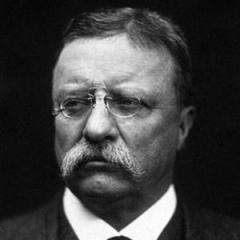
Theodore Roosevelt

Theodore Roosevelt Quotes

26th U.S. President

Filter quotes by topic

Famous Theodore Roosevelt Quotes

“I enter a most earnest plea that in our hurried and rather bustling life of today we do not lose the hold that our forefathers had on the Bible. I wish to see the Bible study as much a matter of course in the secular colleges as in the seminary. No educated man can afford to be ignorant of the Bible, and no uneducated man can afford to be ignorant of the Bible.”

“Every thinking man, when he thinks, realizes that the teachings of the Bible are so interwoven and intertwined with our whole civic and social life that it would be literally, I do not mean figuratively, but literally impossible for us to figure what the loss would be if these teachings were removed. We would lose all the standards by which we now judge both public and private morals; all the standards toward which we, with more or less resolution, strive to raise ourselves.”

“The men and women who have the right ideals . . . are those who have the courage to strive for the happiness which comes only with labor and effort and self-sacrifice, and those whose joy in life springs in part from power of work and sense of duty.”

“If we seek merely swollen, slothful ease and ignoble peace, if we shrink from the hard contests where men must win at the hazard of their lives and at the risk of all they hold dear, then bolder and stronger peoples will pass us by, and will win for themselves the domination of the world.”

“It is not the critic who counts...The credit belongs to the man who is actually in the arena.”

“Leave it as it is. You can not improve on it. You can only mar it. The ages have been at work on it and man can only mar it. What you can do is keep it for your children, your children's children and for all who come after you.”

“On the whole, we think that the greatest victories are yet to be won, the greatest deeds yet to be done, and that there are yet in store for our peoples, and for the causes that we uphold, grander triumphs than have ever yet been scored. But be this as it may, we gladly agree that the one plain duty of every man is to face the future as he faces the present, regardless of what it may have in store for him, turning toward the light as he sees the light, to play his part manfully, as a man among men.”

“Love of peace is common among weak, short-sighted, timid, and lazy persons; and on the other hand courage is found among many men of evil temper and bad character. Neither quality shall by itself avail. Justice among the nations of mankind, and the uplifting of humanity, can be brought about only by those strong and daring men who with wisdom love peace, but who love righteousness more than peace.”

“No greater wrong can ever be done than to put a good man at the mercy of a bad, while telling him not to defend himself or his fellows; in no way can the success of evil be made surer or quicker.”

“My position as regards the monied interests can be put in a few words. In every civilized society property rights must be carefully safeguarded; ordinarily and in the great majority of cases, human rights and property rights are fundamentally and in the long run, identical; but when it clearly appears that there is a real conflict between them, human rights must have the upper hand; for property belongs to man and not man to property.”

“A man must first care for his own household before he can be of use to the state. But no matter how well he cares for his household, he is not a good citizen unless he also takes thought of the state. In the same way, a great nation must think of its own internal affairs; and yet it cannot substantiate its claim to be a great nation unless it also thinks of its position in the world at large.”

“Every man among us is more fit to meet the duties and responsibilities of citizenship because of the perils over which, in the past, the nation has triumphed; because of the blood and sweat and tears, the labor and the anguish, through which, in the days that have gone, our forefathers moved on to triumph.”

“The weakling and the coward are out of place in a strong and free community. In a republic like ours the governing class is composed of the strong men who take the trouble to do the work of government; and if you are too timid or too fastidious or too careless to do your part in this work, then you forfeit your right to be considered one of the governing and you become one of the governed insteadone of the driven cattle of the political arena.”

“The plea of good intentions is not one that can be allowed to have much weight in passing historical judgment upon a man whose wrong-headedness and distorted way of looking at things produced, or helped to produce, such incalculable evil; there is a wide political applicability in the remark attributed to a famous Texan, to the effect that he might, in the end, pardon a man who shot him on purpose, but that he would surely never forgive one who did so accidentally.”

“Some reformers may urge that in the ages distant future, patriotism, like the habit of monogamous marriage, will become a needless and obsolete virtue; but just at present the man who loves other countries as much as he does his own is quite as noxious a member of society as the man who loves other women as much as he loves his wife. Love of country is an elemental virtue, like love of home.”

“If I were a factory employee, a workman on the railroads or a wage-earner of any sort, I would undoubtedly join the union of my trade. If I disapproved of its policy, I would join in order to fight that policy; if the union leaders were dishonest, I would join in order to put them out. I believe in the union and I believe that all men who are benefited by the union are morally bound to help to the extent of their power in the common interests advanced by the union.”

“Any political movement directed against any body of our fellow-citizens because of their religious creed is a grave offense against American principles and American institutions. It is a wicked thing either to support or oppose a man because of the creed he possesses. . . . Such a movement directly contravenes the spirit of the Constitution itself.”

“Short-sighted men who in their greed and selfishness will, if permitted, rob our country of half its charm by their reckless extermination of all useful and beautiful wild things.”

“At the risk of repetition let me say again that my plea is not for immunity to, but for the most unsparing exposure of, the politician who betrays his trust, of the big business man who makes or spends his fortune in illegitimate or corrupt ways. There should be a resolute effort to hunt every such man out of the position he has disgraced. Expose the crime, and hunt down the criminal; but remember that even in the case of crime, if it is attacked in sensational, lurid, and untruthful fashion, the attack may do more damage to the public mind than the crime itself.”

“It is no limitation upon property rights or freedom of contract to require that when men receive from government the privilege of doing business under corporate form... they shall do so under absolutely truthful representations... Great corporations exist only because they were created and safeguarded by our institutions; and it is therefore our right and duty to see that they work in harmony with these institutions.”

“The men of wealth who today are trying to prevent the regulation and control of their business in the interest of the public by the proper government authorities will not succeed, in my judgment, in checking the progress of the movement. But if they did succeed they would find that they had sown the wind and would surely reap the whirlwind, for they would ultimately provoke the violent excesses which accompany a reform coming by convulsion instead of by steady and natural growth.”