Quotessence
Home / Authors / Wole Soyinka Books
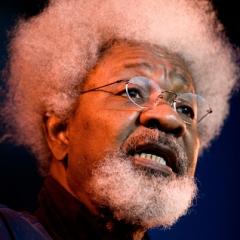
Wole Soyinka

Wole Soyinka Books

Writer

Collected Plays

A source page for quotes linked to Wole Soyinka.
0 quotes

Early Poems

A source page for quotes linked to Wole Soyinka.

0 quotes

Selected poems

A source page for quotes linked to Wole Soyinka.

0 quotes

Six Plays

A source page for quotes linked to Wole Soyinka.

0 quotes

Related Quotes

“In one form or the other, the quest for human dignity has proved to be one of the most propulsive elements for wars, civil strife and willing sacrifice. Yet the entitlement to dignity, enshrined among the 'human rights', does not aspire to being the most self-evident, essential need for human survival, such as food, or physical health. Compared to that other candidate for the basic impulse of human existence - self-preservation - it may even be deemed self-indulgent.”

“the very least we can live with is an agreement that does not reduce us to slaves of imposition, but makes us partners of consent. Yes, we are compelled to make peace, we submit to force majeure, but leave us at least a piece of clothing to cover our nudity. This is the motivation behind every formula of diplomatic contrivance that is sometimes described as face-saving, and wise indeed is the victor who knows that, in order to shield his own rear from the elements, he must not denude his opponents.”

“Sadly, it is within the religious domain that the phenomenon of rhetorical hysteria takes its most devastating form. I am aware that, in some minds, this tends to be regarded as a delicate subject. Let me declare very simply that I do not share such a sentiment. There is nothing in the least delicate about the slaughter of innocents. We all subscribe to the lofty notions contained in the Universal Declaration of Human Rights but, for some reason, become suddenly coy and selective when it comes to defending what is obviously the most elementary of these rights, which is the right to life. One of my all-time favourite lines comes from the black American poet Langston Hughes. It reads, simply, 'There is no lavender word for lynch'.”

“Nigeria is so peculiar and dramatic. Even talking about the potentials before we talk about the negativities, Nigeria is a nation for perpetual study. I think in Nigeria, it is the potential which hits people and makes them believe in Nigeria. It tends to make them react when they see potentials being wasted and it is a tragedy to see potentials wasted. But paradoxically, it is a realization of the existence, that positive, that keeps many Nigerians and even foreign people going.”

“I think Nigerians got it wrong from independence as people became so conscious of the divisions because we wanted so much to satisfy the plurality of interests. I will say, we neglected the importance of real value, human value and the quality of potential in human beings and we contrived phrases like geographical spread, regional quota, etc and allowed mediocrity to reign. I think that is the problem that we are dealing with till today.”

“We must acknowledge that we made a huge error in satisfying the lowest common denominator of the available human potential in Nigeria and we elevated what I call the reign of mediocrity. Quite frankly, I think it is about repudiating the past, creating space for new thinking for the best of the new generation, creating both political and geographical space and going at it with single mindedness that says, 'enough of buttering, sentiments and massaging the ego of the old brigade'.”

“As a president, you've got to show some example. I am disturbed for instance when I read that a candidate said, 'I will not probe anybody or something like that'. You don't fight corruption by sweeping everything under the carpet, you don't. You just say, am going to allow the law take its course; I am going to empower the agencies which has been set up for such specific purpose of stemming the corrupt out flow of resources from this nation and don't even talk to me about corruption beyond saying you going to strengthen existing institutions.”

“When I was a child, for a public/civil servant to be caught in corrupt practices, that individual will be a pariah. He will be a complete reject of the society; he/she could not raise his or her voice to speak in the public. So what happened between that time and now? That time when a public officer, prison or customs officer caught in corruption hides his face in shame amongst his peers, he just couldn't come out publicly. Today, when they come back, they get chieftaincy titles, they are received in grand style, cows are killed, they ride on white horses.”

“People say human nature is a very vague expression, people tend to say human nature is corruptible anyway and it comes from a theological point of view, goes back to the Garden of Eden, that there is always this corrupt gene waiting to be activated that we inherited from the very beginning. I don't believe in that theological excuse.”

“I was born into a Christian household, in a parsonage in fact, so I grew up in sort of a missionary atmosphere but it was an environment which involved both the traditional religions as well as the Muslim religion, so we were exposed to all the various facets of faith, micro cultures which existed within those beliefs, and even though I've lost whatever Christian faith was drummed into me as a child, I still maintain very good relationship with all the various religions.”