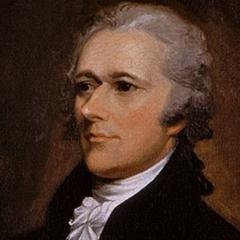
“In disquisitions of every kind there are certain primary truths, or first principles, upon which all subsequent reasoning must depend.”
Source: The Essential Federalist: A New Reading of the Federalist Papers
“Establish that a Government may decline a provision for its debts, though able to make it, and you overthrow all public morality, you unhinge all the principles that must preserve the limits of free constitutions.”
Source: Papers
“The republican principle demands that the deliberate sense of the community should govern the conduct of those to whom they intrust the management of their affairs; but it does not require an unqualified complaisance to every sudden breeze of passion or to every transient impulse which the people may receive from the arts of men, who flatter their prejudices to betray their interests.”
Source: The Federalist Papers and the Constitution of the United States: The Principles of the American Government
“Some reasonable term ought to be allowed to enable aliens to get rid of foreign and acquire American attachments; to learn the principles and imbibe the spirit of our government; and to admit of a probability at least, of their feeling a real interest in our affairs.”
Source: The works of Alexander Hamilton: containing his correspondence, and his political and official writings, exclusive of the Federalist, civil and military
“Great Ambition, unchecked by principle, or the love of Glory, is an unruly Tyrant.”
Source: The Works of Alexander Hamilton: Correspondence [contin.] 1795-1804; 1777; 1791. Letters of H. G. 1789. Address to public creditors. 1790. Vindication of funding system. 1791
“Ambition without principle never was long under the guidance of good sense.”
Source: The Works of Alexander Hamilton: Correspondence [contin.] 1795-1804; 1777; 1791. Letters of H. G. 1789. Address to public creditors. 1790. Vindication of funding system. 1791
“It is a general principle of human nature, that a man will be interested in whatever he possesses, in proportion to the firmness or precariousness of the tenure by which he holds it.”
Source: The Federalist, on the new constitution, written in 1788, with an appendix, containing the letters of Pacificus and Helvidius on the proclamation of neutrality of 1793, also the original articles of confederation and the constitution of the United States
“It is a general principle of human nature, that a man will be interested in whatever he possesses, in proportion to the firmness or precariousness of the tenure by which he holds it; will be less attached to what he holds by a momentary or uncertain title, than to what he enjoys by a durable or certain title; and, of course, will be willing to risk more for the sake of the one, than for the sake of the other.”
Source: The Federalist: On the New Constitution
“That Americans are entitled to freedom is incontestable on every rational principle. All men have one common original: they participate in one common nature, and consequently have one common right. No reason can be assigned why one man should exercise any power or preeminence over his fellow-creatures more than another; unless they have voluntarily vested him with it.”
Source: The works of Alexander Hamilton: comprising his correspondence, and his political and official writings, exclusive of the Federalist, civil and military. Published from the original manuscripts deposited in the Department of State, by order of the Joint Library Committee of Congress
“It is a singular capriciousness of the human mind, that after all the admonitions we have had from experience on this head, there should still be found men, who object to the new constitution for deviating from a principle which has been found the bane of the old.”
Source: The Fœderalist: A Collection of Essays, Written in Favor of the New Constitution, as Agreed Upon by the Fœderal Convention, September 17, 1787. Reprinted from the Original Text. With an Historical Introduction and Notes
“If it were to be asked, What is the most sacred duty and the greatest source of our security in a Republic? The answer would be, An inviolable respect for the Constitution and Laws - the first growing out of the last . . . . A sacred respect for the constitutional law is the vital principle, the sustaining energy of a free government.”
Source: Selected writings and speeches of Alexander Hamilton
“I propose . . . . The conformity of the proposed Constitution to the true principles of republican government.”
Source: The federalist papers
“While the constitution continues to be read, and its principles known, the states, must, by every rational man, be considered as essential component parts of the union; and therefore the idea of sacrificing the former to the latter is totally inadmissible.”
Source: The Works of Alexander Hamilton: Miscellanies, 1774-1789: A full vindication; The farmer refuted; Quebec bill; Resolutions in Congress; Letters from Phocion; New-York Legislature, etc
“The local interest of a State ought in every case to give way to the interests of the Union. For when a sacrifice of one or the other is necessary, the former becomes only an apparent, partial interest, and should yield, on the principle that the smaller good ought never to oppose the greater good.”
Source: The works of Alexander Hamilton: comprising his correspondence, and his political and official writings, exclusive of the Federalist, civil and military. Published from the original manuscripts deposited in the Department of State, by order of the Joint Library Committee of Congress
“I will venture to assert that no combination of designing men under heaven will be capable of making a government unpopular which is in its principles a wise and good one, and vigorous in its operations.”
Source: The Works of Alexander Hamilton: Miscellanies, 1774-1789: A full vindication; The farmer refuted; Quebec bill; Resolutions in Congress; Letters from Phocion; New-York Legislature, etc
“The true principle of government is this - make the system compleat in its structure; give a perfect proportion and balance to its parts; and the powers you give it will never affect your security.”
Source: The Works of Alexander Hamilton: Miscellanies, 1774-1789: A full vindication; The farmer refuted; Quebec bill; Resolutions in Congress; Letters from Phocion; New-York Legislature, etc
“There is no part of the administration of government that requires extensive information and a thorough knowledge of the principles of political economy, so much as the business of taxation. The man who understands those principles best will be least likely to resort to oppressive expedients, or sacrifice any particular class of citizens to the procurement of revenue. It might be demonstrated that the most productive system of finance will always be the least burdensome.”
Source: The Federalist Papers and the Constitution of the United States: The Principles of the American Government
“The idea of governing at all times by the simple force of law (which we have been told is the only admissible principle of republican government) has no place but in the reveries of those political doctors whose sagacity disdains the admonitions of experimental instruction.”
Source: The Federalist Papers: A Collection of Essays Written in Favour of the New Constitution
“It is one thing to be subordinate to the laws, and another [for the Executive] to be dependent on the legislative body. The first comports with, the last violates, the fundamental principles of good government; and, whatever may be the forms of the Constitution, unites all power in the same hands.”
Source: The Federalist on the New Constitution
“The only constitutional exception to the power of making treaties is, that it shall not change the Constitution.… On natural principles, a treaty, which should manifestly betray or sacrifice primary interests of the state, would be null.”
“There is no position which depends on clearer principles than that every act of a delegated authority, contrary to the commission under which it is exercised, is void. No legislative act, therefore, contrary to the Constitution, can be valid.”
Source: The federalist papers
“The true principle of a republic is that the people should choose whom they please to govern them. Representation is imperfect, in proportion as the current of popular favor is checked. The great source of free government, popular election, should be perfectly pure, and the most unbounded liberty allowed.”
Source: The works of Alexander Hamilton: comprising his correspondence, and his political and official writings, exclusive of the Federalist, civil and military. Published from the original manuscripts deposited in the Department of State, by order of the Joint Library Committee of Congress
“The praise of a civilized world is justly due to Christianity;—war, by the influence of the humane principles of that religion, has been stripped of half its horrors. The French renounce Christianity, and they relapse into barbarism;—war resumes the same hideous and savage form which it wore in the ages of Gothic and Roman violence.”
Source: The Works of Alexander Hamilton
“Opinion, whether well or ill-founded, is the governing principle of human affairs”
Source: Citizen Hamilton: The Wit and Wisdom of an American Founder
“Money is, with propriety, considered as the vital principle of the body politic; as that which sustains its life and motion, and enables it to perform its most essential functions.”
Source: The Essential Federalist: A New Reading of the Federalist Papers
“Perhaps myself the first, at some expense of popularity, to unfold the true character of Jefferson, it is too late for me to become his apologist. Nor can I have any disposition to do it. I admit that his politics are tinctured with fanaticism, that he is too much in earnest in his democracy, that he has been a mischievous enemy to the principle measures of our past administration, that he is crafty & persevering in his objects, that he is not scrupulous about the means of success, nor very mindful of truth, and that he is a contemptible hypocrite.”
Source: Correspondence [contin.] 1795-1804; 1777; 1791. Letters of H.G. 1789. Address to public creditors. 1790. Vindication of funding system. 1791
“A sacred respect for the constitutional law is the vital principle, the sustaining energy of a free government.”
Source: The works of Alexander Hamilton: comprising his correspondence, and his political and official writings, exclusive of the Federalist, civil and military. Published from the original manuscripts deposited in the Department of State, by order of the Joint Library Committee of Congress
“Allow a government to decline paying its debts and you overthrow all public morality-you unhinge all the principles that preserve the limits of free constitutions. Nothing can more affect national prosperity than a constant and systematic attention to extinguish the present debt and to avoid as much as possibly the incurring of any new debt.”
“The safety of a republic depends essentially on the energy of a common national sentiment; on a uniformity of principles and habits; on the exemption of the citizens from foreign bias and prejudice; and on that love of country which will almost invariably be found to be closely connected with birth, education and family.”
Source: Citizen Hamilton: The Wit and Wisdom of an American Founder
“Self-preservation is the first principle of our nature.”
Source: The Works of Alexander Hamilton: Miscellanies, 1774-1789: A full vindication; The farmer refuted; Quebec bill; Resolutions in Congress; Letters from Phocion; New-York Legislature, etc