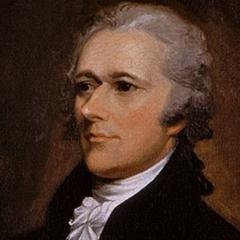
“The superiority...enjoyed by nations that have...perfected a branch of industry, constitutes a...formidable obstacle.”
“In the usual progress of things, the necessities of a nation in every stage of its existence will be found at least equal to its resources.”
Source: The Essential Federalist: A New Reading of the Federalist Papers
“There can be no time, no state of things, in which Credit is not essential to a Nation.”
Source: Reports of the Secretary of the Treasury of the United States, Prepared in Obedience to the Act of the 10th May, 1800: ... to which are Prefixed, the Reports of Alexander Hamilton, on Public Credit, on a National Bank, on Manufactures, and on the Establishment of a Mint ... Printed by Order of the Senate of the United States
“A nation which can prefer disgrace to danger is prepared for a master, and deserves one.”
Source: Citizen Hamilton: The Wit and Wisdom of an American Founder
“Safety from external danger is the most powerful director of national conduct. Even the ardent love of liberty will, after a time, give way to its dictates. The violent destruction of life and property incident to war, the continual effort and alarm attendant on a state of continual danger, will compel nations the most attached to liberty to resort for repose and security to institutions which have a tendency to destroy their civil and political rights. To be more safe, they at length become willing to run the risk of being less free.”
Source: The Federalist Papers: A Collection of Essays Written in Favour of the New Constitution
“Safety from external danger is the most powerful director of national conduct. To be more safe, [nations] at length become willing to run the risk of being less free.”
Source: The Federalist, on the New Constitution, Written in the Year 1788
“The history of human conduct does not warrant that exalted opinion of human virtue which would make it wise in a nation to commit interests of so delicate and momentous a kind as those which concern its intercourse with the rest of the world, to the sole disposal of a magistrate, created and circumstanced, as would be a president of the United States.”
Source: The Federalist on the New Constitution
“As on the one hand, the necessity for borrowing in particular emergencies cannot be doubted, so on the other, it is equally evident that to be able to borrow upon good terms, it is essential that the credit of a nation should be well established.”
Source: The Works of Alexander Hamilton: Miscellanies, 1789-1795: France; Duties on imports; National bank; Manufactures; Revenue circulars; Reports on claims, etc
“It is of the greatest consequence that the debt should, with the consent of the creditors, be remoulded into such a shape as will bring the expenditure of the nation to a level with its income. Till this shall be accomplished, the finances of the United States will never wear a proper countenance. Arrears of interest, continually accruing, will be as continual a monument, either of inability, or of ill faith and will not cease to have an evil influence on public credit.”
“And as the vicissitudes of Nations beget a perpetual tendency to the accumulation of debt, there ought to be in every government a perpetual, anxious, and unceasing effort to reduce that, which at any times exists, as fast as shall be practicable consistently with integrity and good faith.”
Source: Reports of the secretary of the Treasury of the United States
“But the greatest obstacle of all to the successful prosecution of a new branch of industry in a country, in which it was before unknown, consists . . . in the bounties, premiums, and other aids which are granted, in a variety of cases, by the nations, in which the establishments to be imitated are previously introduced.”
Source: Reports of the Secretary of the Treasury of the United States, Prepared in Obedience to the Act of the 10th May, 1800: ... to which are Prefixed, the Reports of Alexander Hamilton, on Public Credit, on a National Bank, on Manufactures, and on the Establishment of a Mint ... Printed by Order of the Senate of the United States
“To cherish and stimulate the activity of the human mind, by multiplying the objects of enterprise, is not among the least considerable of the expedients, by which the wealth of a nation may be promoted. Even things in themselves not positively advantageous, sometimes become so, by their tendency to provoke exertion. Every new scene, which is opened to the busy nature of man to rouse and exert itself, is the addition of a new energy to the general stock of effort.”
Source: Report of the Secretary of the Treasury of the United States, on the Subject of Manufactures: Presented to the House of Representatives, December 5, 1791
“[I]n framing a Government for a nation we ought, in those provisions which are designed to be permanent, to calculate not on temporary, but on permanent causes of expence.”
Source: The Federalist: A Commentary on the Constitution of the United States
“As to Taxes, they are evidently inseparable from Government. It is impossible without them to pay the debts of the nation, to protect it from foreign danger, or to secure individuals from lawless violence and rapine.”
Source: Political essays [etc., 1792-1804] Contents. Index
“There is perhaps, nothing more likely to disturb the tranquillity of nations, than their being bound to mutual contributions for any common object that does not yield an equal and coincident benefit. For it is an observation as true, as it is trite, that there is nothing men differ so readily about as the payment of money.”
Source: The Federalist on the New Constitution
“The rights of neutrality will only be respected when they are defended by an adequate power. A nation, despicable by its weakness, forfeits even the privilege of being neutral.”
Source: The Federalist, on the new constitution, written in 1788, with an appendix, containing the letters of Pacificus and Helvidius on the proclamation of neutrality of 1793, also the original articles of confederation and the constitution of the United States
“There is nothing absurd or impracticable in the idea of a league or alliance between independent nations for certain defined purposes precisely stated in a treaty regulating all the details of time, place, circumstance, and quantity; leaving nothing to future discretion; and depending for its execution on the good faith of the parties.”
Source: The Federalist, on the new constitution, written in 1788, with an appendix, containing the letters of Pacificus and Helvidius on the proclamation of neutrality of 1793, also the original articles of confederation and the constitution of the United States
“Its objects are CONTRACTS with foreign nations which have the force of law, but derive it from the obligations of good faith.”
Source: The federalist papers
“A nation has a right to manage its own concerns as it thinks fit.”
Source: The Works of Alexander Hamilton: Cabinet papers. 1789-1794
“Every nation ought to have a right to provide for its own happiness.”
Source: The Works of Alexander Hamilton: Cabinet papers. 1789-1794
“The circumstances that endanger the safety of nations are infinite, and for this reason no constitutional shackles can wisely be imposed on the power to which the care of it is committed.”
Source: The Federalist, on the new constitution, written in 1788, with an appendix, containing the letters of Pacificus and Helvidius on the proclamation of neutrality of 1793, also the original articles of confederation and the constitution of the United States
“As the duties of superintending the national defense and of securing the public peace against foreign or domestic violence involve a provision for casualties and dangers to which no possible limits can be assigned, the power of making that provision ought to know no other bounds than the exigencies of the nation and the resources of the community.”
Source: The federalist papers
“The honor of a nation is its life. Deliberately to abandon it is to commit an act of political suicide.”
Source: Political essays [etc., 1792-1804] Contents. Index
“The principal purposes to be answered by union are these the common defense of the members; the preservation of the public peace as well against internal convulsions as external attacks; the regulation of commerce with other nations and between the States; the superintendence of our intercourse, political and commercial, with foreign countries.”
Source: The Federalist Papers: A Collection of Essays Written in Favour of the New Constitution
“Divide et impera must be the motto of every nation that either hates or fears us.”
Source: The federalist papers
“To cherish and stimulate the activity of the human mind, by multiplying the objects of enterprise, is not among the least considerable of the expedients, by which the wealth of a nation may be promoted.”
Source: Reports of the Secretary of the Treasury of the United States, Prepared in Obedience to the Act of the 10th May, 1800: ... to which are Prefixed, the Reports of Alexander Hamilton, on Public Credit, on a National Bank, on Manufactures, and on the Establishment of a Mint ... Printed by Order of the Senate of the United States
“There are some who maintain that trade will regulate itself, and it is not to be benefited by the encouragements or restraints of government. Such persons will imagine that there is no need of a common directing power. This is one of those wild speculative paradoxes, which have grown into credit among us, contrary to the uniform practice and sense of the most enlightened nations.”
Source: The Federalist: A Commentary on the Constitution of the United States : a Collection of Essays
“For, when the credit of a country is in any degree questionable, it never fails to give on extravagant premium, in one shape or another, upon all the loans it has occasion to make. Nor does the evil end here; the same disadvantage must be sustained upon whatever is to be bought on terms of future payment. From this constant necessity of borrowing and buying dear, it is easy to conceive how immensely the expenses of a nation, in a course of time, will be augmented by an unsound state of the public credit.”
Source: Reports of the Secretary of the Treasury of the United States, Prepared in Obedience to the Act of the 10th May, 1800: ... to which are Prefixed, the Reports of Alexander Hamilton, on Public Credit, on a National Bank, on Manufactures, and on the Establishment of a Mint ... Printed by Order of the Senate of the United States
“In this distribution of powers the wisdom of our constitution is manifested. It is the province and duty of the Executive to preserve to the Nation the blessings of peace. The Legislature alone can interrupt those blessings, by placing the Nation in a state of War.”
Source: The Federalist, on the New Constitution, Written in the Year 1788
“[W]ar is a question, under our constitution, not of Executive, but of Legislative cognizance. It belongs to Congress to say whether the Nation shall of choice dismiss the olive branch and unfurl the banners of War.”
Source: Papers: Harold C. Syrett, Editor; Jacob E. Cooke, Associate Editor