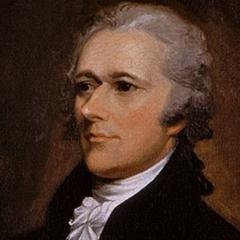
“The loss of liberty to a generous mind is worse than death.”
“There is a certain enthusiasm in liberty, that makes human nature rise above itself, in acts of bravery and heroism.”
Source: Citizen Hamilton: The Wit and Wisdom of an American Founder
“How can you trust people who are poor and own no property? ... Inequality of property will exist as long as liberty exists.”
“The legislatures will have better means of information. They can discover the danger at a distance; and possessing all the organs of civil power, and the confidence of the people, they can at once adopt a regular plan of opposition, in which they can combine all the resources of the community. They can readily communicate with each other in the different States, and unite their common forces for the protection of their common liberty.”
Source: The Federalist Papers: A Collection of Essays Written in Favour of the New Constitution
“A struggle for liberty is in itself respectable and glorious. . . . When conducted with magnanimity, justice and humanity, it ought to command the admiration of every friend to human nature. But if sullied by crimes and extravagancies, it loses its respectability.”
Source: Citizen Hamilton: The Wit and Wisdom of an American Founder
“The Liberty of the press consists in the right to publish with impunity truth with good motives for justifiable ends, though reflecting on government, magistracy, or individuals.”
Source: The Works of Alexander Hamilton: Political essays [etc., 1792-1804] Contents. Index
“Civil liberty is only natural liberty, modified and secured by the sanctions of civil society. It is not a thing, in its own nature, precarious and dependent on human will and caprice; but it is conformable to the constitution of man, as well as necessary to the well-being of society.”
Source: The Works of Alexander Hamilton: Miscellanies, 1774-1789: A full vindication; The farmer refuted; Quebec bill; Resolutions in Congress; Letters from Phocion; New-York Legislature, etc
“In a government framed for durable liberty, not less regard must be paid to giving the magistrate a proper degree of authority, to make and execute the laws with rigour, than to guarding against encroachments upon the rights of the community. As too much power leads to despotism, too little leads to anarchy, and both eventually to the ruin of the people.”
Source: 1779-1781
“If it be asked what is to restrain the House of Representatives from making legal discriminations in favor of themselves and a particular class of the society? I answer, the genius of the whole system, the nature of just and constitutional laws, and above all the vigilant and manly spirit which actuates the people of America, a spirit which nourishes freedom, and in return is nourished by it. If this spirit shall ever be so far debased as to tolerate a law not obligatory on the Legislature as well as on the people, the people will be prepared to tolerate anything but liberty.”
Source: The Federalist, on the New Constitution, Written in the Year 1788
“Safety from external danger is the most powerful director of national conduct. Even the ardent love of liberty will, after a time, give way to its dictates. The violent destruction of life and property incident to war, the continual effort and alarm attendant on a state of continual danger, will compel nations the most attached to liberty to resort for repose and security to institutions which have a tendency to destroy their civil and political rights. To be more safe, they at length become willing to run the risk of being less free.”
Source: The Federalist Papers: A Collection of Essays Written in Favour of the New Constitution
“It will be of little avail to the people, that the laws are made by men of their own choice, if the laws be so voluminous that they cannot be read, or so incoherent that they cannot be understood; if they be repealed or revised before they are promulgated, or undergo such incessant changes that no man, who knows what the law is to-day, can guess what it will be tomorrow.”
Source: The Essential Federalist: A New Reading of the Federalist Papers
“I would die to preserve the law upon a solid foundation; but take away liberty, and the foundation is destroyed.”
Source: The Works of Alexander Hamilton: Miscellanies, 1774-1789: A full vindication; The farmer refuted; Quebec bill; Resolutions in Congress; Letters from Phocion; New-York Legislature, etc
“We are now forming a republican government. Real liberty is never found in despotism or the extremes of democracy, but in moderate governments.”
Source: Jeffersonian principles and Hamiltonian principles: extracts from the writings of Thomas Jefferson and Alexander Hamilton
“Government is frequently and aptly classed under two descriptions-a government of force, and a government of laws; the first is the definition of despotism-the last, of liberty.”
Source: The works of Alexander Hamilton: comprising his correspondence, and his political and official writings, exclusive of the Federalist, civil and military. Published from the original manuscripts deposited in the Department of State, by order of the Joint Library Committee of Congress
“Civil liberty is only natural liberty, modified and secured by the sanctions of civil society.”
Source: The Works of Alexander Hamilton: Miscellanies, 1774-1789: A full vindication; The farmer refuted; Quebec bill; Resolutions in Congress; Letters from Phocion; New-York Legislature, etc
“[V]igor of government is essential to the security of liberty.”
Source: The Fœderalist: A Collection of Essays, Written in Favor of the New Constitution, as Agreed Upon by the Fœderal Convention, September 17, 1787. Reprinted from the Original Text. With an Historical Introduction and Notes
“Safety from external danger is the most powerful director of national conduct. To be more safe, [nations] at length become willing to run the risk of being less free.”
Source: The Federalist, on the New Constitution, Written in the Year 1788
“[If you understood the natural rights of mankind,] [y]ou would be convinced that natural liberty is a gift of the beneficent Creator to the whole human race, and that civil liberty is founded in that, and cannot be wrested from any people without the most manifest violation of justice.”
“Remember civil and religious liberty always go together: if the foundation of the one be sapped, the other will fall of course.”
Source: The Official and Other Papers ...
“No man in his senses can hesitate in choosing to be free, rather than a slave.”
Source: The Works of Alexander Hamilton: Miscellanies, 1774-1789: A full vindication; The farmer refuted; Quebec bill; Resolutions in Congress; Letters from Phocion; New-York Legislature, etc
“Hence, in a state of nature, no man had any moral power to deprive another of his life, limbs, property, or liberty; nor the least authority to command or exact obedience from him, except that which arose from the ties of consanguinity.”
Source: The Official and Other Papers ...
“No person that has enjoyed the sweets of liberty can be insensible of its infinite value, or can reflect on its reverse without horror and detestation”
Source: The Works of Alexander Hamilton: Miscellanies, 1774-1789: A full vindication; The farmer refuted; Quebec bill; Resolutions in Congress; Letters from Phocion; New-York Legislature, etc
“The only distinction between freedom and slavery consists in this: In the former state a man is governed by the laws to which he has given his consent, either in person or by his representative; in the latter, he is governed by the will of another. In the one case, his life and property are his own; in the other, they depend upon the pleasure of his master. It is easy to discern which of these two states is preferable.”
Source: The Official and Other Papers ...
“That Americans are entitled to freedom is incontestable on every rational principle. All men have one common original: they participate in one common nature, and consequently have one common right. No reason can be assigned why one man should exercise any power or preeminence over his fellow-creatures more than another; unless they have voluntarily vested him with it.”
Source: The works of Alexander Hamilton: comprising his correspondence, and his political and official writings, exclusive of the Federalist, civil and military. Published from the original manuscripts deposited in the Department of State, by order of the Joint Library Committee of Congress
“Were not the disadvantages of slavery too obvious to stand in need of it, I might enumerate and describe the tedious train of calamities inseparable from it. I might show that it is fatal to religion and morality; that it tends to debase the mind, and corrupt its noblest springs of action. I might show that it relaxes the sinews of industry, clips the wings of commerce, and introduces misery and indigence in every shape.”
Source: The works of Alexander Hamilton: comprising his correspondence, and his political and official writings, exclusive of the Federalist, civil and military. Published from the original manuscripts deposited in the Department of State, by order of the Joint Library Committee of Congress
“Energy in the executive is a leading character in the definition of good government. It is essential to the protection of the community against foreign attacks; it is not less essential to the steady administration of the laws; to the protection of property against those irregular and high-handed combinations which sometimes interrupt the ordinary course of justice; to the security of liberty against the enterprises and assaults of ambition, of faction, and of anarchy.”
Source: The Essential Federalist: A New Reading of the Federalist Papers
“It equally proves, that though individual oppression may now and then proceed from the courts of justice, the general liberty of the people can never be endangered from that quarter; I mean so long as the judiciary remains truly distinct from both the legislature and the Executive. For I agree, that "there is no liberty, if the power of judging be not separated from the legislative and executive powers." And it proves, in the last place, that as liberty can have nothing to fear from the judiciary alone, but would have every thing to fear from its union with either of the other departments.”
Source: The Federalist Papers: A Collection of Essays Written in Favour of the New Constitution
“The idea of restraining the legislative authority, in the means of providing for the national defense, is one of those refinements which owe their origin to a zeal for liberty more ardent than enlightened.”
Source: The Federalist Papers and the Constitution of the United States: The Principles of the American Government
“The citizens of America have too much discernment to be argued into anarchy. And I am much mistaken, if experience has not wrought a deep and solemn conviction in the public mind, that greater energy of government is essential to the welfare and prosperity of the community”
Source: The federalist papers
“Were it not that it might require too long a discussion, it would not be difficult to demonstrate that a large and well-organized republic can scarcely lose its liberty from any other cause than that of anarchy, to which a contempt of the laws is the high-road.”
Source: The works of Alexander Hamilton: comprising his correspondence, and his political and official writings, exclusive of the Federalist, civil and military. Published from the original manuscripts deposited in the Department of State, by order of the Joint Library Committee of Congress
“Give me the steady, uniform, unshaken security of constitutional freedom. Give me the right to be tried by a jury of my own neighbors, and to be taxed by my own representatives only. What will become of the law and courts of justice without this? The shadow may remain, but the substance will be gone. I would die to preserve the law upon a solid foundation; but take away liberty, and the foundation is destroyed.”
“The institution of delegated power implies that there is a portion of virtue and honor among mankind which may be a reasonable foundation of confidence.”
Source: The Essential Federalist: A New Reading of the Federalist Papers
“The laws of certain states . . . give an ownership in the service of Negroes as personal property . . . . But being men, by the laws of God and nature, they were capable of acquiring liberty - and when the captor in war . . . thought fit to give them liberty, the gift was not only valid, but irrevocable.”
“The best we can hope for concerning the people at large is that they be properly armed.”
“...that standing army can never be formidable (threatening) to the liberties of the people, while there is a large body of citizens, little if at all inferior to them in the use of arms.”
“The State governments possess inherent advantages, which will ever give them an influence and ascendancy over the National Government, and will for ever preclude the possibility of federal encroachments. That their liberties, indeed, can be subverted by the federal head, is repugnant to every rule of political calculation.”
Source: The Works of Alexander Hamilton: Miscellanies, 1774-1789: A full vindication; The farmer refuted; Quebec bill; Resolutions in Congress; Letters from Phocion; New-York Legislature, etc
“There is something so far-fetched and so extravagant in the idea of danger to liberty from the militia that one is at a loss whether to treat it with gravity or with raillery; whether to consider it as a mere trial of skill, like the paradoxes of rhetoricians; as a disingenuous artifice to instil prejudices at any price; or as the serious.”
Source: The federalist papers
“The instrument by which it [government] must act are either the AUTHORITY of the laws or FORCE. If the first be destroyed, the last must be substituted; and where this becomes the ordinary instrument of government there is an end to liberty!”
Source: The works of Alexander Hamilton: comprising his correspondence, and his political and official writings, exclusive of the Federalist, civil and military. Published from the original manuscripts deposited in the Department of State, by order of the Joint Library Committee of Congress
“It will be forgotten, on the one hand, that jealousy is the usual concomitant of violent love, and that the noble enthusiasm of liberty is too apt to be infected with a spirit of narrow and illiberal distrust. On the other hand, it will be equally forgotten, that the vigour of government is essential to the security of liberty.”
Source: The Federalist: A Commentary on the Constitution of the United States. A Collection of Essays
“Of those men who have overturned the liberties of republics, the greatest number have begun their career by paying an obsequious court to the people, commencing demagogues and ending tyrants.”
Source: The Federalist Papers: A Collection of Essays Written in Favour of the New Constitution
“What bitter anguish would not the people of Athens have often escaped if their government had contained so provident a safeguard against tyranny of their own passions? Popular liberty might then have escaped the indelible reproach of decreeing to the same citizens the hemlock on one day and statutes the next.”
Source: The Fœderalist: A Collection of Essays, Written in Favor of the New Constitution, as Agreed Upon by the Fœderal Convention, September 17, 1787. Reprinted from the Original Text. With an Historical Introduction and Notes
“[H]owever weak our country may be, I hope we shall never sacrifice our liberties.”
Source: The works of Alexander Hamilton; compris. his corresp. and his polit. and official writings, excl. of the federalist, civil and military. Ed. by John C. Hamilton
“And it proves, in the last place, that liberty can have nothing to fear from the judiciary alone, but would have everything to fear from its union with either of the other departments.”
Source: The Federalist Papers: A Collection of Essays Written in Favour of the New Constitution
“[T]hough individual oppression may now and then proceed fro the courts of justice, the general liberty of the people can never be endangered from that quarter . . .”
Source: The Essential Federalist: A New Reading of the Federalist Papers
“Good constitutions are formed upon a comparison of the liberty of the individual with the strength of government: If the tone of either be too high, the other will be weakened too much. It is the happiest possible mode of conciliating these objects, to institute one branch peculiarly endowed with sensibility, another with knowledge and firmness. Through the opposition and mutual control of these bodies, the government will reach, in its regular operations, the perfect balance between liberty and power.”
Source: The Political Writings of Alexander Hamilton:
“Schemes to subvert the liberties of a great community require time to mature them for execution.”
Source: The federalist papers
“The true principle of a republic is that the people should choose whom they please to govern them. Representation is imperfect, in proportion as the current of popular favor is checked. The great source of free government, popular election, should be perfectly pure, and the most unbounded liberty allowed.”
Source: The works of Alexander Hamilton: comprising his correspondence, and his political and official writings, exclusive of the Federalist, civil and military. Published from the original manuscripts deposited in the Department of State, by order of the Joint Library Committee of Congress
“Upon this law, depend the natural rights of mankind, the supreme being gave existence to man, together with the means of preserving and beatifying that existence. He endowed him with rational faculties, by the help of which, to discern and pursue such things, as were consistent with his duty and interest, and invested him with an inviolable right to personal liberty, and personal safety.”
Source: The Official and Other Papers of the Late Major-General Alexander Hamilton: Comp. Chiefly from the Originals in the Possession of Mrs. Hamilton ...
“The civil jury is a valuable safeguard to liberty.”
“It may safely be received as an axiom in our political system, that the state governments will in all possible contingencies afford complete security against invasions of the public liberty by the national authority.”
Source: The Federalist Papers and the Constitution of the United States: The Principles of the American Government