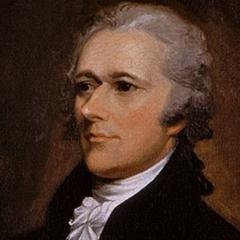
“[Imeachable conduct is] misconduct by public men, or, in other words, from the abuse or violation of some public trust.”
“The prosecution [of impeachments], will seldom fail to agitate the passions of the whole community, and to divide it into parties more or less friendly or inimical to the accused. The subjects of its jurisdiction are those offenses which proceed from the misconduct of public men, or, in other words, from the abuse or violation of some public trust, and they relate chiefly to injuries done immediately to the society itself.”
“I should esteem it the extreme of imprudence to prolong the precarious state of our national affairs, and to expose the Union to the jeopardy of successive experiments, in the chimerical pursuit of a perfect plan. I never expect to see a perfect work from imperfect man. The result of the deliberations of all collective bodies must necessarily be a compound, as well of the errors and prejudices, as of the good sense and wisdom, of the individuals of whom they are composed.”
Source: The federalist papers
“Men often oppose a thing merely because they have had no agency in planning it, or because it may have been planned by those whom they dislike.”
Source: The Federalist on the New Constitution
“Why has government been instituted at all? Because the passions of man will not conform to the dictates of reason and justice without constraint.”
“I never expect to see a perfect work from an imperfect man.”
Source: The Federalist on the New Constitution, Written in the Year 1788, with an Appendix Containing the Letters of Pacificus and Helvidius on the Proclamation of Neutrality of 1793
“In the main it will be found that a power over a man's support [salary] is a power over his will.”
“When the sword is once drawn, the passions of men observe no bounds of moderation.”
Source: The Essential Federalist: A New Reading of the Federalist Papers
“In the general course of human nature, A power over a man's subsistence amounts to a power over his will.”
Source: The Federalist
“Man is a reasoning rather than a reasonable animal.”
“Civil liberty is only natural liberty, modified and secured by the sanctions of civil society. It is not a thing, in its own nature, precarious and dependent on human will and caprice; but it is conformable to the constitution of man, as well as necessary to the well-being of society.”
Source: The Works of Alexander Hamilton: Miscellanies, 1774-1789: A full vindication; The farmer refuted; Quebec bill; Resolutions in Congress; Letters from Phocion; New-York Legislature, etc
“Has it been found that bodies of men act with more rectitude or greater disinterestedness than individuals? The contrary of this has been inferred by all accurate observers of the conduct of mankind; and the inference is founded upon obvious reasons. Regard to reputation has a less active influence, when the infamy of a bad action is to be divided among a number than when it is to fall singly upon one.”
Source: The Essential Federalist: A New Reading of the Federalist Papers
“The origin of all civil government, justly established, must be a voluntary compact, between the rulers and the ruled; and must be liable to such limitations, as are necessary for the security of the absolute rights of the latter; for what original title can any man or set of men have, to govern others, except their own consent?”
Source: The Works of Alexander Hamilton: Miscellanies, 1774-1789: A full vindication; The farmer refuted; Quebec bill; Resolutions in Congress; Letters from Phocion; New-York Legislature, etc
“It has been frequently remarked, that it seems to have been reserved to the people of this country to decide, by their conduct and example, the important question, whether societies of men are really capable or not, of establishing good government from reflection and choice, or whether they are forever destined to depend, for their political constitutions, on accident and force.”
Source: The Works of Alexander Hamilton: Comprising His Most Important Official Reports: An Improved Edition of the Federalist, on the New Constitution, Written in 1788; and Pacificus, on the Proclamation of Neutrality, Written in 1793 ...
“The republican principle demands that the deliberate sense of the community should govern the conduct of those to whom they intrust the management of their affairs; but it does not require an unqualified complaisance to every sudden breeze of passion or to every transient impulse which the people may receive from the arts of men, who flatter their prejudices to betray their interests.”
Source: The Federalist Papers and the Constitution of the United States: The Principles of the American Government
“There are seasons in every country when noise and impudence pass current for worth; and in popular commotions especially, the clamors of interested and factious men are often mistaken for patriotism.”
Source: The Works of Alexander Hamilton: Miscellanies, 1774-1789: A full vindication; The farmer refuted; Quebec bill; Resolutions in Congress; Letters from Phocion; New-York Legislature, etc
“Men give me credit for some genius. All the genius I have lies in this; when I have a subject in hand, I study it profoundly. Day and night it is before me. My mind becomes pervaded with it. Then the effort that I have made is what people are pleased to call the fruit of genius. It is the fruit of labor and thought.”
“It will be of little avail to the people, that the laws are made by men of their own choice, if the laws be so voluminous that they cannot be read, or so incoherent that they cannot be understood; if they be repealed or revised before they are promulgated, or undergo such incessant changes that no man, who knows what the law is to-day, can guess what it will be tomorrow.”
Source: The Essential Federalist: A New Reading of the Federalist Papers
“A fondness for power is implanted in most men, and it is natural to abuse it when acquired.”
Source: The Works of Alexander Hamilton: Miscellanies, 1774-1789: A full vindication; The farmer refuted; Quebec bill; Resolutions in Congress; Letters from Phocion; New-York Legislature, etc
“It is a general principle of human nature, that a man will be interested in whatever he possesses, in proportion to the firmness or precariousness of the tenure by which he holds it.”
Source: The Federalist, on the new constitution, written in 1788, with an appendix, containing the letters of Pacificus and Helvidius on the proclamation of neutrality of 1793, also the original articles of confederation and the constitution of the United States
“Men are rather reasoning than reasonable animals for the most part governed by the impulse of passion.”
Source: The Works of Alexander Hamilton: Correspondence [contin.] 1795-1804; 1777; 1791. Letters of H.G. 1789. Address to public creditors. 1790. Vindication of funding system. 1791
“The passions of a revolution are apt to hurry even good men into excesses.”
Source: Papers
“A fondness for power is implanted in most men, and it is natural to abuse it when acquired. This maxim, drawn from the experience of all ages, makes it the height of folly to intrust any set of men with power which is not under every possible control; perpetual strides are made after more as long as there is any part withheld.”
Source: The Works of Alexander Hamilton: Miscellanies, 1774-1789: A full vindication; The farmer refuted; Quebec bill; Resolutions in Congress; Letters from Phocion; New-York Legislature, etc
“It is a general principle of human nature, that a man will be interested in whatever he possesses, in proportion to the firmness or precariousness of the tenure by which he holds it; will be less attached to what he holds by a momentary or uncertain title, than to what he enjoys by a durable or certain title; and, of course, will be willing to risk more for the sake of the one, than for the sake of the other.”
Source: The Federalist: On the New Constitution
“Men are rather reasoning than reasonable animals for the most part governed by the impulse of passion. This is a truth well understood by our adversaries who have practised upon it with no small benefit to their cause. For at the very moment they are eulogizing the reason of men & professing to appeal only to that faculty, they are courting the strongest & most active passion of the human heart - VANITY!”
Source: The Works of Alexander Hamilton: Correspondence [contin.] 1795-1804; 1777; 1791. Letters of H.G. 1789. Address to public creditors. 1790. Vindication of funding system. 1791
“In all general questions which become the subjects of discussion, there are always some truths mixed with falsehoods. I confess, there is danger where men are capable of holding two offices. Take mankind in general, they are vicious, their passions may be operated upon. We have been taught to reprobate the danger of influence in the British government, without duly reflecting how far it was necessary to support a good government. We have taken up many ideas upon trust, and at last, pleased with our own opinions, establish them as undoubted truths.”
“No man in his senses can hesitate in choosing to be free, rather than a slave.”
Source: The Works of Alexander Hamilton: Miscellanies, 1774-1789: A full vindication; The farmer refuted; Quebec bill; Resolutions in Congress; Letters from Phocion; New-York Legislature, etc
“Hence, in a state of nature, no man had any moral power to deprive another of his life, limbs, property, or liberty; nor the least authority to command or exact obedience from him, except that which arose from the ties of consanguinity.”
Source: The Official and Other Papers ...
“The only distinction between freedom and slavery consists in this: In the former state a man is governed by the laws to which he has given his consent, either in person or by his representative; in the latter, he is governed by the will of another. In the one case, his life and property are his own; in the other, they depend upon the pleasure of his master. It is easy to discern which of these two states is preferable.”
Source: The Official and Other Papers ...
“That Americans are entitled to freedom is incontestable on every rational principle. All men have one common original: they participate in one common nature, and consequently have one common right. No reason can be assigned why one man should exercise any power or preeminence over his fellow-creatures more than another; unless they have voluntarily vested him with it.”
Source: The works of Alexander Hamilton: comprising his correspondence, and his political and official writings, exclusive of the Federalist, civil and military. Published from the original manuscripts deposited in the Department of State, by order of the Joint Library Committee of Congress
“I have carefully examined the evidences of the Christian religion, and if I was sitting as a juror upon its authenticity I would unhesitatingly give my verdict in its favor. I can prove its truth as clearly as any proposition ever submitted to the mind of man.”
“The laws of certain states . . . give an ownership in the service of Negroes as personal property . . . . But being men, by the laws of God and nature, they were capable of acquiring liberty - and when the captor in war . . . thought fit to give them liberty, the gift was not only valid, but irrevocable.”
“Experience teaches, that men are often so much governed by what they are accustomed to see and practice, that the simplest and most obvious improvements . . . are adopted with hesitation, reluctance, and slow gradations.”
Source: Citizen Hamilton: The Wit and Wisdom of an American Founder
“To presume a want of motives for such contests . . . would be to forget that men are ambitious, vindictive, and rapacious.”
Source: The federalist papers
“It is astonishing that so simple a truth should ever have had an adversary; and it is one among a multitude of proofs, how apt a spirit of ill-informed jealousy, or of too great abstraction and refinement is to lead men astray from the plainest paths of reason and conviction.”
Source: The Federalist on the New Constitution, Written in the Year 1788, with an Appendix Containing the Letters of Pacificus and Helvidius on the Proclamation of Neutrality of 1793
“It is a singular capriciousness of the human mind, that after all the admonitions we have had from experience on this head, there should still be found men, who object to the new constitution for deviating from a principle which has been found the bane of the old.”
Source: The Fœderalist: A Collection of Essays, Written in Favor of the New Constitution, as Agreed Upon by the Fœderal Convention, September 17, 1787. Reprinted from the Original Text. With an Historical Introduction and Notes
“Nothing is more natural to men in office, than to look with peculiar deference towards that authority to which they owe their official existence.”
Source: The Federalist Papers: A Collection of Essays Written in Favour of the New Constitution
“Man is very much a creature of habit. A thing that rarely strikes his senses will generally have but little influence upon his mind. A government continually at a distance and out of sight, can hardly be expected to interest the sensations of the people. The inference is, that the authority of the Union, and the affections of the citizens towards it, will be strengthened rather than weakened by its extension to what are called matters of internal concern.”
Source: America's Founding Documents: The Declaration of Independence, the Articles of Confederation, the United States Constitution, the Federalist Papers, and the Bill of Rights
“With regard to the learned professions, little need be observed; they truly form no distinct interest in society . . . [discussing the landed, merchant, and learned classes in legislative assembly]. Will not the man of the learned profession, who will feel a neutrality to the rivalships between the different branches of industry, be likely to prove an impartial arbiter between them, ready to promote either, so far as it shall appear to him conducive to the general interests of society?”
“When men, engaged in unjustifiable pursuits, are aware that obstructions may come from a quarter which bare apprehension of opposition from doing what they would with eagerness rush into if no such external impediments were to be feared.”
Source: The Federalist on the New Constitution
“There is a contagion in example which few men have sufficient force of mind to resist.”
Source: The Essential Federalist: A New Reading of the Federalist Papers
“Can any reasonable man be well disposed toward a government which makes war and carnage the only means of supporting itself?”
Source: Selected writings and speeches of Alexander Hamilton
“While the constitution continues to be read, and its principles known, the states, must, by every rational man, be considered as essential component parts of the union; and therefore the idea of sacrificing the former to the latter is totally inadmissible.”
Source: The Works of Alexander Hamilton: Miscellanies, 1774-1789: A full vindication; The farmer refuted; Quebec bill; Resolutions in Congress; Letters from Phocion; New-York Legislature, etc
“There are still to be found visionary or designing men, who stand ready to advocate the paradox of perpetual peace between the states, though dismembered and alienated from each other.... The genius of republics, say they, is pacific; the spirit of commerce has a tendency to soften the manners of men, and to extinguish those inflammable humours which have so often kindled into wars. Commercial republics, like ours, will never be disposed to waste themselves in ruinous contentions with each other. They will be governed by mutual interest, and will cultivate a spirit of mutual amity and concord.”
“By multiplying the means of gratification, by promoting the introduction and circulation of the precious metals, those darling objects of human avarice and enterprise, it serves to vivify and invigorate the channels of industry, and to make them flow with greater activity and copiousness. The assiduous merchant, the laborious husbandman, the active mechanic, and the industrious manufacturer,-all orders of men, look forward with eager expectation and growing alacrity to this pleasing reward of their toils.”
Source: The Federalist Papers: A Collection of Essays Written in Favour of the New Constitution
“To cherish and stimulate the activity of the human mind, by multiplying the objects of enterprise, is not among the least considerable of the expedients, by which the wealth of a nation may be promoted. Even things in themselves not positively advantageous, sometimes become so, by their tendency to provoke exertion. Every new scene, which is opened to the busy nature of man to rouse and exert itself, is the addition of a new energy to the general stock of effort.”
Source: Report of the Secretary of the Treasury of the United States, on the Subject of Manufactures: Presented to the House of Representatives, December 5, 1791
“Manufacturing establishments not only occasion a positive augmentation of the produce and revenue of the society . . . they contribute essentially to rendering them greater than they could possibly be, without such establishments. These circumstances are . . . greater scope for the diversity of talents and dispositions which discriminate men from each other.”
Source: Report of the Secretary of the Treasury of the United States, on the Subject of Manufactures: Presented to the House of Representatives, December 5, 1791
“The truth is that the general genius of a government is all that can be substantially relied upon for permanent effects. Particular provisions, though not altogether useless, have far less virtue and efficacy than are commonly ascribed to them; and the want of them will never be with men of sound discernment a decisive objection to any plan which exhibits the leading characters of a good government.”
Source: The Works of Alexander Hamilton: Comprising His Most Important Official Reports: An Improved Edition of the Federalist, on the New Constitution, Written in 1788; and Pacificus, on the Proclamation of Neutrality, Written in 1793 ...
“Would they not fear that citizens not less tenacious than conscious of their rights would flock from the remotest extremes of their respective states to the places of election, to overthrow their tyrants, and to substitute men who would be disposed to avenge the violated majesty of the people?”
Source: The Federalist: With Letters of Brutus
“I will venture to assert that no combination of designing men under heaven will be capable of making a government unpopular which is in its principles a wise and good one, and vigorous in its operations.”
Source: The Works of Alexander Hamilton: Miscellanies, 1774-1789: A full vindication; The farmer refuted; Quebec bill; Resolutions in Congress; Letters from Phocion; New-York Legislature, etc