Quotessence
Home / Authors / Alexander Hamilton
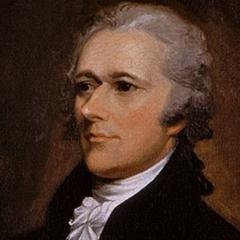
Alexander Hamilton

Alexander Hamilton Quotes

Founding Father of the United States

Filter quotes by topic

Famous Alexander Hamilton Quotes

“The desire of reward is one of the strongest incentives of human conduct; ... the best security for the fidelity of mankind is to make their interest coincide with their duty.”

“The republican principle demands that the deliberate sense of the community should govern the conduct of those to whom they intrust the management of their affairs; but it does not require an unqualified complaisance to every sudden breeze of passion or to every transient impulse which the people may receive from the arts of men, who flatter their prejudices to betray their interests.”

“In a free government, the security for civil rights must be the same as that for religious rights. It consists in the one case in the multiplicity of interests, and in the other in the multiplicity of sects.”

“Some reasonable term ought to be allowed to enable aliens to get rid of foreign and acquire American attachments; to learn the principles and imbibe the spirit of our government; and to admit of a probability at least, of their feeling a real interest in our affairs.”

“The history of human conduct does not warrant that exalted opinion of human virtue which would make it wise in a nation to commit interests of so delicate and momentous a kind as those which concern its intercourse with the rest of the world, to the sole disposal of a magistrate, created and circumstanced, as would be a president of the United States.”

“This position will not be disputed so long as it is admitted that the desire of reward is one of the strongest incentives of human conduct, or that the best security for the fidelity of mankind is to make their interest coincide with their duty. Even the love of fame, the ruling passion of the noblest minds... would on the contrary deter him from the undertaking, when he foresaw that he must quit the scene before he could accomplish the work.”

“The experience of treaties being broken with impunity provide an afflicting lesson to mankind how little dependence is to be placed on treaties which have no other sanction than the obligations of good faith; and which oppose general considerations of peace and justice to the impulse of any immediate interest and passion.”

“Man is very much a creature of habit. A thing that rarely strikes his senses will generally have but little influence upon his mind. A government continually at a distance and out of sight, can hardly be expected to interest the sensations of the people. The inference is, that the authority of the Union, and the affections of the citizens towards it, will be strengthened rather than weakened by its extension to what are called matters of internal concern.”

“Common interest may always be reckoned upon as the surest bond of sympathy.”

“With regard to the learned professions, little need be observed; they truly form no distinct interest in society . . . [discussing the landed, merchant, and learned classes in legislative assembly]. Will not the man of the learned profession, who will feel a neutrality to the rivalships between the different branches of industry, be likely to prove an impartial arbiter between them, ready to promote either, so far as it shall appear to him conducive to the general interests of society?”

“When you assemble from your several counties in the Legislature, were every member to be guided only by the apparent interest of his county, government would be impracticable. There must be a perpetual accomodation and sacrifice of local advantage to general expediency.”

“The local interest of a State ought in every case to give way to the interests of the Union. For when a sacrifice of one or the other is necessary, the former becomes only an apparent, partial interest, and should yield, on the principle that the smaller good ought never to oppose the greater good.”

“To attach full confidence to an institution of this nature, it appears to be an essential ingredient in its structure, that it shall be under private and not a public direction-under the guidance of individual interest, not of public policy; which, would be . . . liable to being too much influenced by public necessity.”

“The variety of more minute interests, which will necessarily fall under the superintendence of the local administrations . . . cannot be particularized without involving a detail too tedious and uninteresting to compensate for the instruction it might afford.”

“It is of the greatest consequence that the debt should, with the consent of the creditors, be remoulded into such a shape as will bring the expenditure of the nation to a level with its income. Till this shall be accomplished, the finances of the United States will never wear a proper countenance. Arrears of interest, continually accruing, will be as continual a monument, either of inability, or of ill faith and will not cease to have an evil influence on public credit.”

“The tendency of a national bank is to increase public and private credit. The former gives power to the state, for the protection of its rights and interests: and the latter facilitates and extends the operations of commerce among individuals. Industry is increased, commodities are multiplied, agriculture and manufacturers flourish: and herein consists the true wealth and prosperity of a state.”

“There are still to be found visionary or designing men, who stand ready to advocate the paradox of perpetual peace between the states, though dismembered and alienated from each other.... The genius of republics, say they, is pacific; the spirit of commerce has a tendency to soften the manners of men, and to extinguish those inflammable humours which have so often kindled into wars. Commercial republics, like ours, will never be disposed to waste themselves in ruinous contentions with each other. They will be governed by mutual interest, and will cultivate a spirit of mutual amity and concord.”

“By a steady adherence to the Union we may hope, erelong, to become the arbiter of Europe in America, and to be able to incline the balance of European competitions in this part of the world as our interest may dictate.”

“There was a time when we were told . . . that a sense of common interest would preside over the conduct of the respective members...This language at the present day would appear as wild as that great part of what we now hear from the same quarter will be thought, when we shall have received further lessons from that best oracle of wisdom, experience.”

“Upon this law, depend the natural rights of mankind, the supreme being gave existence to man, together with the means of preserving and beatifying that existence. He endowed him with rational faculties, by the help of which, to discern and pursue such things, as were consistent with his duty and interest, and invested him with an inviolable right to personal liberty, and personal safety.”

“When occasions present themselves, in which the interests of the people are at variance with their inclinations, it is the duty of the persons whom they have appointed to be the guardians of those interests, to withstand the temporary delusion, in order to give them time and opportunity for more cool and sedate reflection.”