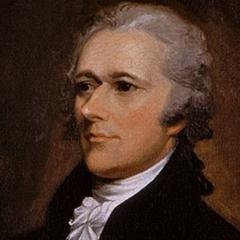
“There is a certain enthusiasm in liberty, that makes human nature rise above itself, in acts of bravery and heroism.”
Source: Citizen Hamilton: The Wit and Wisdom of an American Founder
“The sacred rights of mankind are not to be rummaged for among old parchments or musty records. They are written, as with a sunbeam, in the whole volume of human nature, by the hand of the divinity itself; and can never be erased.”
“In the general course of human nature, A power over a man's subsistence amounts to a power over his will.”
Source: The Federalist
“A struggle for liberty is in itself respectable and glorious. . . . When conducted with magnanimity, justice and humanity, it ought to command the admiration of every friend to human nature. But if sullied by crimes and extravagancies, it loses its respectability.”
Source: Citizen Hamilton: The Wit and Wisdom of an American Founder
“A fondness for power is implanted in most men, and it is natural to abuse it when acquired.”
Source: The Works of Alexander Hamilton: Miscellanies, 1774-1789: A full vindication; The farmer refuted; Quebec bill; Resolutions in Congress; Letters from Phocion; New-York Legislature, etc
“Great Ambition, unchecked by principle, or the love of Glory, is an unruly Tyrant.”
Source: The Works of Alexander Hamilton: Correspondence [contin.] 1795-1804; 1777; 1791. Letters of H. G. 1789. Address to public creditors. 1790. Vindication of funding system. 1791
“There may be in every government a few choice spirits, who may act from more worthy motives. One great error is that we suppose mankind more honest than they are. Our prevailing passions are ambition and interest.”
Source: The Works of Alexander Hamilton
“Ambition without principle never was long under the guidance of good sense.”
Source: The Works of Alexander Hamilton: Correspondence [contin.] 1795-1804; 1777; 1791. Letters of H. G. 1789. Address to public creditors. 1790. Vindication of funding system. 1791
“It is a general principle of human nature, that a man will be interested in whatever he possesses, in proportion to the firmness or precariousness of the tenure by which he holds it.”
Source: The Federalist, on the new constitution, written in 1788, with an appendix, containing the letters of Pacificus and Helvidius on the proclamation of neutrality of 1793, also the original articles of confederation and the constitution of the United States
“Men are rather reasoning than reasonable animals for the most part governed by the impulse of passion.”
Source: The Works of Alexander Hamilton: Correspondence [contin.] 1795-1804; 1777; 1791. Letters of H.G. 1789. Address to public creditors. 1790. Vindication of funding system. 1791
“Take mankind as they are, and what are they governed by? Their passions.”
Source: Jan. 1787-May 1788.-v. 5.June 1778-Nov. 1789.-v. 6. Dec. 1789-Aug. 1790
“The passions of a revolution are apt to hurry even good men into excesses.”
Source: Papers
“Has it not. . . invariably been found that momentary passions, and immediate interests, have a more active and imperious control over human conduct than general or remote considerations of policy, utility and justice?”
Source: The Federalist, on the New Constitution, Written in the Year 1788
“The same state of the passions which fits the multitude, who have not a sufficient stock of reason and knowledge to guide them, for opposition to tyranny and oppression, very naturally leads them to a contempt and disregard of all authority.”
Source: Citizen Hamilton: The Wit and Wisdom of an American Founder
“Take mankind in general, they are vicious-their passions may be operated upon.”
Source: Jan.1787-May 1788
“A fondness for power is implanted in most men, and it is natural to abuse it when acquired. This maxim, drawn from the experience of all ages, makes it the height of folly to intrust any set of men with power which is not under every possible control; perpetual strides are made after more as long as there is any part withheld.”
Source: The Works of Alexander Hamilton: Miscellanies, 1774-1789: A full vindication; The farmer refuted; Quebec bill; Resolutions in Congress; Letters from Phocion; New-York Legislature, etc
“It is a general principle of human nature, that a man will be interested in whatever he possesses, in proportion to the firmness or precariousness of the tenure by which he holds it; will be less attached to what he holds by a momentary or uncertain title, than to what he enjoys by a durable or certain title; and, of course, will be willing to risk more for the sake of the one, than for the sake of the other.”
Source: The Federalist: On the New Constitution
“Men are rather reasoning than reasonable animals for the most part governed by the impulse of passion. This is a truth well understood by our adversaries who have practised upon it with no small benefit to their cause. For at the very moment they are eulogizing the reason of men & professing to appeal only to that faculty, they are courting the strongest & most active passion of the human heart - VANITY!”
Source: The Works of Alexander Hamilton: Correspondence [contin.] 1795-1804; 1777; 1791. Letters of H.G. 1789. Address to public creditors. 1790. Vindication of funding system. 1791
“In all general questions which become the subjects of discussion, there are always some truths mixed with falsehoods. I confess, there is danger where men are capable of holding two offices. Take mankind in general, they are vicious, their passions may be operated upon. We have been taught to reprobate the danger of influence in the British government, without duly reflecting how far it was necessary to support a good government. We have taken up many ideas upon trust, and at last, pleased with our own opinions, establish them as undoubted truths.”
“To model our political system upon speculations of lasting tranquility, is to calculate on the weaker springs of the human character.”
“As riches increase and accumulate in few hands, as luxury prevails in society, virtue will be in a greater degree considered as only a graceful appendage of wealth, and the tendency of things will be to depart from the republican standard. This is the real disposition of human nature; it is what neither the honorable member nor myself can correct. It is a common misfortunate that awaits our State constitution, as well as all others.”
Source: The Works of Alexander Hamilton: Miscellanies, 1774-1789: A full vindication; The farmer refuted; Quebec bill; Resolutions in Congress; Letters from Phocion; New-York Legislature, etc
“That experience is the parent of wisdom is an adage the truth of which is recognized by the wisest as well as the simplest of mankind.”
Source: The Essential Federalist: A New Reading of the Federalist Papers
“The history of human conduct does not warrant that exalted opinion of human virtue which would make it wise in a nation to commit interests of so delicate and momentous a kind as those which concern its intercourse with the rest of the world, to the sole disposal of a magistrate, created and circumstanced, as would be a president of the United States.”
Source: The Federalist on the New Constitution
“To look for a continuation in harmony between a number of independent unconnected sovereignties, situated in the same neighborhood, would be to disregard the uniform course of human events, and to set at defiance the accumulated experience of ages.”
Source: The Federalist, on the New Constitution, Written in the Year 1788
“This position will not be disputed so long as it is admitted that the desire of reward is one of the strongest incentives of human conduct, or that the best security for the fidelity of mankind is to make their interest coincide with their duty. Even the love of fame, the ruling passion of the noblest minds... would on the contrary deter him from the undertaking, when he foresaw that he must quit the scene before he could accomplish the work.”
“To presume a want of motives for such contests . . . would be to forget that men are ambitious, vindictive, and rapacious.”
Source: The federalist papers
“These are not vague inferences . . . but they are solid conclusions drawn from the natural and necessary progress of human affairs.”
Source: The federalist papers
“The inhabitants of territories, often the theatre of war, are unavoidably subject to frequent infringements on their rights, which serve to weaken their sense of those rights; and by degrees, the people are brought to consider the soldiery not only as their protectors but as their superiors.”
Source: The Federalist, on the New Constitution ... by A. Hamilton, James Madison, and John Jay. With an Appendix Containing the Letters of Pacificus (A. Hamilton) and Helvidius (J. Madison), on the Proclamation of Neutrality of 1793; the Original Articles of Confederation ... Sixth Edition, Etc
“It is astonishing that so simple a truth should ever have had an adversary; and it is one among a multitude of proofs, how apt a spirit of ill-informed jealousy, or of too great abstraction and refinement is to lead men astray from the plainest paths of reason and conviction.”
Source: The Federalist on the New Constitution, Written in the Year 1788, with an Appendix Containing the Letters of Pacificus and Helvidius on the Proclamation of Neutrality of 1793
“It is a singular capriciousness of the human mind, that after all the admonitions we have had from experience on this head, there should still be found men, who object to the new constitution for deviating from a principle which has been found the bane of the old.”
Source: The Fœderalist: A Collection of Essays, Written in Favor of the New Constitution, as Agreed Upon by the Fœderal Convention, September 17, 1787. Reprinted from the Original Text. With an Historical Introduction and Notes
“The experience of treaties being broken with impunity provide an afflicting lesson to mankind how little dependence is to be placed on treaties which have no other sanction than the obligations of good faith; and which oppose general considerations of peace and justice to the impulse of any immediate interest and passion.”
“The constitution of human nature" teaches us not to expect "that the persons, entrusted with the administration of the affairs of the particular members of a confederacy, will at all times be ready, with perfect good humor, and an unbiased regard to the public weal, to execute the resolutions of decrees of the general authority." "This tendency is not difficult to be accounted for," Publius argues, "It has its origin in the love of power.”
“Nothing is more natural to men in office, than to look with peculiar deference towards that authority to which they owe their official existence.”
Source: The Federalist Papers: A Collection of Essays Written in Favour of the New Constitution
“Man is very much a creature of habit. A thing that rarely strikes his senses will generally have but little influence upon his mind. A government continually at a distance and out of sight, can hardly be expected to interest the sensations of the people. The inference is, that the authority of the Union, and the affections of the citizens towards it, will be strengthened rather than weakened by its extension to what are called matters of internal concern.”
Source: America's Founding Documents: The Declaration of Independence, the Articles of Confederation, the United States Constitution, the Federalist Papers, and the Bill of Rights
“The obscurity is much oftener in the passions and prejudices of the reasoner than in the subject.”
“Common interest may always be reckoned upon as the surest bond of sympathy.”
Source: The Federalist on the New Constitution, Written in the Year 1788, with an Appendix Containing the Letters of Pacificus and Helvidius on the Proclamation of Neutrality of 1793
“Necessity, especially in politics, often occasions false hopes, false reasonings, and a system of measures, correspondingly erroneous.”
Source: The federalist papers
“With regard to the learned professions, little need be observed; they truly form no distinct interest in society . . . [discussing the landed, merchant, and learned classes in legislative assembly]. Will not the man of the learned profession, who will feel a neutrality to the rivalships between the different branches of industry, be likely to prove an impartial arbiter between them, ready to promote either, so far as it shall appear to him conducive to the general interests of society?”
“Happy will it be for ourselves, and most honorable for human nature, if we have wisdom and virtue enough to set so glorious an example to mankind!”
Source: The Essential Federalist: A New Reading of the Federalist Papers
“Would there not be the greatest reason to apprehend, that error in the first sentence would be the parent of error in the second sentence? That the strong bias of one decision would be apt to overrule the influence of any new lights, which might be brought to vary the complexion of another decision? Those, who know any thing of human nature, will not hesitate to answer these questions in the affirmative.”
Source: The Origin of the Nation: Declaration of Independence, Constitution, Bill of Rights and Other Amendments, Federalist Papers & Common Sense: Creating America - Landmark Documents that Shaped a New Nation
“When men, engaged in unjustifiable pursuits, are aware that obstructions may come from a quarter which bare apprehension of opposition from doing what they would with eagerness rush into if no such external impediments were to be feared.”
Source: The Federalist on the New Constitution
“The propriety of a law, in a constitutional light, must always be determined by the nature of the powers upon which it is founded.”
Source: The Federalist, on the New Constitution, Written in the Year 1788
“A LAW, by the very meaning of the term, includes supremacy. It is a rule which those to whom it is prescribed are bound to observe. This results from every political association.”
Source: The Essential Federalist: A New Reading of the Federalist Papers
“There is a contagion in example which few men have sufficient force of mind to resist.”
Source: The Essential Federalist: A New Reading of the Federalist Papers
“Those who have a tolerable knowledge of human nature will not stand in need of such lights.”
Source: The Federalist, on the New Constitution, Written in the Year 1788