Quotessence
Home / Authors / Alexander Hamilton
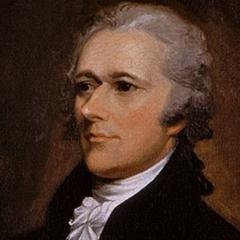
Alexander Hamilton

Alexander Hamilton Quotes

Founding Father of the United States

Filter quotes by topic

Famous Alexander Hamilton Quotes

“The experience of past ages may inform us, that when the circumstances of a people render them distressed, their rulers generally recur to severe, cruel, and oppressive measures. Instead of endeavoring to establish their authority in the affection of their subjects, they think they have no security but in their fear.”

“The states have authority to interpret the Constitution, enforce it, and protect the people from violations of it by the federal government In the first place, there is not a syllable in the plan under consideration which directly empowers the national courts to construe the laws according to the spirit of the Constitution, or which gives them any greater latitude in this respect than may be claimed by the courts of every State.”

“The changes in the human condition are uncertain and frequent. Many, on whom fortune has bestowed her favours, may trace their family to a more unprosperous station; and many who are now in obscurity, may look back upon the affluence and exalted rank of their ancestors.”

“But though a funded debt is not in the first instance, an absolute increase of Capital, or an augmentation of real wealth; yet by serving as a New power in the operation of industry, it has within certain bounds a tendency to increase the real wealth of a Community, in like manner as money borrowed by a thrifty farmer, to be laid out in the improvement of his farm may, in the end, add to his Stock of real riches.”

“The republican principle demands that the deliberate sense of the community should govern the conduct of those to whom they intrust the management of their affairs; but it does not require an unqualified complaisance to every sudden breeze of passion or to every transient impulse which the people may receive from the arts of men, who flatter their prejudices to betray their interests.”

“In all general questions which become the subjects of discussion, there are always some truths mixed with falsehoods. I confess, there is danger where men are capable of holding two offices. Take mankind in general, they are vicious, their passions may be operated upon. We have been taught to reprobate the danger of influence in the British government, without duly reflecting how far it was necessary to support a good government. We have taken up many ideas upon trust, and at last, pleased with our own opinions, establish them as undoubted truths.”

“It equally proves, that though individual oppression may now and then proceed from the courts of justice, the general liberty of the people can never be endangered from that quarter; I mean so long as the judiciary remains truly distinct from both the legislature and the Executive. For I agree, that "there is no liberty, if the power of judging be not separated from the legislative and executive powers." And it proves, in the last place, that as liberty can have nothing to fear from the judiciary alone, but would have every thing to fear from its union with either of the other departments.”

“Give me the steady, uniform, unshaken security of constitutional freedom. Give me the right to be tried by a jury of my own neighbors, and to be taxed by my own representatives only. What will become of the law and courts of justice without this? The shadow may remain, but the substance will be gone. I would die to preserve the law upon a solid foundation; but take away liberty, and the foundation is destroyed.”

“Common interest may always be reckoned upon as the surest bond of sympathy.”

“What plan for the regulation of the militia may be pursued by the national government is impossible to be foreseen...The project of disciplining all the militia of the United States is as futile as it would be injurious if it were capable of being carried into execution... Little more can reasonably be aimed at with the respect to the people at large than to have them properly armed and equipped ; and in order to see that this be not neglected, it will be necessary to assemble them once or twice in the course of a year.”

“It may be laid down as a general rule, that their confidence in and obedience to a government, will be commonly proportioned to the goodness or badness of its administration . . . . Various reasons have been suggested in the course of these papers, to induce a probability that the general government will be better administered than the particular governments.”

“There is at this present juncture, a certain fermentation of mind, a certain activity of speculation and enterprise which if properly directed may be made subservient to useful purposes; but which if left entirely to itself, may be attended with pernicious effects.”

“To cherish and stimulate the activity of the human mind, by multiplying the objects of enterprise, is not among the least considerable of the expedients, by which the wealth of a nation may be promoted. Even things in themselves not positively advantageous, sometimes become so, by their tendency to provoke exertion. Every new scene, which is opened to the busy nature of man to rouse and exert itself, is the addition of a new energy to the general stock of effort.”

“If the federal government should overpass the just bounds of its authority and make a tyrannical use of its powers, the people, whose creature it is, must appeal to the standard they have formed, and take such measures to redress the injury done to the Constitution as the exigency may suggest and prudence justify.”

“By a steady adherence to the Union we may hope, erelong, to become the arbiter of Europe in America, and to be able to incline the balance of European competitions in this part of the world as our interest may dictate.”

“[H]owever weak our country may be, I hope we shall never sacrifice our liberties.”

“If it be said that the legislative body are themselves the constitutional judges of their own powers, and that the construction they put upon them is conclusive upon the other departments, it may be answered, that this cannot be the natural presumption, where it is not be collected from any particular provisions in the Constitution.”

“It may be said that the power of preventing bad laws includes that of preventing good ones; and may be used to the one purpose as well as to the other. But this objection will have little weight with those who can properly estimate the mischiefs of that inconstancy and mutability in the laws, which form the greatest blemish in the character and genius of our governments.”

“Hitherto my observations have only aimed at a vindication of the provision in question, on the ground of theoretic propriety . . . . But there remains to be mentioned a positive advantage . . . I allude to the circumstance of uniformity in the time of elections for the House of Representatives. It is more than possible, that this uniformity may be found by experience to be of great importance to the public welfare; both as a security against the perpetuation of the same spirit in the body; and as a cure for the diseases of faction.”

“The regular distribution of power into distinct departments; the introduction of legislative balances and checks; the institution of courts composed of judges holding their offices during good behavior; the representation of the people in the legislature by deputies of their own election . . . They are means, and powerful means, by which the excellences of republican government may be retained and its imperfections lessened or avoided.”

“It is one thing to be subordinate to the laws, and another [for the Executive] to be dependent on the legislative body. The first comports with, the last violates, the fundamental principles of good government; and, whatever may be the forms of the Constitution, unites all power in the same hands.”

“The injury which may possibly be done by defeating a few good laws, will be amply compensated by the advantage of preventing a number of bad ones.”

“To cherish and stimulate the activity of the human mind, by multiplying the objects of enterprise, is not among the least considerable of the expedients, by which the wealth of a nation may be promoted.”

“[E]very act of a delegated authority, contrary to the tenor of the commission under which it is exercised, is void. No legislative act, therefore, contrary to the Constitution, can be valid. To deny this, would be to affirm, that the deputy is greater than his principal; that the servant is above his master; that the representatives of the people are superior to the people themselves; that men acting by virtue of powers, may do not only what their powers do not authorize, but what they forbid.”

“As you sometimes swear by him that made you, I conclude your sentiments do not correspond with his, in that which is the basis of the doctrine you both agree in: and this makes it impossible to imagine whence this congruity between you arises. "To grant that there is a supreme intelligence who rules the world and has established laws to regulate the actions of his creatures; and still to assert that man, in a state of nature, may be considered as perfectly free from all restraints of law and government, appears to a common understanding altogether irreconcilable.”

“It may safely be received as an axiom in our political system, that the state governments will in all possible contingencies afford complete security against invasions of the public liberty by the national authority.”