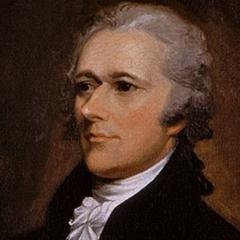
“A treaty cannot be made which alters the Constitution of the country, or which infringes and express exceptions to the power of the Constitution.”
Source: The Works of Alexander Hamilton: Cabinet papers [contin.] 1794-1795. [Miscellanies, 1794-1795] Military papers. 1798-1800. Correspondence [contin.] 1789-1795
“If we set out with... a scrupulous regard to the Constitution, the government will acquire a spirit and a tone productive of permanent blessings to the community. If on the contrary,... the Constitution is slighted, or explained away, upon every frivolous pretext, the future of government will be feeble, distracted and arbitrary. The rights of the subjects will be the sport of every party vicissitude. There will be no settled rule of conduct, but everything will fluctuate with the alternate prevalency of contending factions.”
“The powers contained in a constitution...ought to be construed liberally in advancement of the public good.”
“Constitutions should consist only of general provisions; the reason is that they must necessarily be permanent, and that they cannot calculate for the possible change of things.”
Source: Citizen Hamilton: The Wit and Wisdom of an American Founder
“The states have authority to interpret the Constitution, enforce it, and protect the people from violations of it by the federal government In the first place, there is not a syllable in the plan under consideration which directly empowers the national courts to construe the laws according to the spirit of the Constitution, or which gives them any greater latitude in this respect than may be claimed by the courts of every State.”
“Civil liberty is only natural liberty, modified and secured by the sanctions of civil society. It is not a thing, in its own nature, precarious and dependent on human will and caprice; but it is conformable to the constitution of man, as well as necessary to the well-being of society.”
Source: The Works of Alexander Hamilton: Miscellanies, 1774-1789: A full vindication; The farmer refuted; Quebec bill; Resolutions in Congress; Letters from Phocion; New-York Legislature, etc
“If the end be clearly comprehended within any of the specified powers, and if the measure have an obvious relation to that end, and is not forbidden by any particular provision of the Constitution, it may safely be deemed to come within the compass of the national authority.”
“Establish that a Government may decline a provision for its debts, though able to make it, and you overthrow all public morality, you unhinge all the principles that must preserve the limits of free constitutions.”
Source: Papers
“We are attempting, by this Constitution, to abolish factions, and to unite all parties for the general welfare.”
Source: Papers
“It has been frequently remarked, that it seems to have been reserved to the people of this country to decide, by their conduct and example, the important question, whether societies of men are really capable or not, of establishing good government from reflection and choice, or whether they are forever destined to depend, for their political constitutions, on accident and force.”
Source: The Works of Alexander Hamilton: Comprising His Most Important Official Reports: An Improved Edition of the Federalist, on the New Constitution, Written in 1788; and Pacificus, on the Proclamation of Neutrality, Written in 1793 ...
“For my part, I sincerely esteem the Constitution, a system which without the finger of God, never could have been suggested and agreed upon by such a diversity of interests.”
“As riches increase and accumulate in few hands, as luxury prevails in society, virtue will be in a greater degree considered as only a graceful appendage of wealth, and the tendency of things will be to depart from the republican standard. This is the real disposition of human nature; it is what neither the honorable member nor myself can correct. It is a common misfortunate that awaits our State constitution, as well as all others.”
Source: The Works of Alexander Hamilton: Miscellanies, 1774-1789: A full vindication; The farmer refuted; Quebec bill; Resolutions in Congress; Letters from Phocion; New-York Legislature, etc
“It is a singular capriciousness of the human mind, that after all the admonitions we have had from experience on this head, there should still be found men, who object to the new constitution for deviating from a principle which has been found the bane of the old.”
Source: The Fœderalist: A Collection of Essays, Written in Favor of the New Constitution, as Agreed Upon by the Fœderal Convention, September 17, 1787. Reprinted from the Original Text. With an Historical Introduction and Notes
“The constitution of human nature" teaches us not to expect "that the persons, entrusted with the administration of the affairs of the particular members of a confederacy, will at all times be ready, with perfect good humor, and an unbiased regard to the public weal, to execute the resolutions of decrees of the general authority." "This tendency is not difficult to be accounted for," Publius argues, "It has its origin in the love of power.”
“[T]he present Constitution is the standard to which we are to cling. Under its banners, bona fide must we combat our political foes - rejecting all changes but through the channel itself provides for amendments.”
“I trust that the proposed Constitution afford a genuine specimen of representative government and republican government; and that it will answer, in an eminent degree, all the beneficial purposes of society.”
“If it were to be asked, What is the most sacred duty and the greatest source of our security in a Republic? The answer would be, An inviolable respect for the Constitution and Laws - the first growing out of the last . . . . A sacred respect for the constitutional law is the vital principle, the sustaining energy of a free government.”
Source: Selected writings and speeches of Alexander Hamilton
“Constitutions of civil government are not to be framed upon a calculation of existing exigencies, but upon a combination of these with the probable exigencies of ages, according to the natural and tried course of human affairs. Nothing, therefore, can be more fallacious than to infer the extent of any power, proper to be lodged in the national government, from an estimate of its immediate necessities.”
Source: The Federalist, on the New Constitution, Written in 1788
“To answer the purpose of the adversaries of the Constitution, they ought to prove, not merely that particular provisions in it are not the best, which might have been imagined; but that the plan upon the whole is bad and pernicious.”
Source: The Federalist Papers: A Collection of Essays Written in Favour of the New Constitution
“Tyranny has perhaps oftener grown out of the assumptions of power, called for, on pressing exigencies, by a defective constitution, than out of the full exercise of the largest constitutional authorities.”
Source: The Federalist on the New Constitution
“After an unequivocal experience of the inefficacy of the subsisting federal government, you are called upon to deliberate on a new Constitution for the United States of America.”
Source: The federalist papers
“I propose . . . . The conformity of the proposed Constitution to the true principles of republican government.”
Source: The federalist papers
“While the constitution continues to be read, and its principles known, the states, must, by every rational man, be considered as essential component parts of the union; and therefore the idea of sacrificing the former to the latter is totally inadmissible.”
Source: The Works of Alexander Hamilton: Miscellanies, 1774-1789: A full vindication; The farmer refuted; Quebec bill; Resolutions in Congress; Letters from Phocion; New-York Legislature, etc
“The proposed Constitution, so far from implying an abolition of the State governments, makes them constituent parts of the national sovereignty, by allowing them a direct representation in the Senate, and leaves in their possession certain exclusive and very important portions of sovereign power. This fully corresponds, in every rational import of the terms, with the idea of a federal government.”
Source: The Essential Federalist: A New Reading of the Federalist Papers
“It is by far the safer course to lay [considerations of the future] altogether aside; and to confine our attention wholly to the nature and extent of the powers as they are delineated in the constitution. Everything beyond this, must be left to the prudence and firmness of the people; who, as they will hold the scales in their own hands, it is to be hoped, will always take care to preserve the constitutional equilibrium between the General and State governments.”
“A government, the constitution of which renders it unfit to be trusted with all the powers which a free people ought to delegate to any government, would be an unsafe and improper depositary of the NATIONAL INTERESTS.”
Source: The federalist papers
“If the federal government should overpass the just bounds of its authority and make a tyrannical use of its powers, the people, whose creature it is, must appeal to the standard they have formed, and take such measures to redress the injury done to the Constitution as the exigency may suggest and prudence justify.”
Source: The Federalist, on the New Constitution, Written in the Year 1788
“The truth is, after all the declamations we have heard, that the Constitution is itself, in every rational sense, and to every useful purpose, A BILL OF RIGHTS.”
Source: The Federalist Papers: The Making of the US Constitution
“I go further, and affirm that bills of rights, in the sense and to the extent in which they are contended for, are not only unnecessary in the proposed Constitution, but would even be dangerous. They would contain various exceptions to powers not granted; and on this very account, would afford a colorable pretext to claim more than were granted. For why declare that things shall not be done which there is no power to do?”
Source: The Federalist Papers and the Constitution of the United States: The Principles of the American Government
“If it be said that the legislative body are themselves the constitutional judges of their own powers, and that the construction they put upon them is conclusive upon the other departments, it may be answered, that this cannot be the natural presumption, where it is not be collected from any particular provisions in the Constitution.”
Source: The Essential Federalist: A New Reading of the Federalist Papers
“[T]he Constitution ought to be the standard of construction for the laws, and that wherever there is an evident opposition, the laws ought to give place to the Constitution. But this doctrine is not deducible from any circumstance peculiar to the plan of convention, but from the general theory of a limited Constitution.”
Source: The Essential Federalist: A New Reading of the Federalist Papers
“[T]here is not a syllable in the plan under consideration which directly empowers the national courts to construe the laws according to the spirit of the Constitution.”
Source: The federalist papers
“Whoever attentively considers the different departments of power must perceive, that, in a government in which they are separated from each other, the judiciary, from the nature of its functions, will always be the least dangerous to the political rights of the Constitution; because it will be least in a capacity to annoy or injure them.”
Source: The Federalist on the New Constitution, Written in the Year 1788, with an Appendix Containing the Letters of Pacificus and Helvidius on the Proclamation of Neutrality of 1793
“If, then, the courts of justice are to be considered as the bulwarks of a limited Constitution against legislative encroachments, this consideration will afford a strong argument for the permanent tenure of judicial offices, since nothing will contribute so much as this to that independent spirit in the judges which must be essential to the faithful performance of so arduous a duty.”
Source: The Fœderalist: A Collection of Essays, Written in Favor of the New Constitution, as Agreed Upon by the Fœderal Convention, September 17, 1787. Reprinted from the Original Text. With an Historical Introduction and Notes
“The interpretation of the laws is the proper and peculiar province of the courts. A constitution is, in fact, and must be regarded by the judges, as fundamental law. It therefore belongs to them to ascertain its meaning, as well as the meaning of any particular act proceeding from the legislative body. If there should happen to be an irreconcilable variance between the two, that which has the superior obligation and validity ought, of course, to be preferred; or, in other words, the Constitution ought to be preferred to the statute, the intention of the people to the intention of their agents.”
Source: The Essential Federalist: A New Reading of the Federalist Papers
“Wise politicians will be cautious about fettering the government with restrictions that cannot be observed, because they know that every break of the fundamental laws, though dictated by necessity, impairs that sacred reverence which ought to be maintained in the breast of rulers towards the constitution of a country.”
“Good constitutions are formed upon a comparison of the liberty of the individual with the strength of government: If the tone of either be too high, the other will be weakened too much. It is the happiest possible mode of conciliating these objects, to institute one branch peculiarly endowed with sensibility, another with knowledge and firmness. Through the opposition and mutual control of these bodies, the government will reach, in its regular operations, the perfect balance between liberty and power.”
Source: The Political Writings of Alexander Hamilton:
“It is one thing to be subordinate to the laws, and another [for the Executive] to be dependent on the legislative body. The first comports with, the last violates, the fundamental principles of good government; and, whatever may be the forms of the Constitution, unites all power in the same hands.”
Source: The Federalist on the New Constitution
“The complete independence of the courts of justice is peculiarly essential in a limited Constitution. By a limited Constitution, I understand one which contains certain specified exceptions to the legislative authority. Limitations of this kind can be preserved in practice no other way than through the medium of courts of justice, whose duty it must be to declare all acts contrary to the manifest tenor of the Constitution void. Without this, all the reservations of particular rights or privileges would amount to nothing.”
“The only constitutional exception to the power of making treaties is, that it shall not change the Constitution.… On natural principles, a treaty, which should manifestly betray or sacrifice primary interests of the state, would be null.”
“There is no position which depends on clearer principles than that every act of a delegated authority, contrary to the commission under which it is exercised, is void. No legislative act, therefore, contrary to the Constitution, can be valid.”
Source: The federalist papers
“The President, and government, will only control the militia when a part of them is in the actual service of the federal government, else, they are independent and not under the command of the president or the government. The states would control the militia, only when called out into the service of the state, and then the governor would be commander in chief where enumerated in the respective state constitution.”
“If the Constitution is adopted (and it was) the Union will be in fact and in theory an association of States or a Confederacy.”
“The natural cure for an ill-administration, in a popular or representative constitution, is a change of men.”
Source: The Federalist, on the new constitution, written in 1788, with an appendix, containing the letters of Pacificus and Helvidius on the proclamation of neutrality of 1793, also the original articles of confederation and the constitution of the United States
“[E]very act of a delegated authority, contrary to the tenor of the commission under which it is exercised, is void. No legislative act, therefore, contrary to the Constitution, can be valid. To deny this, would be to affirm, that the deputy is greater than his principal; that the servant is above his master; that the representatives of the people are superior to the people themselves; that men acting by virtue of powers, may do not only what their powers do not authorize, but what they forbid.”
Source: The Essential Federalist: A New Reading of the Federalist Papers
“A sacred respect for the constitutional law is the vital principle, the sustaining energy of a free government.”
Source: The works of Alexander Hamilton: comprising his correspondence, and his political and official writings, exclusive of the Federalist, civil and military. Published from the original manuscripts deposited in the Department of State, by order of the Joint Library Committee of Congress
“Allow a government to decline paying its debts and you overthrow all public morality-you unhinge all the principles that preserve the limits of free constitutions. Nothing can more affect national prosperity than a constant and systematic attention to extinguish the present debt and to avoid as much as possibly the incurring of any new debt.”
“The President is to be commander-in-chief of the army and navy of the United States. In this respect his authority would be nominally the same with that of the king of Great Britain, but in substance much inferior to it. It would amount to nothing more than the supreme command and direction of the land and naval forces, as first general and admiral ... while that of the British king extends to the declaring of war and to the raising and regulating of fleets and armies - all which, by the Constitution under consideration, would appertain to the legislature.”
Source: The Federalist, on the New Constitution ... by A. Hamilton, James Madison, and John Jay. With an Appendix Containing the Letters of Pacificus (A. Hamilton) and Helvidius (J. Madison), on the Proclamation of Neutrality of 1793; the Original Articles of Confederation ... Sixth Edition, Etc
“In this distribution of powers the wisdom of our constitution is manifested. It is the province and duty of the Executive to preserve to the Nation the blessings of peace. The Legislature alone can interrupt those blessings, by placing the Nation in a state of War.”
Source: The Federalist, on the New Constitution, Written in the Year 1788
“[W]ar is a question, under our constitution, not of Executive, but of Legislative cognizance. It belongs to Congress to say whether the Nation shall of choice dismiss the olive branch and unfurl the banners of War.”
Source: Papers: Harold C. Syrett, Editor; Jacob E. Cooke, Associate Editor