Quotessence
Home / Authors / Alexander Hamilton
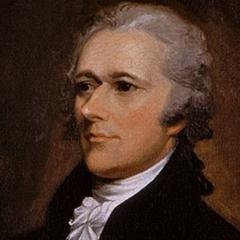
Alexander Hamilton

Alexander Hamilton Quotes

Founding Father of the United States

Filter quotes by topic

Famous Alexander Hamilton Quotes

“[If you understood the natural rights of mankind,] [y]ou would be convinced that natural liberty is a gift of the beneficent Creator to the whole human race, and that civil liberty is founded in that, and cannot be wrested from any people without the most manifest violation of justice.”

“The history of human conduct does not warrant that exalted opinion of human virtue which would make it wise in a nation to commit interests of so delicate and momentous a kind as those which concern its intercourse with the rest of the world, to the sole disposal of a magistrate, created and circumstanced, as would be a president of the United States.”

“To look for a continuation in harmony between a number of independent unconnected sovereignties, situated in the same neighborhood, would be to disregard the uniform course of human events, and to set at defiance the accumulated experience of ages.”

“Would there not be the greatest reason to apprehend, that error in the first sentence would be the parent of error in the second sentence? That the strong bias of one decision would be apt to overrule the influence of any new lights, which might be brought to vary the complexion of another decision? Those, who know any thing of human nature, will not hesitate to answer these questions in the affirmative.”

“It has been observed that a pure democracy if it were practicable would be the most perfect government. Experience has proved that no position is more false than this. The ancient democracies in which the people themselves deliberated never possessed one good feature of government. Their very character was tyranny; their figure deformity.”

“What plan for the regulation of the militia may be pursued by the national government is impossible to be foreseen...The project of disciplining all the militia of the United States is as futile as it would be injurious if it were capable of being carried into execution... Little more can reasonably be aimed at with the respect to the people at large than to have them properly armed and equipped ; and in order to see that this be not neglected, it will be necessary to assemble them once or twice in the course of a year.”

“If it were to be asked, What is the most sacred duty and the greatest source of our security in a Republic? The answer would be, An inviolable respect for the Constitution and Laws - the first growing out of the last . . . . A sacred respect for the constitutional law is the vital principle, the sustaining energy of a free government.”

“When you assemble from your several counties in the Legislature, were every member to be guided only by the apparent interest of his county, government would be impracticable. There must be a perpetual accomodation and sacrifice of local advantage to general expediency.”

“To attach full confidence to an institution of this nature, it appears to be an essential ingredient in its structure, that it shall be under private and not a public direction-under the guidance of individual interest, not of public policy; which, would be . . . liable to being too much influenced by public necessity.”

“The administration of private justice between the citizens of the same state, the supervision of agriculture and of other concerns of a similar nature, all those things in short which are proper to be provided for by local legislation, can never be desirable cares of a general jurisdiction . . . the attempt to exercise these powers would be as troublesome as it would be nugatory; and the possession of them, for that reason, would contribute nothing to the dignity, to the importance, or to the splendour of the national government.”

“Nothing can be more evident, than that an exclusive power of regulating elections for the National Government, in the hands of the State Legislatures, would leave the existence of the Union entirely at their mercy . . . . It is to little purpose to say that a neglect or omission of this kind [not letting the feds have elections], would be unlikely to take place. The constitutional possibility of the thing, without an equivalent for the risk, is an unanswerable objection.”

“Passive commerce . . . should thus . . . [compel us] to content ourselves with the first price of our commodities, and to see the profits of our trade snatched from us, to enrich our enemies and persecutors. That unequalled spirit of enterprise . . . an inexhaustible mine of national wealth, would be stifled and lost; and poverty and disgrace would overspread a country, which, with wisdom, might make herself the admiration and envy of the world.”

“Would they not fear that citizens not less tenacious than conscious of their rights would flock from the remotest extremes of their respective states to the places of election, to overthrow their tyrants, and to substitute men who would be disposed to avenge the violated majesty of the people?”

“It is an unquestionable truth, that the body of the people in every country desire sincerely its prosperity. But it is equally unquestionable that they do not possess the discernment and stability necessary for systematic government. To deny that they are frequently led into the grossest of errors, by misinformation and passion, would be a flattery which their own good sense must despise.”

“The President, and government, will only control the militia when a part of them is in the actual service of the federal government, else, they are independent and not under the command of the president or the government. The states would control the militia, only when called out into the service of the state, and then the governor would be commander in chief where enumerated in the respective state constitution.”

“[E]very act of a delegated authority, contrary to the tenor of the commission under which it is exercised, is void. No legislative act, therefore, contrary to the Constitution, can be valid. To deny this, would be to affirm, that the deputy is greater than his principal; that the servant is above his master; that the representatives of the people are superior to the people themselves; that men acting by virtue of powers, may do not only what their powers do not authorize, but what they forbid.”

“To attempt to enumerate the complicated variety of mischiefs in the whole system of the social economy, which proceed from a neglect of the maxims that uphold public credit, and justify the solicitude manifested by the House on this point, would be an improper intrusion on their time and patience.”

“The President of the United States would be liable to be impeached, tried, and upon conviction of treason, bribery, or other high crimes and misdemeanors, removed from office; and would afterwards be liable to prosecution and punishment in the ordinary course of law. The person of the King of Great Britain is sacred and inviolable: There is no constitutional tribunal to which he is amenable, no punishment to which he can be subjected without involving the crisis of a national revolution.”

“The President is to be commander-in-chief of the army and navy of the United States. In this respect his authority would be nominally the same with that of the king of Great Britain, but in substance much inferior to it. It would amount to nothing more than the supreme command and direction of the land and naval forces, as first general and admiral ... while that of the British king extends to the declaring of war and to the raising and regulating of fleets and armies - all which, by the Constitution under consideration, would appertain to the legislature.”