Quotessence
Home / Authors / Hermann Hesse
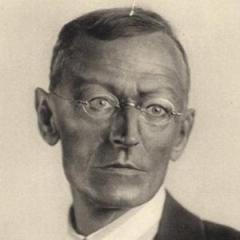
Hermann Hesse

Hermann Hesse Quotes

Poet

Filter quotes by topic

Famous Hermann Hesse Quotes

“If man has nothing to eat, fasting is the most intelligent thing he can do. If, for instance, Siddhartha had not learned to fast, he would have had to seek some kind of work today, either with you, or elsewhere, for hunger would have driven him. But as it is, Siddhartha can wait calmly. He is not impatient, he is not in need, he can ward off hunger for a long time and laugh at it. Therefore, fasting is useful, sir.”

“When someone seeks," said Siddhartha, "then it easily happens that his eyes see only the thing that he seeks, and he is able to find nothing, to take in nothing because he always thinks only about the thing he is seeking, because he has one goal, because he is obsessed with his goal. Seeking means: having a goal. But finding means: being free, being open, having no goal.”

“When someone is seeking, it happens quite easily that he only sees the thing that he is seeking; that he is unable to find anything, unable to absorb anything, because he is only thinking of the thing he is seeking, because he has a goal, because he is obsessed with his goal. Seeking means: to have a goal; but finding means: to be free, to be receptive, to have no goal. You, O worthy one, are perhaps indeed a seeker, for in striving towards your goal, you do not see many things that are under your nose.”

“It may be important to great thinkers to examine the world, to explain and despise it. But I think it is only important to love the world, not to despise it, not for us to hate each other, but to be able to regard the world and ourselves and all beings with love, admiration and respect.”

“The reason why I do not know anything about myself, the reason why Siddhartha has remained alien and unknown to myself is due to one thing, to one single thing--I was afraid of myself, I was fleeing from myself. I was seeking Atman, I was seeking Brahman, I was determined to dismember myself and tear away its layers of husk in order to find in its unknown innermost recess the kernel at the heart of those layers, the Atman, life, the divine principle, the ultimate. But in so doing, I was losing myself.”

“There is, so I believe, in the essence of everything, something that we cannot call learning. There is, my friend, only a knowledge-that is everywhere, that is Atman, that is in me and you and in every creature, and I am beginning to believe that this knowledge has no worse enemy than the man of knowledge, than learning.”

“Whether it is good or evil, whether life in itself is pain or pleasure, whether it is uncertain-that it may perhaps be this is not important-but the unity of the world, the coherence of all events, the embracing of the big and the small from the same stream, from the same law of cause, of becoming and dying.”

“He lost his Self a thousand times and for days on end he dwelt in non-being. But although the paths took him away from Self, in the end they always led back to it. Although Siddhartha fled from the Self a thousand times, dwelt in nothing, dwelt in animal and stone, the return was inevitable; the hour was inevitable when he would again find himself in sunshine or in moonlight, in shadow or in rain, and was again Self and Siddhartha, again felt the torment of the onerous life cycle.”

“What a wonderful sleep it had been! Never had sleep so refreshed him, so renewed him, so rejuvenated him! Perhaps he had really died, perhaps he had been drowned and was reborn in another form. No, he recognized himself, he recognized his hands and feet, the place where he lay and the Self in his breast, Siddhartha, self-willed, individualistic. But this Siddhartha was somewhat changed, renewed. He had slept wonderfully. He was remarkably awake, happy and curious.”

“So she thoroughly taught him that one cannot take pleasure without giving pleasure, and that every gesture, every caress, every touch, every glance, every last bit of the body has its secret, which brings happiness to the person who knows how to wake it. She taught him that after a celebration of love the lovers should not part without admiring each other, without being conquered or having conquered, so that neither is bleak or glutted or has the bad feeling of being used or misused.”