Quotessence
Home / Authors / Hermann Hesse
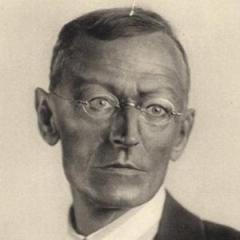
Hermann Hesse

Hermann Hesse Quotes

Poet

Filter quotes by topic

Famous Hermann Hesse Quotes

“When a tree is polled, it will sprout new shoots nearer its roots. A soul that is ruined in the bud will frequently return to the springtime of its beginnings and its promise-filled childhood, as though it could discover new hopes there and retie the broken threads of life. The shoots grow rapidly and eagerly, but it is only a sham life that will never be a genuine tree.”

“Knulp said: “Every human being has his own soul, he can’t mix it with any other. Two people can meet, they can talk with one another, they can be close together. But their souls are like flowers, each rooted to its place. One can’t go to another, because it would have to break away from its roots, and that it can’t do. Flowers send out their scent and their seeds, because they would like to go to each other; but a flower can’t do anything to make a seed go to its right place; the wind does that, and the wind comes and goes where it pleases.”

Book:Knulp

“When I have neither pleasure nor pain and have been breathing for a while the lukewarm insipid air of these so-called good and tolerable days, I feel so bad in my childish soul that I smash my rusty lyre of thanksgiving in the face of the slumbering god of contentment and would rather feel the most devilish pain burn in me than this warmth of a well-heated room. - Harry Haller”

“We must become so alone, so utterly alone, that we withdraw into our innermost self. It is a way of bitter suffering. But then our solitude is overcome, we are no longer alone, for we find that our innermost self is the spirit, that it is God, the indivisible. And suddenly we find ourselves in the midst of the world, yet undisturbed by its multiplicity, for our innermost soul we know ourselves to be one with all being.”

“A soul that is ruined in the bud will frequently return to the springtime of its beginning and its promise-filled childhood, as though it could discover new hopes there and retie the broken threads of life. The shoots grow rapidly and eagerly, but it is only a sham life that will never be a genuine tree.”

“...Haller's sickness of the soul, as I now know, is not the eccentricity of a single individual, but the sickness of the times themselves, the neurosis of that generation to which Haller belongs, a sickness, it seems, that by no means attacks the weak and worthless only but, rather, precisely those who are strongest in spirit and richest in gifts.”

“Man designs for himself a garden with a hundred kinds of trees, a thousand kinds of flowers, a hundred kinds of fruit and vegetables. Suppose, then, that the gardener of this garden knew no other distinction between edible and inedible, nine-tenths of this garden would be useless to him. He would pull up the most enchanting flowers and hew down the noblest trees and even regard them with a loathing and envious eye. This is what the Steppenwolf does with the thousand flowers of his soul. What does not stand classified as either man or wolf he does not see at all.”

“She stood before him and surrendered herself to him and sky, forest, and brook all came toward him in new and resplendent colors, belonged to him, and spoke to him in his own language. And instead of merely winning a woman he embraced the entire world and every star in heaven glowed within him and sparkled with joy in his soul. He had loved and had found himself. But most people love to lose themselves.”

“Rain Soft rain, summer rain Whispers from bushes, whispers from trees. Oh, how lovely and full of blessing To dream and be satisfied. I was so long in the outer brightness, I am not used to this upheaval: Being at home in my own soul, Never to be led elsewhere. I want nothing, I long for nothing, I hum gently the sounds of childhood, And I reach home astounded In the warm beauty of dreams. Heart, how torn you are, How blessed to plow down blindly, To think nothing, to know nothing, Only to breathe, only to feel.”

“The judge who sits over the murderer and looks into his face, and at one moment recognizes all the emotions and potentialities and possibilities of the murderer in his own soul and hears the murderer's voice as his own, is at the next moment one and indivisible as the judge, and scuttles back into the shell of his cultivated self and does his duty and condemns the murderer to death.”