Quotessence
Home / Authors / Hermann Hesse
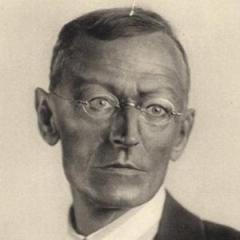
Hermann Hesse

Hermann Hesse Quotes

Poet

Filter quotes by topic

Famous Hermann Hesse Quotes

“For me, trees have always been the most penetrating preachers. I revere them when they live in tribes and families, in forests and groves. And even more I revere them when they stand alone. They are like lonely persons. Not like hermits who have stolen away out of some weakness, but like great, solitary men, like Beethoven and Nietzsche. In their highest boughs the world rustles, their roots rest in infinity; but they do not lose themselves there, they struggle with all the force of their lives for one thing only: to fulfil themselves according to their own laws, to build up their own form, to represent themselves. Nothing is holier, nothing is more exemplary than a beautiful, strong tree. When a tree is cut down and reveals its naked death-wound to the sun, one can read its whole history in the luminous, inscribed disk of its trunk: in the rings of its years, its scars, all the struggle, all the suffering, all the sickness, all the happiness and prosperity stand truly written, the narrow years and the luxurious years, the attacks withstood, the storms endured. And every young farmboy knows that the hardest and noblest wood has the narrowest rings, that high on the mountains and in continuing danger the most indestructible, the strongest, the ideal trees grow.”

“Mas cada homem não é apenas ele mesmo; é também um ponto único, singularíssimo, sempre importante e peculiar, no qual os fenômenos do mundo se cruzam daquela forma uma só vez e nunca mais. Assim, a história de cada homem é essencial, eterna e divina, e cada homem, ao viver em alguma parte e cumprir os ditames da Natureza, é algo maravilhoso e digno de toda a atenção”

“The bourgeois treasures nothing more highly than the self.... And so at the cost of intensity he achieves his own preservation andsecurity. His harvest is a quiet mind which he prefers to being possessed by God, as he prefers comfort to pleasure, convenience to liberty, and a pleasant temperature to that deathly inner consuming fire.”

“We must become so alone, so utterly alone, that we withdraw into our innermost self. It is a way of bitter suffering. But then our solitude is overcome, we are no longer alone, for we find that our innermost self is the spirit, that it is God, the indivisible. And suddenly we find ourselves in the midst of the world, yet undisturbed by its multiplicity, for our innermost soul we know ourselves to be one with all being.”

“What is meditation?... It is fleeing from the self, it is a short escape of the agony of being a self, it is a short numbing of the senses against the pain and the pointlessness of life. The same escape, the same short numbing is what the driver of an ox-cart finds in the inn, drinking a few bowls of rice wine or fermented coconut-milk.”

“He lost his Self a thousand times and for days on end he dwelt in non-being. But although the paths took him away from Self, in the end they always led back to it. Although Siddhartha fled from the Self a thousand times, dwelt in nothing, dwelt in animal and stone, the return was inevitable; the hour was inevitable when he would again find himself in sunshine or in moonlight, in shadow or in rain, and was again Self and Siddhartha, again felt the torment of the onerous life cycle.”

“What a wonderful sleep it had been! Never had sleep so refreshed him, so renewed him, so rejuvenated him! Perhaps he had really died, perhaps he had been drowned and was reborn in another form. No, he recognized himself, he recognized his hands and feet, the place where he lay and the Self in his breast, Siddhartha, self-willed, individualistic. But this Siddhartha was somewhat changed, renewed. He had slept wonderfully. He was remarkably awake, happy and curious.”

“The judge who sits over the murderer and looks into his face, and at one moment recognizes all the emotions and potentialities and possibilities of the murderer in his own soul and hears the murderer's voice as his own, is at the next moment one and indivisible as the judge, and scuttles back into the shell of his cultivated self and does his duty and condemns the murderer to death.”