Quotessence
Home / Authors / Isaac Newton Books
Isaac Newton

Isaac Newton Books

Physicist

Observations

A source page for quotes linked to Isaac Newton.
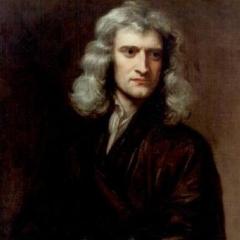
0 quotes

1691-1695

A source page for quotes linked to Isaac Newton.

0 quotes

1718-1727

A source page for quotes linked to Isaac Newton.

0 quotes

Related Quotes

“This most beautiful system of the sun, planets and comets, could only proceed from the counsel and dominion of an intelligent and powerful Being... This Being governs all things, not as the soul of the world, but as Lord over all; and on account of his dominion he is wont, to be called Lord God παντοκρατωρ or Universal Ruler.”

“Kepler's laws, although not rigidly true, are sufficiently near to the truth to have led to the discovery of the law of attraction of the bodies of the solar system. The deviation from complete accuracy is due to the facts, that the planets are not of inappreciable mass, that, in consequence, they disturb each other's orbits about the Sun, and, by their action on the Sun itself, cause the periodic time of each to be shorter than if the Sun were a fixed body, in the subduplicate ratio of the mass of the Sun to the sum of the masses of the Sun and Planet; these errors are appreciable although very small, since the mass of the largest of the planets, Jupiter, is less than 1/1000th of the Sun's mass.”

“God without dominion, providence, and final causes, is nothing else but Fate and Nature. Blind metaphysical necessity, which is certainly the same always and everywhere, could produce no variety of things. All that diversity of natural things which we find suited to different times and places could arise from nothing but the ideas and will of a Being necessarily existing.”

“The main Business of Natural Philosophy is to argue from Phænomena without feigning Hypotheses, and to deduce Causes from Effects till we come to the very first Cause, which certainly is not mechanical; and not only to unfold the Mechanism of the World, but chiefly to resolve these, and to such like Questions.”

“Qu. 31. Have not the small Particles of Bodies certain Powers, Virtues or Forces, by which they act at a distance, not only upon the Rays of Light for reflecting, refracting and reflecting them, but also upon one another for producing a great part of the Phænomena of Nature?”

“All material Things seem to have been composed of the hard and solid Particles ... variously associated with the first Creation by the Counsel of an intelligent Agent. For it became him who created them to set them in order: and if he did so, it is unphilosophical to seek for any other Origin of the World, or to pretend that it might arise out of a Chaos by the mere Laws of Nature.”

“The Synthesis consists in assuming the Causes discovered and established as Principles, and by them explaining the Phænomena proceeding from them, and proving the Explanations.”

“To derive two or three general Principles of Motion from Phænomena, and afterwards to tell us how the Properties and Actions of all corporeal Things follow from those manifest Principles, would be a very great step in Philosophy.”

“Our design, not respecting arts, but philosophy, and our subject, not manual, but natural powers, we consider chiefly those things which relate to gravity, levity, elastic force, the resistance of fluids, and the like forces, whether attractive or impulsive; and therefore we offer this work as mathematical principles of philosophy; for all the difficulty of philosophy seems to consist in this from the phenomena of motions to investigate the forces of nature, and then from these forces to demonstrate the other phenomena.”

“Do not several sorts of Rays make Vibrations of several bignesses, which according to their bigness excite Sensations of several Colours, much after the manner that the Vibrations of the Air, according to their several bignesses excite Sensations of several Sounds? And particularly do not the most refrangible Rays excite the shortest Vibrations for making a Sensation of deep violet, the least refrangible the largest form making a Sensation of deep red, and several intermediate sorts of Rays, Vibrations of several intermediate bignesses to make Sensations of several intemediate Colours?”

“Doth not this Æthereal Medium in passing out of Water, Glass, Crystal, and other compact and dense Bodies into empty Spaces, grow denser and denser by degrees, and by that means refract the Rays of Light not in a point, but by bending them gradually in curve Lines? And doth not the gradual condensation of this Medium extend to some distance from the Bodies, and thereby cause the Inflexions of the Rays of Light, which pass by the edges of dense Bodies, at some distance from the Bodies?”

“As Attraction is stronger in small Magnets than in great ones in proportion to their Bulk, and Gravity is greater in the Surfaces of small Planets than in those of great ones in proportion to their bulk, and small Bodies are agitated much more by electric attraction than great ones; so the smallness of the Rays of Light may contribute very much to the power of the Agent by which they are refracted.”

“What is there in places empty of matter? and Whence is it that the sun and planets gravitate toward one another without dense matter between them? Whence is it that Nature doth nothing in vain? and Whence arises all that order and beauty which we see in the world? To what end are comets? and Whence is it that planets move all one and the same way in orbs concentrick, while comets move all manner of ways in orbs very excentrick? and What hinders the fixed stars from falling upon one another?”

“One [method] is by a Watch to keep time exactly. But, by reason of the motion of the Ship, the Variation of Heat and Cold, Wet and Dry, and the Difference of Gravity in different Latitudes, such a watch hath not yet been made.”

“The kingdoms represented by the second and third Beasts, or the Bear and Leopard, are again described by Daniel in his last Prophecy written in the third year of Cyrus over Babylon , the year in which he conquered Persia. For this Prophecy is a commentary upon the Vision of the Ram and He-Goat.”

“The monarchy of the Greeks for want of an heir was broken into several kingdoms; four of which, seated to the four winds of heaven, were very eminent. For Ptolemy reigned over Egypt, Lybia and Ethiopia ; Antigonus over Syria and the lesser Asia; Lysimachus over Thrace ; and Cassander over Macedon, Greece and Epirus .”

“Henceforward the Christian Churches having a form of godliness, but denying the power thereof, came into the hands of the Encratites: and the Heathens, who in the fourth century came over in great numbers to the Christians, embraced more readily this sort of Christianity, as having a greater affinity with their old superstitions, than that of the sincere Christians; who by the lamps of the seven Churches of Asia, and not by the lamps of the Monasteries, had illuminated the Church Catholic during the three first centuries.”

“In scripture we are told of some trusting in God and others trusting in idols, and that God is our refuge, our strength, our defense. In this sense God is the rock of his people, and false Gods are called the rock of those that trust in them. In the same sense the Gods of the King who shall do according to his will are called Mahuzzims, munitions, fortresses, protectors, guardians, or defenders.”

“I do not define time, space, place, and motion, as being well known to all. Only I must observe, that the common people conceive those quantities under no other notions but from the relation they bear to sensible objects. And thence arise certain prejudices, for the removing of which it will be convenient to distinguish them into absolute and relative, true and apparent, mathematical and common.”

“It is indeed a matter of great difficulty to discover, and effectually to distinguish, the true motions of particular bodies from the apparent; because the parts of that immovable space, in which those motions are performed, do by no means come under the observation of our senses. Yet the thing is not altogether desperate; for we have some arguments to guide us, partly from the apparent motions, which are the differences of the true motions; partly from the forces, which are the causes and effects of the true motions.”

“Do not the Rays of Light which fall upon Bodies, and are reflected or refracted, begin to bend before they arrive at the Bodies; and are they not reflected, refracted, and inflected, by one and the same Principle, acting variously in various Circumstances?”

“The other part of the true religion is our duty to man. We must love our neighbour as our selves, we must be charitable to all men for charity is the greatest of graces, greater then even faith or hope & covers a multitude of sins. We must be righteous & do to all men as we would they should do to us.”

“The Prophecies of Daniel are all of them related to one another, as if they were but several parts of one general Prophecy, given at several times. The first is the easiest to be understood, and every following Prophecy adds something new to the former.”

“Daniel was in the greatest credit amongst the Jews, till the reign of the Roman Emperor Hadrian . And to reject his prophecies, is to reject the Christian religion. For this religion is founded upon his prophecy concerning the Messiah .”