Quotessence
Home / Authors / Karl Marx
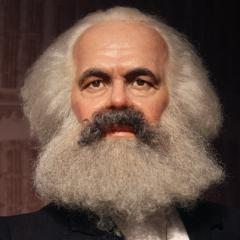
Karl Marx

Karl Marx Quotes

Philosopher

Filter quotes by topic

Famous Karl Marx Quotes

“Communism deprives no man of the power to appropriate the products of society: all that it does is to deprive him of the power to subjugate the labor of others by means of such appropriation. It has been objected, that upon the abolition of private property all work will cease, and universal laziness will overtake us. According to this, bourgeois society ought long ago to have gone to the dogs through sheer idleness; for those of its members who work, acquire nothing, and those who acquire anything, do not work.”

“Or how does it happen that trade, which after all is nothing more than the exchange of products of various individuals and countries, rules the whole world through the relation of supply and demand—a relation which, as an English economist says, hovers over the earth like the fate of the ancients, and with invisible hand allots fortune and misfortune to men, sets up empires and overthrows empires, causes nations to rise and to disappear—while with the abolition of the basis of private property, with the communistic regulation of production (and implicit in this, the destruction of the alien relation between men and what they themselves produce), the power of the relation of supply and demand is dissolved into nothing, and men get exchange, production, the mode of their mutual relation, under their own control again?”

“It is the alienated insight into the actual objectification of man and into the actual appropriation of his objective nature by the destruction of the alienated character of the objective world, by the transcendence of the objective world in its alienated existence, just as atheism which transcends God is the emergence of theoretical humanism, and communism which transcends private property is the vindication of actual human life as man's property, the emergence of practical humanism. Or, atheism is humanism mediated through itself by the transcendence of religion, and communism is humanism mediated through itself by the transcendence of private property. Only through the transcendence of this mediation--which is, however, a necessary presupposition--emerges positive humanism, humanism emerging positively from itself.”

“We thus see that the price of a commodity is indeed determined by its cost of production, but in such wise that the periods in which the price of these commodities rises above the cost of production are balanced by the periods in which it sinks below the cost of production, and vice versa. Of course this does not hold good for a single given product of an industry, but only for that branch of industry. So also it does not hold good for an individual manufacturer, but only for the whole class of manufacturers.”

“The bourgeoisie, by the rapid improvement of all instruments of production, by the immensely facilitated means of communication, draws all, even the most barbarian, nations into civilization. The cheap prices of its commodities are the heavy artillery with which it batters down all Chinese walls, with which it forces the barbarians' intensely obstinate hatred of foreigners to capitulate. It compels all nations, on pain of extinction, to adopt the bourgeois mode of production; it compels them to introduce what it calls civilization into their midst, i.e., to become bourgeois themselves. In one word, it creates a world after its own image.”

“A specter is haunting Europe—the specter of Communism. All the powers of old Europe have entered into a holy alliance to exorcise this specter; Pope and Czar, Metternich and Guizot, French radicals and German police spies. Where is the party in opposition that has not been decried as Communistic by its opponents in power? Where the opposition that has not hurled back the branding reproach of Communism, against the more advanced opposition parties, as well as against its reactionary adversaries? Two things result from this fact. I. Communism is already acknowledged by all European powers to be in itself a power. II. It is high time that Communists should openly, in the face of the whole world, publish their views, their aims, their tendencies, and meet this nursery tale of the Specter of Communism with a Manifesto of the party itself.”

“We also understand, therefore, that wages and private property are identical. Indeed, where the product, as the object of labor, pays for labor itself, there the wage is but a necessary consequence of labor’s estrangement. Likewise, in the wage of labor, labor does not appear as an end in itself but as the servant of the wage... An enforced increase of wages (disregarding all other difficulties, including the fact that it would only be by force, too, that such an increase, being an anomaly, could be maintained) would therefore be nothing but better payment for the slave, and would not win either for the worker or for labor their human status and dignity. Indeed, even the equality of wages, as demanded by Proudhon, only transforms the relationship of the present-day worker to his labor into the relationship of all men to labor. Society would then be conceived as an abstract capitalist. Wages are a direct consequence of estranged labor, and estranged labor is the direct cause of private property. The downfall of the one must therefore involve the downfall of the other.”

“The sum of productive forces, capital funds and social forms of intercourse, which every individual and generation finds in existence as something given, is the real basis of what the philosophers have conceived as "substance" and "essence of man," and what they have deified and attacked: a real basis which is not in the least disturbed, in its effect and influence on the development of men, by the fact that these philosophers revolt against it as "self-consciousness" and the "Unique.”

“The bourgeoisie, wherever it has got the upper hand, has put an end to all feudal, patriarchal, idyllic relations. It has pitilessly torn asunder the motley feudal ties that bound man to his 'natural superiors,' and has left remaining no other nexus between man and man than naked self-interest, callous 'cash payment.' It has drowned the most heavenly ecstasies of religious fervor, of chivalrous enthusiasm, of philistine sentimentalism, in the icy water of egotistical calculation. It has resolved personal worth into exchange value, and in place of the numberless indefeasible chartered freedoms, has set up that single, unconscionable freedom—Free Trade. In one word, for exploitation, veiled by religious and political illusions, it has substituted naked, shameless, direct, brutal exploitation. The bourgeoisie has stripped of its halo every occupation hitherto honored and looked up to with reverent awe. It has converted the physician, the lawyer, the priest, the poet, the man of science, into its paid wage laborers. The bourgeoisie has torn away from the family its sentimental veil, and has reduced the family relation to a mere money relation.”

“You are horrified at our intending to do away with private property. But in your existing society private property is already done away with for nine-tenths of the population; its existence for the few is solely due to its non-existence in the hands of those nine-tenths. You reproach us, therefore, with intending to do away with a form of property, the necessary condition for whose existence is the non-existence of any property for the immense majority of society. In one word, you reproach us with intending to do away with your property. Precisely so: that is just what we intend.”

“You are horrified at our intending to do away with private property.  But in your existing society, private property is already done away with for nine-tenths of the population; its existence for the few is solely due to its non-existence in the hands of those nine-tenths.  You reproach us, therefore, with intending to do away with a form of property, the necessary condition for whose existence is the non-existence of any property for the immense majority of society. In a word, you reproach us with intending to do away with your property. Precisely so, that is just what we intend.”

“When, in the course of development, class distinctions have disappeared and all production has been concentrated in the hands of a vast association of the whole nation, the public power will lose its political character. Political power, properly so called, is merely the organized power of one class for oppressing another. If the proletariat during its contest with the bourgeoisie is compelled, by the force of circumstances, to organize itself as a class, if, by means of a revolution, it makes itself the ruling class, and, as such, sweeps away by force the old conditions of production then it will, along with these conditions, have swept away the conditions for the existence of class antagonisms, and of classes generally, and will thereby have abolished its own supremacy as a class. In place of the old bourgeois society with its classes and class antagonisms we shall have an association in which the free development of each is the condition for the free development of all.”

“The specific economic form, in which unpaid surplus-labour is pumped out of direct producers, determines the relationship of rulers and ruled, as it grows directly out of production itself and, in turn, reacts upon it as a determining element. Upon this, however, is founded the entire formation of the economic community which grows up out of the production relations themselves, thereby simultaneously its specific political form. It is always the direct relationship of the owners of the conditions of production to the direct producers — a relation always naturally corresponding to a definite stage in the development of the methods of labour and thereby its social productivity — which reveals the innermost secret, the hidden basis of the entire social structure and with it the political form of the relation of sovereignty and dependence, in short, the corresponding specific form of the state. This does not prevent the same economic basis — the same from the standpoint of its main conditions — due to innumerable different empirical circumstances, natural environment, racial relations, external historical influences, etc. from showing infinite variations and gradations in appearance, which can be ascertained only by analysis of the empirically given circumstances.”

“In a higher phase of communist society, after the enslaving subordination of the individual to the division of labor, and therewith also the antithesis between mental and physical labor, has vanished; after labor has become not only a means of life but life's prime want; after the productive forces have also increased with the all-around development of the individual, and all the springs of co-operative wealth flow more abundantly—only then can the narrow horizon of bourgeois right be crossed in its entirety and society inscribe on its banners: From each according to his ability, to each according to his needs!”

“The history of all hitherto existing society is the history of class struggles. Freeman and slave, patrician and plebeian, lord and serf, guildmaster and journeyman, in a word, oppressor and oppressed, stood in constant opposition to one another, carried on an uninterrupted, now hidden, now open fight, that each time ended, either in the revolutionary reconstitution of society at large, or in the common ruin of the contending classes.”

“Undoubtedly," it will be said, "religious, moral, philosophical and juridical ideas have been modified in the course of historical development. But religion, morality, philosophy, political science, and law, constantly survived this change. "There are besides, eternal truths, such as Freedom, Justice, etc., that are common to all states of society. But Communism abolishes eternal truths, it abolishes all religion and all morality, instead of constituting them on a new basis; it therefore acts in contradiction to all past historical experience.”

“The bourgeois sees in his wife a mere instrument of production. He hears that the instruments of production are to be exploited in common, and, naturally, can come to no other conclusion than that the lot of being common to all will likewise fall to the women. He has not even a suspicion that the real point is to do away with the status of women as mere instruments of production. For the rest, nothing is more ridiculous than the virtuous indignation of our bourgeois at the community of women which, they pretend, is to be openly and officially established by the Communists. The Communists have no need to introduce the community of women; it has existed almost from time immemorial. Our bourgeois, not content with having the wives and daughters of their proletarians at their disposal, not to speak of common prostitutes, take the greatest pleasure in seducing each other's wives. Bourgeois marriage is in reality a system of wives in common and thus, at the most, what the Communists might possibly be reproached with, is that they desire to introduce, in substitution for a hypocritically concealed, an openly legalised community of women. For the rest, it is self-evident that the abolition of the present system of production must bring with it the abolition of the community of women springing from that system, i.e., of prostitution both public and private.”

“Communism... is the genuine resolution of the antagonism between man and nature and between man and man; it is the true resolution of the conflict between existence and essence, objectification and self-affirmation, freedom and necessity, individual and species. It is the riddle of history solved and knows itself as the solution.”

“Owners of capital will stimulate working class to buy more and more of expensive goods, houses and technology, pushing them to take more and more expensive credits, until their debt becomes unbearable. The unpaid debt will lead to bankruptcy of banks which will have to be nationalized and State will have to take the road which will eventually lead to communism.”

“A spectre is haunting Europe-the spectre of Communism. All the Powers of old Europe have entered into holy alliance to exorcise this spectre: Pope and Czar, Metternich and Guizot, French Radicals and German police-spies. Where is the Party in opposition that has not been decried as Communistic by its opponents in power? Where the Opposition that has not hurled back the branding reproach of Communism, against the more advanced opposition parties, as well as against its reactionary adversaries?”

“You are horrified at our intending to do away with private property. But in your existing society, private property is already done away with for nine tenths of the population; its existence for the few is solely due to its non-existence in the hands of those nine tenths. You reproach us, therefore, with intending to do away with a form of property, the necessary condition for whose existence is the non-existence of any property for the immense majority of society.”

“There are, besides, eternal truths, such as Freedom, , etc., that are common to all states of society. But Communism abolishes eternal truths, it abolishes all religion, and all morality, instead of constituting them on a new basis; it therefore acts in contradiction to all past historical experience.”