Quotessence
Home / Authors / Murray Rothbard
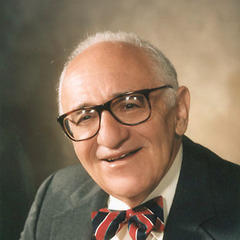
Murray Rothbard

Murray Rothbard Quotes

Economist

Filter quotes by topic

Famous Murray Rothbard Quotes

“It is curious that people tend to regard government as a quasi-divine, selfless, Santa Claus organization. Government was constructed neither for ability nor for the exercise of loving care; government was built for the use of force and for necessarily demagogic appeals for votes. If individuals do not know their own interests in many cases, they are free to turn to private experts for guidance. It is absurd to say that they will be served better by a coercive, demagogic apparatus.”

“The policy of letting the child 'do what he likes' is an insidious one, since the children are encouraged to continue always at their original superficial level, without receiving guidance in study. Furthermore, the 'three Rs,' the fundamental tools, are neglected as long as possible, with the result that the child's chance to develop his mind is greatly retarded. The policy of teaching words via pictures instead of by the alphabet tends to deprive the young child of the greatest reasoning tool of all.”

“Children are prepared for democracy by being led to discuss current events without first learning the systematic subjects (politics, economics, history) which are necessary in order to discuss them. The Mole effect is to substitute slogans and superficial opinion for considered individual thought. And the opinion is that of the lowest common denominator of the group.”

“The libertarian creed...offers the fulfillment of the best of the American past along with the promise of a far better future. Libertarians are squarely in the great classical liberal tradition that built the United States and bestowed on us the American heritage of individual liberty, a peaceful foreign policy, minimal government, and a free-market economy.”

“The diversity of mankind is a basic postulate of our knowledge of human beings. But if mankind is diverse and individuated, then how can anyone propose equality as an ideal? Every year, scholars hold Conferences on Equality and call for greater equality, and no one challenges the basic tenet. But what justification can equality find in the nature of man? If each individual is unique, how else can he be made 'equal' to others than by destroying most of what is human in him and reducing human society to the mindless uniformity of the ant heap?”

“The individual man, in introspecting the fact of his own consciousness, also discovers the primordial natural fact of his freedom: his freedom to choose, his freedom to use or not use his reason about any given subject. In short, the natural fact of his "free will." He also discovers the natural fact of his mind's command over his body and its actions: that is, of his natural ownership over his self.”

“If government manages to establish paper tickets or bank credit as money, as equivalent to gold grams or ounces, then the government, as dominant money-supplier, becomes free to create money costlessly and at will. As a result, this 'inflation' of the money supply destroys the value of the dollar or pound, drives up prices, cripples economic calculation, and hobbles and seriously damages the workings of the market economy.”

“It is particularly odd that economists who profess to be champions of a free-market economy, should go to such twists and turns to avoid facing the plain fact: that gold, that scarce and valuable market-produced metal, has always been, and will continue to be, by far the best money for human society.”

“Money is different from all other commodities: other things being equal, more shoes, or more discoveries of oil or copper benefit society, since they help alleviate natural scarcity. But once a commodity is established as a money on the market, no more money at all is needed. Since the only use of money is for exchange and reckoning, more dollars or pounds or marks in circulation cannot confer a social benefit: they will simply dilute the exchange value of every existing dollar or pound or mark.”

“At the base of the Fed pyramid, and therefore of the bank system's creation of "money" in the sense of deposits, is the Fed's power to print legal tender money. But the Fed tries its best not to print cash but rather to "print" or create demand deposits, checking deposits, out of thin air, since its demand deposits constitute the reserves on top of which the commercial banks can pyramid a multiple creation of bank deposits, or "checkbook money."”

“Since leaving office in 1977, Dr. Kissinger has continued to play a highly influential role in U.S. politics, in the U.S. media, and in the Rockefeller world empire. It was Kissinger, along with David Rockefeller, who was decisive in the disastrous decision of President Carter to admit the recently toppled Shah of Iran, old friend and ally of the Rockefellers into the United States, a decision that led directly to the Iranian hostage crisis and to Carter's downfall.”

“Kissinger's major, and most lucrative role, has come as head of Kissinger Associates in New York City, founded on a loan obtained in 1982 from the international banking firm of E.M. Warburg, Pincus and Company. Nominally, Kissinger Associates (KA) is an "international consulting firm" but "consultant" covers many sins, and in KA's case, this means international political influence-peddling for its two dozen or so important corporate clients.”

“To those advocates of independent paper moneys who also champion the free market, I would address this simple question: "Why don't you advocate the unlimited freedom of each individual to manufacture dollars?" If dollars are really and properly things-in-themselves, why not let everyone manufacture them as they manufacture wheat and baby food?”

“[Professional politicians] don't mind if price controls cause shortages of health care. In fact, they welcome the prospect, because then they can impose rationing; they can impose priorities, and tell everyone how much of what kind of medical care they can have. And besides, ... there's that deeply satisfying rush of power.”

“Briefly, the State is that organization in society which attempts to maintain a monopoly of the use of force and violence in a given territorial area; in particular, it is the only organization in society that obtains its revenue not by voluntary contribution or payment for services rendered but by coercion.”

“I define anarchist society as one where there is no legal possibility for coercive aggression against the person or property of any individual. Anarchists oppose the State because it has its very being in such aggression, namely, the expropriation of private property through taxation, the coercive exclusion of other providers of defense service from its territory, and all of the other depredations and coercions that are built upon these twin foci of invasions of individual rights.”

“Once one concedes that a single world government is not necessary, then where does one logically stop at the permissibility of separate states? If Canada and the United States can be separate nations without being denounced as in a state of impermissible ‘anarchy’, why may not the South secede from the United States? New York State from the Union? New York City from the state? Why may not Manhattan secede? Each neighbourhood? Each block? Each house? Each person?”