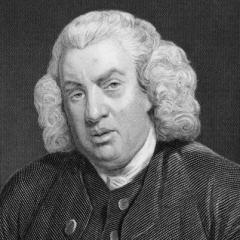
“A student may easily exhaust his life in comparing divines and moralists without any practical regard to morals and religion; he may be learning not to live but to reason... while the chief use of his volumes is unthought of, his mind is unaffected, and his life is unreformed.”
Source: The Works of Samuel Johnson: LL.D. A New Edition in Twelve Volumes. With an Essay on His Life and Genius, by Arthur Murphy, Esq
“Wine gives great pleasure, and every pleasure is of itself a good. and
A man should cultivate his mind so as to have that confidence and readiness without wine, which wine gives.”
Source: The Life of Samuel Johnson
“Among other pleasing errors of young minds is the opinion of their own importance. He that has not yet remarked, how little attention his contemporaries can spare from themselves, conceives all eyes turned upon himself, and imagines everyone that approaches him to be an enemy or a follower, an admirer or a spy.”
Source: Essays from the Rambler, Adventurer, and Idler
“If useless thoughts could be expelled from the mind, all the valuable parts of our knowledge would more frequently recur.”
Source: The Rambler: A Periodical Paper, Published in 1750, 1751, 1752
“Celestial wisdom calms the mind.”
Source: The Life of Samuel Johnson, LL. D.: Including His Tour to the Hebrides, Correspondence with Mrs. Thrale, &c. With Numerous Additions
“Nothing concentrates one's mind so much as the realization that one is going to be hanged in the morning!”
“1. Turn all care out of your head as soon as you mount the chaise.
2. Do not think about frugality: your health is worth more than it can cost.
3. Do not continue any day's journey to fatigue.
4. Take now and then a day's rest.
5. Get a smart seasickness if you can.
6. Cast away all anxiety, and keep your mind easy.
This last direction is the principal; with an unquiet mind neither exercise, nor diet, nor physic can be of much use.”
Source: The Letters of Samuel Johnson with Mrs. Thrale's Genuine Letters to Him: 1775-1782
“There are minds so impatient of inferiority that their gratitude is a species of revenge, and they return benefits, not because recompense is a pleasure, but because obligation is a pain.”
“My dear friend, clear your mind of can't.”
“The mind is never satisfied with the objects immediately before it, but is always breaking away from the present moment, and losing itself in schemes of future felicity... The natural flights of the human mind are not from pleasure to pleasure, but from hope to hope.”
Source: The Rambler: A Periodical Paper, Published in 1750, 1751, 1752
“He who does not mind his belly, will hardly mind anything else.”
“The natural flights of the human mind are not from pleasure to pleasure, but from hope to hope.”
Source: The Rambler
“When a man knows he is to be hanged in a fortnight, it concentrates his mind wonderfully.”
“Our minds, like our bodies, are in continual flux; something is hourly lost, and something acquired.... Do not suffer life to stagnate; it will grow muddy for want of motion: commit yourself again to the current of the world.”
Source: The Works of Samuel Johnson, LL.D.: A New Edition in Twelve Volumes, to which is Prefixed, an Essay on His Life and Genius, by Arthur Murphy, Esq. Containing Adventurer and Rasselas
“No weakness of the human mind has more frequently incurred animadversion, than the negligence with which men overlook their own faults, however flagrant, and the easiness with which they pardon them, however frequently repeated.”
Source: The Rambler: A Periodical Paper, Published in 1750, 1751, 1752
“Distance has the same effect on the mind as on the eye.”
Source: The History of Rasselas, Prince of Abyssinia: A Tale
“Some people have a foolish way of not minding, or pretending not to mind, what they eat. For my part, I mind my belly very studiously, and very carefully; for I look upon it, that he who does not mind his belly will hardly mind anything else.”
“Idleness is often covered by turbulence and hurry. He that neglects his known duty and real employment naturally endeavours to crowd his mind with something that may bar out the remembrance of his own folly, and does any thing but what he ought to do with eager diligence, that he may keep himself in his own favour.”
Source: The Rambler: A Periodical Paper, Published in 1750, 1751, 1752
“To have the management of the mind is a great art, and it may be attained in a considerable degree by experience and habitual exercise... Let him take a course of chemistry, or a course of rope-dance, or a course of any thing to which he is inclined at the time. Let him contrive to have as many retreats for his mind as he can, as many things to which it can fly from itself.”
“Since every man is obliged to promote happiness and virtue, he should be careful not to mislead unwary minds, by appearing to set too high a value upon things by which no real excellence is conferred.”
Source: The Works of Samuel Johnson, LL.D..: The Rambler
“To have the management of the mind is a great art, and it may be attained in a considerable degree by experience and habitual exercise.”
Source: The life of Samuel Johnson, LL. D., comprehending an account of his studies, and numerous works, in chronological order: a series of his epistolary correspondence and conversations with many eminent persons; and various original pieces of his composition, never before published; the whole exhibiting a view of literature and literary men in Great Britain, for near half a century during which he flourished
“What we read with inclination makes a much stronger impression. If we read without inclination, half the mind is employed in fixing the attention; so there is but one half to be employed on what we read.”
Source: The life of Samuel Johnson, LL. D., comprehending an account of his studies, and numerous works, in chronological order: a series of his epistolary correspondence and conversations with many eminent persons; and various original pieces of his composition, never before published; the whole exhibiting a view of literature and literary men in Great Britain, for near half a century during which he flourished
“Philosophers there are who try to make themselves believe that this life is happy; but they believe it only while they are saying it, and never yet produced conviction in a single mind.”
Source: Essay on the life and genius of Dr. Johnson [by Arthur Murphy] Poems. Rasselas, prince of Abissinia. Letters
“It is, indeed, at home that every man must be known by those who would make a just estimate either of his virtue or felicity; for smiles and embroidery are alike occasional, and the mind is often dressed for show in painted honor, and fictitious benevolence.”
“The true genius is a mind of large general powers, accidentally determined to some particular direction.”
“No man will be found in whose mind airy notions do not sometimes tyrannize, and force him to hope or fear beyond the limits of sober probability.”
Source: The History of Rasselas, Prince of Abissinia: A Tale
“No mind is much employed upon the present; recollection and anticipation fill up almost all our moments.”
Source: The Works of Samuel Johnson, LL. D.: With an Essay on His Life and Genius /c by Arthur Murphy, Esq
“When female minds are embittered by age or solitude, their malignity is generally exerted in a rigorous and spiteful superintendence of domestic trifles.”
Source: The Works of Samuel Johnson, LL.D.: With An Essay on His Life and Genius
“As any action or posture, long continued, will distort and disfigure the limbs, so the mind likewise is crippled and contracted by perpetual application to the same set of ideas.”
Source: The Rambler: In Four Volumes
“Curiosity is, in great and generous minds, the first passion and the last.”
Source: Boswell's Life of Johnson: Including Boswell's Journal of a Tour of the Hebrides, and Johnson's Diary of A Journey Into North Wales
“To expect that the intricacies of science will be pierced by a careless glance, or the eminences of fame ascended without labour, is to expect a peculiar privilege, a power denied to the rest of mankind; but to suppose that the maze is inscrutable to diligence, or the heights inaccessible to perseverance, is to submit tamely to the tyranny of fancy, and enchain the mind in voluntary shackles.”
Source: The Rambler
“Nothing has tended more to retard the advancement of science than the disposition in vulgar minds to vilify what they cannot comprehend.”
“Great abilities are not requisite for an Historian; for in historical composition, all the greatest powers of the human mind are quiescent.”
Source: The life of Samuel Johnson, LL. D., comprehending an account of his studies, and numerous works, in chronological order: a series of his epistolary correspondence and conversations with many eminent persons; and various original pieces of his composition, never before published; the whole exhibiting a view of literature and literary men in Great Britain, for near half a century during which he flourished
“There are innumerable questions to which the inquisitive mind can in this state receive no answer: Why do you and I exist? Why was this world created? Since it was to be created, why was it not created sooner?”
Source: The life of Samuel Johnson, LL. D., comprehending an account of his studies, and numerous works, in chronological order: a series of his epistolary correspondence and conversations with many eminent persons; and various original pieces of his composition, never before published; the whole exhibiting a view of literature and literary men in Great Britain, for near half a century during which he flourished
“He that outlives a wife whom he has long loved, sees himself disjoined from the only mind that has the same hopes, and fears, and interest; from the only companion with whom he has shared much good and evil; and with whom he could set his mind at liberty, to retrace the past or anticipate the future. The continuity of being is lacerated; the settled course of sentiment and action is stopped; and life stands suspended and motionless.”
Source: A Johnson Sampler
“Our minds should not be empty because if they are not preoccupied by good, evil will break in upon them.”
“Vulgar and inactive minds confound familiarity with knowledge, and conceive themselves informed of the whole nature of things, when they are shown their form or told their use.”
Source: The Rambler: A Periodical Paper, Published in 1750, 1751, 1752
“None but those who have learned the art of subjecting their senses as well as reason to hypothetical systems can be persuaded by the most specious rhetorician that the lots of life are equal; yet it cannot be denied that every one has his peculiar pleasures and vexations, that external accidents operate variously upon different minds, and that no man can exactly judge from his own sensations what another would feel in the same circumstances.”
Source: The Rambler
“There are occasions on which it is noble to dare to stand alone. To be pious among infidels, to be disinterested in a time of general venality, to lead a life of virtue and reason in the midst of sensualists, is a proof of a mind intent on nobler things than the praise or blame of men, of a soul fixed in the contemplation of the highest good, and superiour to the tyranny of custom and example.”
Source: The Works of Samuel Johnson, LL.D.: With An Essay on His Life and Genius
“To be of no church is dangerous. Religion, of which the rewards are distant, and which is animated only by faith and hope, will glide by degrees out of the mind unless it be invigorated and reimpressed by external ordinances, by stated calls to worship, and the salutary influence of example.”
Source: The Beauties of Samuel Johnson: Consisting of Maxims and Observations, Moral, Critical, and Miscellaneous
“Here lies our good Edmund, whose genius was such,
We scarcely can praise it or blame it too much;
Who, born for the Universe, narrowed his mind,
And to party gave up what was meant for mankind.”
“A generous and elevated mind is distinguished by nothing more certainly than an eminent degree of curiosity.”
“Curiosity is, in great and generous minds, the first passion and the last; and perhaps always predominates in proportion to the strength of the contemplative faculties. He who easily comprehends all that is before him, and soon exhausts any single subject, is always eager for new inquiries; and in proportion as the intellectual eye takes in a wider prospect, it must be gratified with variety, by more rapid flights and bolder excursions.”
Source: The Works of Samuel Johnson, LL.D.: With Murphy's Essay
“I am far from any intention to limit curiosity, or confine the labours of learning to arts of immediate and necessary use. It is only from the various essays of experimental industry, and the vague excursions of mind set upon discovery, that any advancement of knowledge can be expected; and though many must be disappointed in their labours, yet they are not to be charged with having spent their time in vain; their example contributed to inspire emulation, and their miscarriage taught others the way to success.”
Source: Select Essays
“Composition is for the most part an effort of slow diligence and steady perseverance, to which the mind is dragged by necessity or resolution, and from which the attention is every moment starting to more delightful amusements.”
Source: The Works of Samuel Johnson, LL.D.
“When any anxiety or gloom of the mind takes hold of you, make it a rule not to publish it by complaining; but exert yourselves to hide it, and by endeavoring to hide it you drive it away.”
“When any fit of gloominess, or perversion of mind, lays hold upon you, make it a rule not to publish it by complaints, but exert your whole care to hide it; by endeavouring to hide it; you will dry it away. Be always busy.”
Source: The life of Samuel Johnson, LL. D., comprehending an account of his studies, and numerous works, in chronological order: a series of his epistolary correspondence and conversations with many eminent persons; and various original pieces of his composition, never before published; the whole exhibiting a view of literature and literary men in Great Britain, for near half a century during which he flourished
“He is a benefactor of mankind who contracts the great rules of life into the short sentences, that may be easily impressed on the memory, and so recur habitually to the mind.”
“It is wonderful when a calculation is made, how little the mind is actually employed in the discharge of any profession.”
“The truly strong and sound mind is the mind that can embrace equally great things and small.”
Source: The Life of Samuel Johnson, LL. D.: Including a Journal of a Tour to the Hebrides