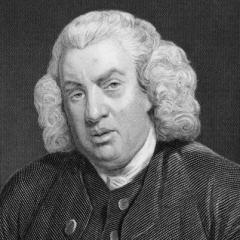
“To understand the works of celebrated authors, to comprehend their systems, and retain their reasonings, is a task more than equal to common intellects; and he is by no means to be accounted useless or idle, who has stored his mind with acquired knowledge, and can detail it occasionally to others who have less leisure or weaker abilities.”
Source: The Works of Samuel Johnson, LL.D.: With An Essay on His Life and Genius
“Friendship, peculiar boon of Heaven, The noble mind's delight and pride, To men and angels only given, To all the lower world denied.”
Source: The Poems of Dr. Samuel Johnson. To which is Prefixed, a Life of the Author
“Present opportunities are neglected, and attainable good is slighted, by minds busied in extensive ranges and intent upon future advantages.”
Source: The Rambler: A Periodical Paper, Published in 1750, 1751, 1752
“It has long been observed, that an atheist has no just reason for endeavouring conversions; and yet none harass those minds which they can influence, with more importunity of solicitation to adopt their opinions. In proportion as they doubt the truth of their own doctrines, they are desirous to gain the attestation of another understanding: and industriously labour to win a proselyte, and eagerly catch at the slightest pretense to dignify their sect with a distinguished name.”
Source: The Beauties of Samuel Johnson: Consisting of Maxims and Observations, Moral, Critical, and Miscellaneous
“It is man's own fault, it is from want of use, if his mind grows torpid in old age.”
Source: The life of Samuel Johnson, LL. D., comprehending an account of his studies, and numerous works, in chronological order: a series of his epistolary correspondence and conversations with many eminent persons; and various original pieces of his composition, never before published; the whole exhibiting a view of literature and literary men in Great Britain, for near half a century during which he flourished
“Sir, if a man has a mind to prance, he must study at Christ Church and All Souls.”
“Human experience, which is constantly contradicting theory, is the great test of truth. A system, built upon the discoveries of a great many minds, is always of more strength, than what is produced by the mere workings of any one mind, which, of itself, can do very little. There is not so poor a book in the world that would not be a prodigious effort were it wrought out entirely by a single mind, without the aid of prior investigators.”
Source: Life of Johnson: Including Boswell's Journal of a Tour to the Hebrides and Johnson's Diary of a Journey Into North Wales
“I advised Chambers, and would advise every young man beginning to compose, to do it as fast as he can, to get a habit of having his mind to start promptly; it is so much more difficult to improve in speed than in accuracy.”
Source: The Life of Samuel Johnson, LL. D.: Including a Journal of a Tour to the Hebrides
“The task of an author is, either to teach what is not known, or to recommend known truths by his manner of adorning them; either to let new light in upon the mind, and open new scenes to the prospect, or to vary the dress and situation of common objects, so as to give them fresh grace and more powerful attractions, to spread such flowers over the regions through which the intellect has already made its progress, as may tempt it to return, and take a second view of things hastily passed over, or negligently regarded.”
Source: The works of Samuel Johnson, LL.D.: Together with his life, and notes on his Lives of the poets, by Sir John Hawkins, Knt. In eleven volumes ...
“Among the many inconsistencies which folly produces or infirmity suffers in the human mind, there has often been observed a manifest and striking contrariety between the life of an author and his writings... Those whom the appearance of virtue or the evidence of genius has tempted to a nearer knowledge of the writer, in whose performances they may be found, have indeed had frequent reason to repent their curiosity.”
Source: Selected poetry and prose
“Consultation and compliance can conduce little to the perfection of any literary performance; for whoever is so doubtful of his own abilities as to encourage the remarks of others, will find himself every day embarrassed with new difficulties, and will harass his mind, in vain, with the hopeless labour of uniting heterogeneous ideas, digesting independent hints, and collecting into one point the several rays of borrowed light, emitted often with contrary directions.”
Source: Samuel Johnson: Selected Writings
“Works of imagination excel by their allurement and delight; by their power of attracting and detaining the attention. That book is good in vain which the reader throws away. He only is the master who keeps the mind in pleasing captivity; whose pages are perused with eagerness, and in hope of new pleasure are perused again; and whose conclusion is perceived with an eye of sorrow, such as the traveller casts upon departing day.”
Source: Lives of the Most Eminent English Poets: With Critical Observations on Their Works
“He that condemns himself to compose on a stated day will often bring to his task attention dissipated, a memory embarrassed, an imagination overwhelmed, a mind distracted with anxieties, a body languishing with disease: he will labour on a barren topic till it is too late to change it; or, in the ardour of invention, diffuse his thoughts into wild exuberance, which the pressing hour of publication cannot suffer judgment to examine or reduce.”
Source: The Works of Samuel Johnson: An essay on the life and genius of Dr. Johnson [by A. Murphy] Poems.- v. 2-4. The rambler.- v. 5. The idler. History of Rasselas, prince of Abissinia.- v. 6-8. The lives of the English poets.- v. 9. Lives of eminent persons. Letters, selected from the collection of Mrs. Piozzi and others. Prayers and meditations.- v. 10. Philological tracts, &c.- v. 11. Miscellaneous tracts, &c. Dedications. Reviews and criticisms. Tales of imagination. The adventurers.-
“There are certain topicks which are never exhausted. Of some images and sentiments the mind of man may be said to be enamoured; it meets them, however often they occur, with the same ardour which a lover feels at the sight of his mistress, and parts from them with the same regret when they can no longer be enjoyed.”
Source: The Works of Samuel Johnson, LL.D.
“It is, however, not necessary, that a man should forbear to write, till he has discovered some truth unknown before; he may be sufficiently useful, by only diversifying the surface of knowledge, and luring the mind by a new appearance to a second view of those beauties which it had passed over inattentively before.”
Source: Samuel Johnson: Selected Writings
“To write is, indeed, no unpleasing employment, when one sentiment readily produces another, and both ideas and expressions present themselves at the first summons; but such happiness, the greatest genius does not always obtain; and common writers know it only to such a degree, as to credit its possibility. Composition is, for the most part, an effort of slow diligence and steady perseverance, to which the mind is dragged by necessity or resolution, and from which the attention is every moment starting to more delightful amusements.”
Source: The Works of Samuel Johnson: The Adventurer and Idler
“If an author be supposed to involve his thoughts in voluntary obscurity, and to obstruct, by unnecessary difficulties, a mind eager in the pursuit of truth; if he writes not to make others learned, but to boast the learning which he possesses himself, and wishes to be admired rather than understood, he counteracts the first end of writing, and justly suffers the utmost severity of censure, or the more afflicting severity of neglect.”
Source: The Rambler: A Periodical Paper, Published in 1750, 1751, 1752
“Truth, like beauty, varies its fashions, and is best recommended by different dresses to different minds; and he that recalls the attention of mankind to any part of learning which time has left behind it, may be truly said to advance the literatures of his own age. As the manners of nations vary, new topicks of persuasion become necessary, and new combinations of imagery are produced; and he that can accommodate himself to the reigning taste, may always have readers who perhaps would not have looked upon better performances.”
Source: The Rambler: A Periodical Paper, Published in 1750, 1751, 1752
“Avarice is a uniform and tractable vice; other intellectual distempers are different in different constitutions of mind. That which soothes the pride of one will offend the pride of another, but to the favor of the covetous bring money, and nothing is denied.”
Source: Selected poetry and prose
“The parallel circumstances and kindred images to which we readily conform our minds are, above all other writings, to be found in the lives of particular persons, and therefore no species of writing seems more worthy of cultivation than biography.”
Source: The Works of Samuel Johnson, LL.D.: With An Essay on His Life and Genius
“Such are the vicissitudes of the world, through all its parts, that day and night, labor and rest, hurry and retirement, endear each other; such are the changes that keep the mind in action: we desire, we pursue, we obtain, we are satiated; we desire something else and begin a new pursuit.”
Source: The Rambler: In Four Volumes..
“Distance either of time or place is sufficient to reconcile weak minds to wonderful relations.”
Source: The works of Samuel Johnson, with Murphy's essay, ed. by R. Lynam
“Timidity is a disease of the mind, obstinate and fatal; for a man once persuaded that any impediment is insuperable has given it, with respect to himself, that strength and weight which it had not before.”
Source: The Rambler
“Good-humor is a state between gayety and unconcern,--the act or emanation of a mind at leisure to regard the gratification of another.”
Source: The Yale Edition of the Works of Samuel Johnson: The Rambler
“Hope is an amusement rather than a good, and adapted to none but very tranquil minds.”
Source: Johnsoniana: Or, Supplement to Boswell: Being Anecdotes and Sayings of Dr. Johnson
“At length weariness succeeds to labor, and the mind lies at ease in the contemplation of her own attainments without any desire of new conquests or excursions. This is the age of recollection and narrative; the opinions are settled, and the avenues of apprehension shut against any new intelligence; the days that are to follow must pass in the inculcation of precepts already collected, and assertion of tenets already received; nothing is henceforward so odious as opposition, so insolent as doubt, or so dangerous as novelty.”
Source: Selected essays
“When a friend is carried to his grave, we at once find excuses for every weakness, and palliation of every fault. We recollect a thousand endearments, which before glided off our minds without impression, a thousand favors unrepaid, a thousand duties unperformed; and wish, vainly wish, for his return, not so much that we may receive as that we may bestow happiness, and recompense that kindness which before we never understood.”
Source: The Wisdom of the Rambler, Adventurer, and Idler
“The mere power of saving what is already in our hands must be of easy acquisition to every mind; and as the example of Lord Bacon may show that the highest intellect cannot safely neglect it, a thousand instances every day prove that the humblest may practise it with success.”
“We frequently fall into error and folly, not because the true principles of action are not known, but because for a time they are not remembered; he may, therefore, justly be numbered among the benefactors of mankind who contracts the great rules of life into short sentences that may early be impressed on the memory, and taught by frequent recollection to occur habitually to the mind.”
Source: The beauties of Johnson: choice selections from his works
“None of the projects or designs which exercise the mind of man are equally subject to obstructions and disappointments with the pursuit of fame.”
Source: The Rambler: In Four Volumes
“Foppery is never cured; it is the bad stamina of the mind, which, like those of the body, are never rectified; once a coxcomb always a coxcomb.”
“Every human being whose mind is not debauched, will be willing to give all that he has to get knowledge.”
Source: Life of Johnson: Including Boswell's Journal of a Tour to the Hebrides and Johnson's Diary of a Journey Into North Wales
“A minute analysis of life at once destroys that splendor which dazzles the imagination. Whatsoever grandeur can display, or luxury enjoy, is procured by offices of which the mind shrinks from the contemplation. All the delicacies of the table may be traced back to the shambles and the dunghill; all magnificence of building was hewn from the quarry, and all the pomp of ornament dug from among the damps and darkness of the mine.”
Source: The beauties of Samuel Johnson, LL. D.: consisting of maxims and observations, moral, critical, and miscellaneous: to which are now added biographical anecdotes of the doctor, selected from the works of Mrs. Piozzi;--his Life, recently published by Mr. Boswell, and other authentic testimonies; also his will, and the sermon he wrote for the late Doctor Dodd
“More is learned in a public than in a private school, from emulation. There is the collision of mind with mind, or the radiation of many minds pointing to one center.”
Source: The life of Samuel Johnson, LL. D. Together with the journal of a tour to the Hebrides: James Boswell
“The love of retirement has in all ages adhered closely to those minds which have been most enlarged by knowledge, or elevated by genius. Those who enjoyed everything generally supposed to confer happiness have been forced to seek it in the shades of privacy.”
Source: The works of Samuel Johnson, LL. D.: with an essay on his life and genius
“Sorrow is properly that state of the mind in which our desires are fixed upon the past without looking forward to the future.”
Source: The Rambler
“Whatever professes to benefit by pleasing must please at once. The pleasures of the mind imply something sudden and unexpected; that which elevates must always surprise.”
Source: Selected poetry and prose
“A man who always talks for fame never can be pleasing. The man who talks to unburthen his mind is the man to delight you.”
“The necessary connexion of representatives with taxes, seems to have sunk deep into many of those minds, that admit sounds, without their meaning.”
Source: The Works of Samuel Johnson, LL. D.: Lives of the poets
“Presumption will be easily corrected; but timidity is a disease of the mind more obstinate and fatal.”
Source: The Life and Writings of Samuel Johnson...
“Never mind the use--do it!”
Source: The life of Samuel Johnson, LL. D., comprehending an account of his studies, and numerous works, in chronological order: a series of his epistolary correspondence and conversations with many eminent persons; and various original pieces of his composition, never before published; the whole exhibiting a view of literature and literary men in Great Britain, for near half a century during which he flourished
“To purchase Heaven has gold the power?
Can gold remove the mortal hour?
In life can love be bought with gold?
Are friendship's pleasures to be sold?
No--all that's worth a wish--a thought,
Fair virtue gives unbribed, unbought.
Cease then on trash thy hopes to bind,
Let nobler views engage thy mind.”
Source: The Works of Samuel Johnson, LL. D.: With an Essay on His Life and Genius /c by Arthur Murphy, Esq
“The prosperity of a people is proportionate to the number of hands and minds usefully employed. To the community, sedition is a fever, corruption is a gangrene, and idleness is an atrophy. Whatever body or society wastes more than it acquires, must gradually decay, and every being that continues to be fed, and eases to labor, takes away something from the public stock.”
“Life of Ages, richly poured,
Love of God unspent and free,
Flowing in the Prophet's word
And the People's liberty!
Never was to chosen race
That unstinted tide confined;
Thine is every time and place,
Fountain sweet of heart and mind!”
Source: Hymns of the Spirit
“Forgetfulness is necessary to remembrance. Ideas are retained by renovation of that impression which time is always wearing away,and which new images are striving to obliterate. If useless thoughts could be expelled from the mind, all the valuable parts of our knowledge would more frequently recur, and every recurrence would reinstate them in their former place.”
Source: The Rambler: A Periodical Paper, Published in 1750, 1751, 1752
“Pour forth thy fervors for a healthful mind,
Obedient passions, and a will resigned”
Source: Selected poetry and prose
“Few moments are more pleasing than those in which the mind is concerting measures for a new undertaking.”
Source: The Rambler: In Four Volumes..
“Among the innumerable mortifications which waylay human arrogance on every side may well be reckoned our ignorance of the most common objects and effects, a defect of which we become more sensible by every attempt to supply it. Vulgar and inactive minds confound familiarity with knowledge and conceive themselves informed of the whole nature of things when they are shown their form or told their use; but the speculatist, who is not content with superficial views, harasses himself with fruitless curiosity, and still, as he inquires more, perceives only that he knows less.”
“Do not ... hope wholly to reason away your troubles; do not feed them with attention, and they will die imperceptibly away. Fix your thoughts upon your business, fill your intervals with company, and sunshine will again break in upon your mind.”
Source: The Letters of Samuel Johnson, Volume II: 1773-1776
“A person loves to review his own mind. That is the use of a diary, or journal.”
Source: The life of Samuel Johnson, LL. D., comprehending an account of his studies, and numerous works, in chronological order: a series of his epistolary correspondence and conversations with many eminent persons; and various original pieces of his composition, never before published; the whole exhibiting a view of literature and literary men in Great Britain, for near half a century during which he flourished