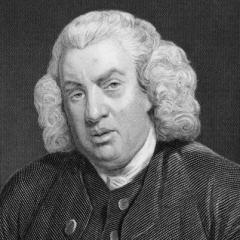
“It is better a man should be abused than forgotten.”
Source: Johnsoniana; or supplement to Boswell; being Anecdotes and sayings of Dr. Johnson, etc
“A man should be careful never to tell tales of himself to his own disadvantage. People may be amused at the time, but they will be remembered, and brought out against him upon some subsequent occasion.”
“The student who would build his knowledge on solid foundations, and proceed by just degrees to the pinnacles of truth, is directed by the great philosopher of France to begin by doubting of his own existence. In like manner, whoever would complete any arduous and intricate enterprise, should, as soon as his imagination can cool after the first blaze of hope, place before his own eyes every possible embarrassment that may retard or defeat him. He should first question the probability of success, and then endeavour to remove the objections that he has raised.”
Source: The Rambler: A Periodical Paper, Published in 1750, 1751, 1752
“Had I learned to fiddle, I should have done nothing else.”
Source: The Life of Samuel Johnson
“It is no matter what you teach them first, any more than what leg you shall put into your breeches first. You may stand disputing which is best to put in first, but in the mean time your breech is bare. Sir, while you are considering which of two things you should teach your child first, another boy has learned them both.”
Source: Dr. Johnson's Table-talk: Containing Aphorisms on Literature, Life, and Manners, with Anecdotes of Distinguished Persons, Selected and Arranged from Mr. Boswell's Life of Johnson
“Words too familiar, or too remote, defeat the purpose of a poet. From those sounds which we hear on small or on coarse occasions, we do not easily receive strong impressions, or delightful images; and words to which we are nearly strangers, whenever they occur, draw that attention on themselves which they should transmit to other things.”
Source: The Lives of the English Poets
“As every writer has his use, every writer ought to have his patrons; and since no man, however high he may now stand, can be certain that he shall not be soon thrown down from his elevation by criticism or caprice, the common interest of learning requires that her sons should cease from intestine hostilities, and, instead of sacrificing each other to malice and contempt, endeavour to avert persecution from the meanest of their fraternity.”
Source: The works of Samuel Johnson, LL.D.: Together with his life, and notes on his Lives of the poets, by Sir John Hawkins, Knt. In eleven volumes ...
“Critics ought never to be consulted, but while errors may yet be rectified or insipidity suppressed. But when the book has once been dismissed into the world, and can be no more retouched, I know not whether a very different conduct should not be prescribed, and whether firmness and spirit may not sometimes be of use to overpower arrogance and repel brutality.”
Source: Selected essays
“It is, however, not necessary, that a man should forbear to write, till he has discovered some truth unknown before; he may be sufficiently useful, by only diversifying the surface of knowledge, and luring the mind by a new appearance to a second view of those beauties which it had passed over inattentively before.”
Source: Samuel Johnson: Selected Writings
“There are three distinct kind of judges upon all new authors or productions; the first are those who know no rules, but pronounce entirely from their natural taste and feelings; the second are those who know and judge by rules; and the third are those who know, but are above the rules. These last are those you should wish to satisfy. Next to them rate the natural judges; but ever despise those opinions that are formed by the rules.”
Source: The critical opinions of Samuel Johnson
“There should be a stated day for commemorating the birthday of our Savior, because there is danger that what may be done on any day, will be neglected.”
“No man is without some quality, by the due application of which he might deserve well of the world; and whoever he be that has but little in his power should be in haste to do that little, lest he be confounded with him that can do nothing.”
Source: The Works of Samuel Johnson, LL.D.: With An Essay on His Life and Genius
“There is nothing against which an old man should be so much upon his guard as putting himself to nurse.”
Source: The life of Samuel Johnson, LL. D., comprehending an account of his studies, and numerous works, in chronological order: a series of his epistolary correspondence and conversations with many eminent persons; and various original pieces of his composition, never before published; the whole exhibiting a view of literature and literary men in Great Britain, for near half a century during which he flourished
“Dishonor waits on perfidy. A man should blush to think a falsehood; it is the crime of cowards.”
“The man who feels himself ignorant should, at least, be modest.”
Source: The beauties of Samuel Johnson, LL. D.: consisting of maxims and observations, moral, critical, and miscellaneous: to which are now added biographical anecdotes of the doctor, selected from the works of Mrs. Piozzi;--his Life, recently published by Mr. Boswell, and other authentic testimonies; also his will, and the sermon he wrote for the late Doctor Dodd
“How gloomy would be the mansions of the dead to him who did not know that he should never die: that what now acts shall continue its agency, and what now thinks shall think on forever!”
Source: THE
“A man of sense and education should meet a suitable companion in a wife. It is a miserable thing when the conversation can only be such as whether the mutton should be boiled or roasted, and probably a dispute about that.”
Source: The Life of Samuel Johnson, LL. D.: Including a Journal of a Tour to the Hebrides
“Books, says Lord Bacon, can never teach us the use of books; the student must learn by commerce with mankind to reduce his speculations to practice. No man should think so highly of himself as to think he can receive but little light from books; no one so meanly, as to believe he can discover nothing but what is to be learned from them.”
“The care of the critic should be to distinguish error from inability, faults of inexperience from defects of nature.”
Source: The Idler: With Additional Essays
“Misfortunes should always be expected.”
“To grieve for evils is often wrong; but it is much more wrong to grieve without them. All sorrow that lasts longer than its cause is morbid, and should be shaken off as an attack of melancholy, as the forerunner of a greater evil than poverty or pain.”
Source: The Letters of Samuel Johnson, Volume III: 1777-1781
“He that would travel for the entertainment of others should remember that the great object of remark is human life.”
Source: The Beauties of Samuel Johnson, LL.D.: Consisting of Maxims and Observations, Moral, Critical, and Miscellaneous, to which are Now Added, Biographical Anecdotes of the Doctor, Selected from the Late Productions of Mrs. Piozzi, Mr. Boswell, ...
“The greatest human virtue bears no proportion to human vanity. We always think ourselves better than we are, and are generally desirous that others should think us still better than we think ourselves. To praise us for actions or dispositions which deserve praise is not to confer a benefit, but to pay a tribute. We have always pretensions to fame which, in our own hearts, we know to be disputable, and which we are desirous to strengthen by a new suffrage; we have always hopes which we suspect to be fallacious, and of which we eagerly snatch at every confirmation.”
Source: The Wisdom of the Rambler, Adventurer, and Idler
“A country gentleman should bring his lady to visit London as soon as he can, that they may have agreeable topicks for conversation when they are by themselves.”
Source: The life of Samuel Johnson, LL. D., comprehending an account of his studies, and numerous works, in chronological order: a series of his epistolary correspondence and conversations with many eminent persons; and various original pieces of his composition, never before published; the whole exhibiting a view of literature and literary men in Great Britain, for near half a century during which he flourished
“Whosoever shall look heedfully upon those who are eminent for their riches will not think their condition such as that he should hazard his quiet, and much less his virtue, to obtain it, for all that great wealth generally gives above a moderate fortune is more room for the freaks of caprice, and more privilege for ignorance and vice, a quicker succession of flatteries, and a larger circle of voluptuousness.”
Source: The Rambler: A Periodical Paper, Published in 1750, 1751, 1752
“There must always be some advantage on one side or the other, and it is better that advantage should be had by talents than by chance.”
Source: Boswell's Life of Johnson: Including Boswell's Journal of a Tour of the Hebrides, and Johnson's Diary of A Journey Into North Wales
“Wine gives great pleasure, and every pleasure is of itself a good. and
A man should cultivate his mind so as to have that confidence and readiness without wine, which wine gives.”
Source: The Life of Samuel Johnson
“I would injure no man, and should provoke no resentment. I would relieve every distress, and should enjoy the benedictions of gratitude. I would choose my friends among the wise and my wife among the virtuous, and therefore should be in no danger from treachery or unkindness. My children should by my care be learned and pious, and would repay to my age what their childhood had received.”
Source: Rasselas
“It is strange that there should be so little reading in the world, and so much writing. People in general do not willingly read, if they can have any thing else to amuse them.”
“No man should attempt to teach others what he has never learned himself”
Source: The Works of Samuel Johnson, LL.D.: With Murphy's Essay
“Books like friends, should be few and well-chosen.”
“Subordination tends greatly to human happiness. Were we all upon an equality, we should have no other enjoyment than mere animal pleasure.”
Source: The table talk of Samuel Johnson
“If a man does not make new acquaintances as he advances through life, he will soon find himself left alone. A man, sir, should keep his friendship in a constant repair.”
“It is better that some should be unhappy rather than that none should be happy, which would be the case in a general state of equality.”
“Melancholy, indeed, should be diverted by every means but drinking.”
Source: The life of Samuel Johnson, LL. D., comprehending an account of his studies, and numerous works, in chronological order: a series of his epistolary correspondence and conversations with many eminent persons; and various original pieces of his composition, never before published; the whole exhibiting a view of literature and literary men in Great Britain, for near half a century during which he flourished
“You raise your voice when you should reinforce your argument.”
“The Church does not superstitiously observe days, merely as days, but as memorials of important facts. Christmas might be kept as well upon one day of the year as another; but there should be a stated day for commemorating the birth of our Saviour, because there is danger that what may be done on any day, will be neglected.”
Source: The Table Talk of Dr. Johnson: Comprising Opinions and Anecdotes of Life and Literature, Men, Manners, and Morals
“Sir, I did not count your glasses of wine, why should you number up my cups of tea?”
Source: Life of Johnson: Including Boswell's Journal of a Tour to the Hebrides and Johnson's Diary of a Journey Into North Wales
“When I was as you are now, towering in the confidence of twenty-one, little did I suspect that I should be at forty-nine, what I now am.”
Source: Life of Johnson: Including Boswell's Journal of a Tour to the Hebrides and Johnson's Diary of a Journey Into North Wales
“Cucumber should be well sliced, dressed with pepper and vinegar, and then thrown out.”
“Since every man is obliged to promote happiness and virtue, he should be careful not to mislead unwary minds, by appearing to set too high a value upon things by which no real excellence is conferred.”
Source: The Works of Samuel Johnson, LL.D..: The Rambler
“Reproof should not exhaust its power upon petty failings.”
Source: The Beauties of Samuel Johnson, LL.D.: Consisting of Maxims and Observations, Moral, Critical, and Miscellaneous, to which are Now Added, Biographical Anecdotes of the Doctor, Selected from the Late Productions of Mrs. Piozzi, Mr. Boswell, ...
“Yet it is necessary to hope, though hope should always be deluded, for hope itself is happiness, and its frustrations, however frequent, are yet less dreadful than its extinction.”
Source: The Works of Samuel Johnson, LL.D..: The Adventurer and Idler
“In all evils which admit a remedy, impatience is to be avoided, because it wastes that time and attention in complaints, that, if properly applied might remove the cause.”
“In order that all men might be taught to speak truth, it is necessary that all likewise should learn to hear it.”
Source: The Beauties of Johnson: Consisting of Maxims and Observations, Moral, Critical, and Miscellaneous, Accurately Extracted from the Works of Dr. Samuel Johnson, and Arranged in Alphabetical Order, After the Manner of the Duke de la Roche-Foucault's Maxims
“Fear is implanted in us as a preservative from evil but its duty, like that of other passions, is not to overbear reason, but to assist it. It should not be suffered to tyrannize in the imagination, to raise phantoms of horror, or to beset life with supernumerary distresses.”
Source: The Rambler: In Four Volumes
“It is very strange, and very melancholy, that the paucity of human pleasures should persuade us ever to call hunting one of them.”
“God Himself, sir, does not propose to judge a man until his life is over. Why should you and I?”
“No degree of knowledge attainable by man is able to set him above the want of hourly assistance, or to extinguish the desire of fond endearments and tender officiousness; and, therefore, no one should think it unnecessary to learn those arts by which friendship may be gained.”
Source: Johnsoniana: Or, Supplement to Boswell: Being Anecdotes and Sayings of Dr. Johnson
“He that would travel for the entertainment of others, should remember that the great object of remark is human life. Every Nation has something peculiar in its Manufactures, its Works of Genius, its Medicines, its Agriculture, its Customs, and its Policy. He only is a useful Traveller, who brings home something by which his country may be benefited; who procures some supply of Want, or some mitigation of Evil, which may enable his readers to compare their condition with that of others, to improve it whenever it is worse, and whenever it is better to enjoy it.”