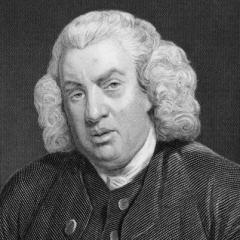
“There is no problem the mind of man can set that the mind of man cannot solve.”
“Many of our miseries are merely comparative: we are often made unhappy, not by the presence of any real evil, but by the absence of some fictitious good; of something which is not required by any real want of nature, which has not in itself any power of gratification, and which neither reason nor fancy would have prompted us to wish, did we not see it in the possession of others.”
Source: The Works of Samuel Johnson, LL.: D., with an Essay on His Life and Genius
“The accidental prescriptions of authority, when time has procured them veneration, are often confounded with the laws of nature, and those rules are supposed coeval with reason, of which the first rise cannot be discovered.”
Source: The Rambler: A Periodical Paper, Published in 1750, 1751, 1752
“Reason will by degrees submit to absurdity, as the eye is in time accommodated to darkness.”
“It has long been observed, that an atheist has no just reason for endeavouring conversions; and yet none harass those minds which they can influence, with more importunity of solicitation to adopt their opinions. In proportion as they doubt the truth of their own doctrines, they are desirous to gain the attestation of another understanding: and industriously labour to win a proselyte, and eagerly catch at the slightest pretense to dignify their sect with a distinguished name.”
Source: The Beauties of Samuel Johnson: Consisting of Maxims and Observations, Moral, Critical, and Miscellaneous
“I have two very cogent reasons for not printing any list of subscribers; one, that I have lost all the names, the other, that I have spent all the money.”
“Among the many inconsistencies which folly produces or infirmity suffers in the human mind, there has often been observed a manifest and striking contrariety between the life of an author and his writings... Those whom the appearance of virtue or the evidence of genius has tempted to a nearer knowledge of the writer, in whose performances they may be found, have indeed had frequent reason to repent their curiosity.”
Source: Selected poetry and prose
“It is not difficult to conceive, however, that for many reasons a man writes much better than he lives. For without entering into refined speculations, it may be shown much easier to design than to perform. A man proposes his schemes of life in a state of abstraction and disengagement, exempt from the enticements of hope, the solicitations of affection, the importunities of appetite, or the depressions of fear.”
Source: The Rambler: A Periodical Paper, Published in 1750, 1751, 1752
“Admiration must be continued by that novelty which first produces it; and how much soever is given, there must always be reason to imagine that more remains.”
Source: The Rambler
“Advice, as it always gives a temporary appearance of superiority, can never be very grateful, even when it is most necessary or most judicious; but, for the same reason, every one is eager to instruct his neighbors.”
Source: The Works of Samuel Johnson, LL.D.: With An Essay on His Life and Genius
“Locke, whom there is no reason to suspect of being a favorer of idleness or libertinism, has advanced that whoever hopes to employ any part of his time with efficacy and vigor must allow some of it to pass with trifles.”
“There is nothing more dreadful to an author than neglect; compared with which reproach, hatred, and opposition are names of happiness; yet this worst, this meanest fate, every one who dares to write has reason to fear.”
Source: The Rambler: A Periodical Paper, Published in 1750, 1751, 1752
“Their origin is commonly unknown; for the practice often continues when the cause has ceased, and concerning superstitious ceremonies it is in vain to conjecture; for what reason did not dictate, reason cannot explain.”
Source: Selected poetry and prose
“Yet reason frowns in war's unequal game,
Where wasted nations raise a single name;
And mortgag'd states their grandsire's wreaths regret,
From age to age in everlasting debt;
Wreaths which at last the dear-bought right convey
To rust on medals, or on stones decay.”
Source: The Poems of Dr. Samuel Johnson. To which is Prefixed, a Life of the Author
“The duty of criticism is neither to depreciate nor dignify by partial representations, but to hold out the light of reason, whatever it may discover; and to promulgate the determinations of truth, whatever she shall dictate”
Source: The works of Samuel Johnson, LL. D.: with an essay on his life and genius
“Human reason borrowed many arts from the instinct of animals.”
Source: The History of Rasselas, Prince of Abyssinia: the vanity of human wished: The History of Solÿman and Almena by John Langhorne
“All power of fancy over reason is a degree of madness.”
Source: Johnsoniana; or supplement to Boswell; being Anecdotes and sayings of Dr. Johnson, etc
“Wisdom and virtue are by no means sufficient, without the supplemental laws of good-breeding, to secure freedom from degenerating into rudeness, or self esteem from swelling into insolence. A thousand incivilities may be committed, and a thousand offices neglected. without any remorse of conscience, or reproach from reason.”
Source: The Works of Samuel Johnson, LL.D.: With Murphy's Essay
“Reason elevates our thoughts as high as the stars, and leads us through the vast space of this mighty fabric; yet it comes far short of the real extent of our corporeal being.”
“He who would govern his actions by the laws of virtue must regulate his thoughts by those of reason.”
Source: Selected poetry and prose
“There may be other reasons for a man's not speaking in publick than want of resolution: he may have nothing to say.”
Source: The life of Samuel Johnson, LL. D., comprehending an account of his studies, and numerous works, in chronological order: a series of his epistolary correspondence and conversations with many eminent persons; and various original pieces of his composition, never before published; the whole exhibiting a view of literature and literary men in Great Britain, for near half a century during which he flourished
“Among the innumerable mortifications which waylay human arrogance on every side may well be reckoned our ignorance of the most common objects and effects, a defect of which we become more sensible by every attempt to supply it. Vulgar and inactive minds confound familiarity with knowledge and conceive themselves informed of the whole nature of things when they are shown their form or told their use; but the speculatist, who is not content with superficial views, harasses himself with fruitless curiosity, and still, as he inquires more, perceives only that he knows less.”
“Do not ... hope wholly to reason away your troubles; do not feed them with attention, and they will die imperceptibly away. Fix your thoughts upon your business, fill your intervals with company, and sunshine will again break in upon your mind.”
Source: The Letters of Samuel Johnson, Volume II: 1773-1776
“What is the reason that women servants ... have much lower wages than men servants ... when in fact our female house servants work much harder than the male?”
“A student may easily exhaust his life in comparing divines and moralists without any practical regard to morals and religion; he may be learning not to live but to reason... while the chief use of his volumes is unthought of, his mind is unaffected, and his life is unreformed.”
Source: The Works of Samuel Johnson: LL.D. A New Edition in Twelve Volumes. With an Essay on His Life and Genius, by Arthur Murphy, Esq
“We have less reason to be surprised or offended when we find others differ from us in opinion, because we very often differ from ourselves.”
Source: Essays from the Rambler, Adventurer, and Idler
“Whatever is proposed, it is much easier to find reasons for rejecting than embracing.”
Source: The Works of Samuel Johnson, LL. D.: With an Essay on His Life and Genius /c by Arthur Murphy, Esq
“Prejudice is a great time-saver. You can form opinions without having to get the facts. Prejudice not being founded on reason cannot be removed by argument.”
“There is, indeed, nothing that so much seduces reason from vigilance, as the thought of passing life with an amiable woman.”
Source: The life of Samuel Johnson, LL. D., comprehending an account of his studies, and numerous works, in chronological order: a series of his epistolary correspondence and conversations with many eminent persons; and various original pieces of his composition, never before published; the whole exhibiting a view of literature and literary men in Great Britain, for near half a century during which he flourished
“Prejudice, not being founded on reason, cannot be removed by argument.”
“A man finds in the productions of nature an inexhaustible stock of material on which he can employ himself, without any temptations to envy or malevolence, and has always a certain prospect of discovering new reasons for adoring the sovereign author of the universe.”
Source: The Rambler: A Periodical Paper, Published in 1750, 1751, 1752
“Fear is implanted in us as a preservative from evil but its duty, like that of other passions, is not to overbear reason, but to assist it. It should not be suffered to tyrannize in the imagination, to raise phantoms of horror, or to beset life with supernumerary distresses.”
Source: The Rambler: In Four Volumes
“Evil is uncertain in the same degree as good, and for the reason that we ought not to hope too securely, we ought not to fear with to much dejection.”
Source: The Rambler: A Periodical Paper, Published in 1750, 1751, 1752
“The majority have no other reason for their opinions than that they are the fashion.”
“The world will never be long without some good reason to hate the unhappy; their real faults are immediately detected; and if those are not sufficient to sink them into infamy, an individual weight of calumny will be super-added.”
“It is not from reason and prudence that people marry, but from inclination.”
Source: The Table Talk of Dr. Johnson: Comprising Opinions and Anecdotes of Life and Literature, Men, Manners, and Morals
“Solitude is dangerous to reason, without being favourable to virtue. Remember that the solitary mortal is certainly luxurious, probably superstitious, and possibly mad.”
“There is reason to suspect, that the distinctions of mankind have more show than value, when it is found that all agree to be weary alike of pleasures and of cares; that the powerful and the weak, the celebrated and obscure, join in one common wish, and implore from nature's hand the nectar of oblivion.”
Source: The Works of Samuel Johnson, LL.D.: With An Essay on His Life and Genius
“Of many, imagined blessings it may be doubted whether he that wants or possesses them had more reason to be satisfied with his lot.”
Source: Murphy's essay. The rambler. The adventurer. The idler. Rasselas. Tales of the imagination. Letters. Irene. Miscellaneous poems
“Advice, as it always gives a temporary appearance of superiority, can never be very grateful, even when it is most necessary or most judicious. But for the same reason everyone is eager to instruct his neighbours. To be wise or to be virtuous is to buy dignity and importance at a high price; but when nothing is necessary to elevation but detection of the follies or faults of others, no man is so insensible to the voice of fame as to linger on the ground.”
“None but those who have learned the art of subjecting their senses as well as reason to hypothetical systems can be persuaded by the most specious rhetorician that the lots of life are equal; yet it cannot be denied that every one has his peculiar pleasures and vexations, that external accidents operate variously upon different minds, and that no man can exactly judge from his own sensations what another would feel in the same circumstances.”
Source: The Rambler
“There are occasions on which it is noble to dare to stand alone. To be pious among infidels, to be disinterested in a time of general venality, to lead a life of virtue and reason in the midst of sensualists, is a proof of a mind intent on nobler things than the praise or blame of men, of a soul fixed in the contemplation of the highest good, and superiour to the tyranny of custom and example.”
Source: The Works of Samuel Johnson, LL.D.: With An Essay on His Life and Genius
“No man can perform so little as not to have reason to congratulate himself on his merits, when he beholds the multitude that live in total idleness, and have never yet endeavoured to be useful.”
Source: The Works of Samuel Johnson, LL.D.: With An Essay on His Life and Genius
“Pity is not natural to man. Children are always cruel. Savages are always cruel. Pity is acquired and improved by the cultivation of reason. We may have uneasy sensations from seeing a creature in distress, without pity; for we have not pity unless we wish to relieve them.”
“Those who have any intention of deviating from the beaten roads of life, and acquiring a reputation superior to names hourly swept away by time among the refuse of fame, should add to their reason and their spirit the power of persisting in their pur”
Source: The Rambler
“Reason and truth will prevail at last”
Source: The Works of Samuel Johnson, LL. D.
“Sir, sorrow is inherent in humanity. As you cannot judge two and two to be either five, or three, but certainly four, so, when comparing a worse present state with a better which is past, you cannot but feel sorrow. It is not cured by reason, but by the incursion of present objects, which bear out the past.”
Source: Boswell's Life of Johnson: Including Boswell's Journal of a Tour of the Hebrides, and Johnson's Diary of A Journey Into North Wales
“Surely nothing is more reproachful to a being endowed with reason, than to resign its powers to the influence of the air, and live in dependence on the weather and the wind, for the only blessings which nature has put into our power, tranquillity and benevolence. To look up to the sky for the nutriment of our bodies, is the condition of nature; to call upon the sun for peace and gaiety, or deprecate the clouds lest sorrow should overwhelm us, is the cowardice of idleness, and the idolatry of folly.”
Source: Samuel Johnson: Selected Writings
“Some people wave their dogmatic thinking until their own reason is entangled.”
“We may take Fancy for a companion, but must follow Reason as our guide.”
Source: The life of Samuel Johnson, LL. D., comprehending an account of his studies, and numerous works, in chronological order: a series of his epistolary correspondence and conversations with many eminent persons; and various original pieces of his composition, never before published; the whole exhibiting a view of literature and literary men in Great Britain, for near half a century during which he flourished