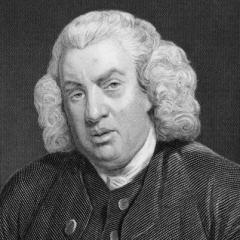
“A tavern chair is the throne of human felicity.”
Source: Selected poetry and prose
“Human experience, which is constantly contradicting theory, is the great test of truth. A system, built upon the discoveries of a great many minds, is always of more strength, than what is produced by the mere workings of any one mind, which, of itself, can do very little. There is not so poor a book in the world that would not be a prodigious effort were it wrought out entirely by a single mind, without the aid of prior investigators.”
Source: Life of Johnson: Including Boswell's Journal of a Tour to the Hebrides and Johnson's Diary of a Journey Into North Wales
“Among the many inconsistencies which folly produces or infirmity suffers in the human mind, there has often been observed a manifest and striking contrariety between the life of an author and his writings... Those whom the appearance of virtue or the evidence of genius has tempted to a nearer knowledge of the writer, in whose performances they may be found, have indeed had frequent reason to repent their curiosity.”
Source: Selected poetry and prose
“No place affords a more striking conviction of the vanity of human hopes than a public library; for who can see the wall crowded on every side by mighty volumes, the works of laborious meditations and accurate inquiry, now scarcely known but by the catalogue.”
Source: The Works of Samuel Johnson, LL. D.: With an Essay on His Life and Genius /c by Arthur Murphy, Esq
“Many leave the labours of half their life to their executors and to chance, because they will not send them abroad unfinished, and are unable to finish them, having prescribed to themselves such a degree of exactness as human diligence can scarcely ontain.”
Source: The Works of Samuel Johnson, LL.D.: With An Essay on His Life and Genius
“Of those that spin out trifles and die without a memorial, many flatter themselves with high opinions of their own importance, and imagine that they are every day adding some improvement to human life.”
Source: The Rambler: A Periodical Paper, Published in 1750, 1751, 1752
“Disease generally begins that equality which death completes; the distinctions which set one man so much above another are very little perceived in the gloom of a sick chamber, where it will be vain to expect entertainment from the gay, or instruction from the wise; where all human glory is obliterated, the wit is clouded, the reasoner perplexed, and the hero subdued; where the highest and brightest of mortal beings finds nothing left him but the consciousness of innocence.”
Source: The Rambler: In Four Volumes..
“Such is the emptiness of human enjoyment that we are always impatient of the present. Attainment is followed by neglect, and possession by disgust.”
Source: The Rambler: In Four Volumes
“Pound St. Paul's Church into atoms, and consider any single atom; it is to be sure, good for nothing; but put all these atoms together, and you have St. Paul's Church. So it is with human felicity, which is made up of many ingredients, each of which may be shown to be very insignificant.”
Source: The Life of Samuel Johnson, LL. D.: Including a Journal of a Tour to the Hebrides
“Providence has fixed the limits of human enjoyment by immovable boundaries, and has set different gratifications at such a distance from each other, that no art or power can bring them together. This great law it is the business of every rational being to understand, that life may not pass away in an attempt to make contradictions consistent, to combine opposite qualities, and to unite things which the nature of their being must always keep asunder.”
Source: Life and Writings
“Human reason borrowed many arts from the instinct of animals.”
Source: The History of Rasselas, Prince of Abyssinia: the vanity of human wished: The History of Solÿman and Almena by John Langhorne
“The present is never a happy state to any human being.”
“Such is the uncertainty of human affairs, that security and despair are equal follies; and as it is presumption and arrogance to anticipate triumphs, it is weakness and cowardice to prog-nosticate miscarriages.”
Source: The Rambler
“The time will come to every human being when it must be known how well he can bear to die.”
Source: The Works of Sir Thomas Browne: Preface. Dr. Johnson's Life of Sir Thomas Browne. Supplementary memoir by the editor. Mrs. Lyttleton's communication to Bishop Kennet. Pseudodoxia epidemica, books I-IV
“Every human being whose mind is not debauched, will be willing to give all that he has to get knowledge.”
Source: Life of Johnson: Including Boswell's Journal of a Tour to the Hebrides and Johnson's Diary of a Journey Into North Wales
“A small country town is not the place in which one would choose to quarrel with a wife; every human being in such places is a spy.”
“He that would travel for the entertainment of others should remember that the great object of remark is human life.”
Source: The Beauties of Samuel Johnson, LL.D.: Consisting of Maxims and Observations, Moral, Critical, and Miscellaneous, to which are Now Added, Biographical Anecdotes of the Doctor, Selected from the Late Productions of Mrs. Piozzi, Mr. Boswell, ...
“The greatest human virtue bears no proportion to human vanity. We always think ourselves better than we are, and are generally desirous that others should think us still better than we think ourselves. To praise us for actions or dispositions which deserve praise is not to confer a benefit, but to pay a tribute. We have always pretensions to fame which, in our own hearts, we know to be disputable, and which we are desirous to strengthen by a new suffrage; we have always hopes which we suspect to be fallacious, and of which we eagerly snatch at every confirmation.”
Source: The Wisdom of the Rambler, Adventurer, and Idler
“Among the innumerable mortifications which waylay human arrogance on every side may well be reckoned our ignorance of the most common objects and effects, a defect of which we become more sensible by every attempt to supply it. Vulgar and inactive minds confound familiarity with knowledge and conceive themselves informed of the whole nature of things when they are shown their form or told their use; but the speculatist, who is not content with superficial views, harasses himself with fruitless curiosity, and still, as he inquires more, perceives only that he knows less.”
“To wipe all tears from off all faces is a task too hard for mortals; but to alleviate misfortunes is often within the most limited power: yet the opportunities which every day affords of relieving the most wretched of human beings are overlooked and neglected with equal disregard of policy and goodness.”
Source: The Works of Samuel Johnson, LL. D.: With an Essay on His Life and Genius /c by Arthur Murphy, Esq
“To proportion the eagerness of contest to its importance seems too hard a task for human wisdom. The pride of wit has kept ages busy in the discussion of useless questions, and the pride of power has destroyed armies, to gain or to keep unprofitable possessions.”
Source: Lives of the poets. Lives of eminent persons. Political tracts. Philological tracts. Miscellaneous tracts. Dedications. Opinions on questions of law. Reviews and criticisms. Journey to the Western islands of Scotland. Prayers and meditations
“The cure for the greatest part of human miseries is not radical, but palliative.”
Source: The Rambler: In Four Volumes
“It is certain that success naturally confirms in us a favourable opinion of our own abilities. Scarce any man is willing to allot to accident, friendship, and a thousand causes, which concur in every event without human contrivance or interposition, the part which they may justly claim in his advancement. We rate ourselves by our fortune rather than our virtues, and exorbitant claims are quickly produced by imaginary merit.”
Source: The Rambler: In Four Volumes..
“He who has so little knowledge of human nature as to seek happiness by changing anything but his own disposition will waste his life in fruitless efforts.”
Source: The beauties of Johnson: choice selections from his works
“The mind is never satisfied with the objects immediately before it, but is always breaking away from the present moment, and losing itself in schemes of future felicity... The natural flights of the human mind are not from pleasure to pleasure, but from hope to hope.”
Source: The Rambler: A Periodical Paper, Published in 1750, 1751, 1752
“Resolve not to be poor: whatever you have, spend less. Poverty is a great enemy to human happiness; it certainly destroys liberty, and it makes some virtues impracticable, and others extremely difficult.”
“I have always considered it as treason against the great republic of human nature, to make any man's virtues the means of deceiving him.”
Source: The Works of Samuel Johnson, LL. D.: With an Essay on His Life and Genius /c by Arthur Murphy, Esq
“Subordination tends greatly to human happiness. Were we all upon an equality, we should have no other enjoyment than mere animal pleasure.”
Source: The table talk of Samuel Johnson
“Human life is everywhere a state in which much is to be endured, and little to be enjoyed.”
“To strive with difficulties, and to conquer them, is the highest human felicity.”
Source: The Works of Samuel Johnson, LL. D.: With an Essay on His Life and Genius /c by Arthur Murphy, Esq
“No place affords a more striking conviction of the vanity of human hopes than a public library.”
“Everything that enlarges the sphere of human powers, that shows man he can do what he thought he could not do, is valuable.”
Source: The Life of Samuel Johnson, LL. D.: Including a Journal of a Tour to the Hebrides
“The natural flights of the human mind are not from pleasure to pleasure, but from hope to hope.”
Source: The Rambler
“No weakness of the human mind has more frequently incurred animadversion, than the negligence with which men overlook their own faults, however flagrant, and the easiness with which they pardon them, however frequently repeated.”
Source: The Rambler: A Periodical Paper, Published in 1750, 1751, 1752
“The applause of a single human being is of great consequence.”
Source: Dr. Johnson's Table Talk: Containing Aphorisms on Literature, Life, and Manners; with Anecdotes of Distinguished Persons, Selected and Arranged from Dr. Boswell's Life of Johnson
“The law is the last result of human wisdom acting upon human experience for the benefit of the public.”
“There lurks, perhaps, in every human heart a desire of distinction, which inclines every man first to hope, and then to believe, that Nature has given him something peculiar to himself.”
Source: Selected poetry and prose
“It is very strange, and very melancholy, that the paucity of human pleasures should persuade us ever to call hunting one of them.”
“In bed we laugh, in bed we cry, and born in bed, in bed we die; the near approach a bed may show of human bliss to human woe.”
Source: The Works of the English Poets, from Chaucer to Cowper: Including the Series Edited with Prefaces, Biographical and Critical
“I have often thought that there has rarely passed a life of which a judicious and faithful narrative would not be useful; for not only every man has, in the mighty mass of the world, great numbers in the same condition with himself, to whom his mistakes and miscarriages, escapes and expedients, would be of immediate and apparent use; but there is such a uniformity in the state of man, considered apart from adventitious and separable decorations and disguises, that there is scarce any possibility of good or ill but is common to human kind.”
Source: The Life and Writings of Samuel Johnson...
“Every man has frequent grievances which only the solicitude of friendship will discover and remedy, and which would remain for ever unheeded in the mighty heap of human calamity, were it only surveyed by the eye of general benevolence equally attentive to every misery.”
Source: The Rambler: In Four Volumes..
“Human happiness has always its abatements; the brightest sunshine of success is not without a cloud.”
Source: Lives of the British Poets: In Four Volumes
“The uniform necessities of human nature produce in a great measure uniformity of life, and for part of the day make one place like another; to dress and to undress, to eat and to sleep, are the same in London as in the country.”
Source: The Rambler: A Periodical Paper, Published in 1750, 1751, 1752
“He that would travel for the entertainment of others, should remember that the great object of remark is human life. Every Nation has something peculiar in its Manufactures, its Works of Genius, its Medicines, its Agriculture, its Customs, and its Policy. He only is a useful Traveller, who brings home something by which his country may be benefited; who procures some supply of Want, or some mitigation of Evil, which may enable his readers to compare their condition with that of others, to improve it whenever it is worse, and whenever it is better to enjoy it.”
“Great abilities are not requisite for an Historian; for in historical composition, all the greatest powers of the human mind are quiescent.”
Source: The life of Samuel Johnson, LL. D., comprehending an account of his studies, and numerous works, in chronological order: a series of his epistolary correspondence and conversations with many eminent persons; and various original pieces of his composition, never before published; the whole exhibiting a view of literature and literary men in Great Britain, for near half a century during which he flourished
“Nothing has so exposed men of learning to contempt and ridicule as their ignorance of things which are known to all but themselves. Those who have been taught to consider the institutions of the schools as giving the last perfection to human abilities are surprised to see men wrinkled with study, yet wanting to be instructed in the minute circumstances of propriety, or the necessary form of daily transaction; and quickly shake off their reverence for modes of education which they find to produce no ability above the rest of mankind.”
Source: Works
“No government power can be abused long. Mankind will not bear it.... There is a remedy in human nature against tyranny, that will keep us safe under every form of government.”
Source: Johnsonian miscellanies
“Being reproached for giving to an unworthy person, Aristotle said, I did not give it to the man, but to humanity.”
“Every other enjoyment malice may destroy; every other panegyric envy may withhold; but no human power can deprive the boaster of his own encomiums.”
Source: Samuel Johnson: Selected Writings
“How small of all that human hearts endure/That part which laws or kings can cause or cure.”