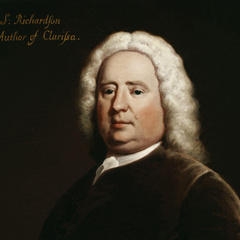
“A departure from the truth was hardly ever known to be a single one.”
“She who is more ashamed of dishonesty than of poverty will not be easily overcome.”
Source: A collection of the moral and instructive sentiments, maxims, cautions, and reflexions, contained in the histories of Pamela, Clarissa, and Sir Charles Grandison: Digested under proper heads, with references to the volume, ...
“What pleasure can those over-happy persons know, who, from their affluence and luxury, always eat before they are hungry and drink before they are thirsty?”
Source: A collection of the moral and instructive sentiments, maxims, cautions, and reflexions, contained in the histories of Pamela, Clarissa, and Sir Charles Grandison: Digested under proper heads, with references to the volume, ...
“The wisest among us is a fool in some things.”
“In all Works of This, and of the Dramatic Kind, STORY, or AMUSEMENT, should be considered as little more than the Vehicle to the more necessary INSTRUCTION.”
Source: Clarissa: Preface
“What pity that Religion and Love, which heighten our relish for the things of both worlds, should ever run the human heart into enthusiasm, superstition, or uncharitableness!”
“A good man will honor him who lives up to his religious profession, whatever it be.”
“Tis certain that Morality is an indispensable Requisite of true Religion, and there can be none without it. But it would become the Pride and Ignorance of Pagans only, to magnify it, as the Whole of what is necessary.”
“Youth is rather to be pitied than envied by people in years since it is doomed to toil through the rugged road of life which the others have passed through, in search of happiness that is not to be met with in it and that, at the highest, can be compounded for only by the blessing of a contented mind.”
“Love is a blazing, crackling, green-wood flame, as much smoke as flame; friendship, married friendship particularly, is a steady,intense, comfortable fire. Love, in courtship, is friendship in hope; in matrimony, friendship upon proof.”
Source: The Correspondence of Samuel Richardson ...: Selected from the Original Manuscripts, Bequeathed by Him to His Family, to which are Prefixed, a Biographical Account of that Author, and Observations on His Writings
“Tis a barbarous temper, and a sign of a very ill nature, to take delight in shocking any one: and, on the contrary, it is the mark of an amiable and a beneficent temper, to say all the kind things one can, without flattery or playing the hypocrite,--and what never fails of procuring the love and esteem of every one; which, next to doing good to a deserving object who wants it, is one of the greatest pleasures of this life.”
“What a world is this! What is there in it desirable? The good we hope for so strangely mixed, that one knows not what to wish for!And one half of mankind tormenting the other, and being tormented themselves in tormenting!”
Source: Clarissa Harlowe, or The History of a Young Lady - Complete
“The World is not enough used to this way of writing, to the moment. It knows not that in the minutiae lie often the unfoldings ofthe Story, as well as of the heart; and judges of an action undecided, as if it were absolutely decided.”
“The Nature of Familiar Letters, written, as it were, to the Moment, while the Heart is agitated by Hopes and Fears, on Events undecided, must plead an Excuse for the Bulk of a Collection of this Kind. Mere Facts and Characters might be comprised in a much smaller Compass: But, would they be equally interesting?”
Source: Delphi Complete Works of Samuel Richardson (Illustrated)
“The uselessness and expensiveness of modern women multiply bachelors.”
Source: A collection of the moral and instructive sentiments, maxims, cautions, and reflexions, contained in the histories of Pamela, Clarissa, and Sir Charles Grandison: Digested under proper heads, with references to the volume, ...
“All women, from the countess to the cook-maid, are put into high good humor with themselves when a man is taken with them at firstsight. And be they ever so plain, they will find twenty good reasons to defend the judgment of such a man.”
“The eye is the casement at which the heart generally looks out. Many a woman who will not show herself at the door, has tipt the sly, the intelligible wink from the window.”
Source: Clarissa Harlowe, or The History of a Young Lady - Complete
“Women love those best (whether men, women, or children) who give them most pain.”
Source: A collection of the moral and instructive sentiments, maxims, cautions, and reflexions, contained in the histories of Pamela, Clarissa, and Sir Charles Grandison: Digested under proper heads, with references to the volume, ...
“Women's eyes are wanderers, and too often bring home guests that are very troublesome to them, and whom, once introduced, they cannot get out of the house.”
Source: Works
“The longer a woman remains single, the more apprehensive she will be of entering into the state of wedlock. At seventeen or eighteen, a girl will plunge into it, sometimes without either fear or wit; at twenty, she will begin to think; at twenty-four, will weigh and discriminate; at twenty-eight, will be afraid of venturing; at thirty, will turn about, and look down the hill she has ascended, and sometimes rejoice, sometimes repent, that she has gained that summit sola.”
“Twenty-four is a prudent age for women to marry at.”
Source: A collection of the moral and instructive sentiments, maxims, cautions, and reflexions, contained in the histories of Pamela, Clarissa, and Sir Charles Grandison: Digested under proper heads, with references to the volume, ...
“Parents cannot expect advice to have the same force upon their children as experience has upon themselves.”
“Men and women are brothers and sisters; they are not of different species; and what need be obtained to know both, but to allow for different modes of education, for situation and constitution, or perhaps I should rather say, for habits, whether good or bad.”
Source: The Correspondence of Samuel Richardson, Author of Pamela, Clarissa, and Sir Charles Grandison: Selected from the Original Manuscripts, Bequeathed by Him to His Family, to which are Prefixed, a Biographical Account of that Author, and Observations on His Writings
“What the unpenetrating world call Humanity, is often no more than a weak mind pitying itself.”
Source: Letters and passages restored from the original manuscripts of the History of Clarissa. To which is subjoined, a collection of such of the moral and instructive sentiments ... contained in the History, as are presumed to be of general use and service ... Published for the sake of doing justice to the purchasers of the first two editions of that work
“Though a censure lies against those who are poor and proud, yet is Pride sooner to be forgiven in a poor person than in a rich one; since in the latter it is insult and arrogance; in the former, it may be a defense against temptations to dishonesty; and, if manifested on proper occasions, may indicate a natural bravery of mind, which the frowns of fortune cannot depress.”
“The world, the wise world, that never is wrong itself, judges always by events. And if he should use me ill, then I shall be blamed for trusting him: if well, O then I did right, to be sure!--But how would my censurers act in my case, before the event justifies or condemns the action, is the question.”
Source: Pamela Volume 1: Samuel Richardson Collections
“I never knew a man who deserved to be thought well of for his morals who had a slight opinion of our Sex in general.”
Source: A collection of the moral and instructive sentiments, maxims, cautions, and reflexions, contained in the histories of Pamela, Clarissa, and Sir Charles Grandison: Digested under proper heads, with references to the volume, ...
“Old men, imagining themselves under obligation to young paramours, seldom keep any thing from their knowledge.”
“Reverence to a woman in courtship is less to be dispensed with, as, generally, there is but little of it shown afterwards.”
“The coyest maids make the fondest wives.”
Source: Clarissa
“Those who doubt themselves most generally err least.”
Source: A collection of the moral and instructive sentiments, maxims, cautions, and reflexions, contained in the histories of Pamela, Clarissa, and Sir Charles Grandison: Digested under proper heads, with references to the volume, ...
“The unhappy never want enemies.”
Source: Clarissa Harlowe or the History of a Young Lady (Complete)
“A good man will extend his munificence to the industrious poor of all persuasions reduced by age, infirmity, or accident; to thosewho labour under incurable maladies; and to the youth of either sex, who are capable of beginning the world with advantage, but have not the means.”
“Those commands of superiors which are contrary to our first duties are not to be obeyed.”
Source: A collection of the moral and instructive sentiments: a facsimile reproduction
“Men know no medium: They will either, spaniel-like, fawn at your feet, or be ready to leap into your lap.”
Source: The History of Sir Charles Grandison: In a Series of Letters Published from the Originals, by the Editor of Pamela and Clarissa. In Seven Volumes
“When we reflect upon the cruelties daily practised upon such of the animal creation as are given us for food, or which we ensnarefor our diversion, we shall be obliged to own that there is more of the savage in human nature than we are aware of.”
Source: A collection of the moral and instructive sentiments, maxims, cautions, and reflexions, contained in the histories of Pamela, Clarissa, and Sir Charles Grandison: Digested under proper heads, with references to the volume, ...
“A good man will not engage even in a national cause, without examining the justice of it.”
Source: A collection of the moral and instructive sentiments, maxims, cautions, and reflexions, contained in the histories of Pamela, Clarissa, and Sir Charles Grandison: Digested under proper heads, with references to the volume, ...
“If women would make themselves appear as elegant to an Husband, as they were desirous to appear to him while a Lover, the Rake, which all women love, would last longer in the Husband than it generally does.”
Source: A collection of the moral and instructive sentiments, maxims, cautions, and reflexions, contained in the histories of Pamela, Clarissa, and Sir Charles Grandison: Digested under proper heads, with references to the volume, ...
“Marriage is a state that is attended with so much care and trouble, that it is a kind of faulty indulgence and selfishness to livesingle, in order to avoid the difficulties it is attended with.”
“There is a good and a bad light in which every thing that befalls us may be taken. If the human mind will busy itself to make theworst of every disagreeable occurrence, it will never want woe.”
Source: Clarissa Harlowe, or The History of a Young Lady - Complete
“All that hoops are good for is to clean dirty shoes and keep fellows at a distance.”
Source: Letters and passages restored from the original manuscripts of the History of Clarissa. To which is subjoined, a collection of such of the moral and instructive sentiments ... contained in the History, as are presumed to be of general use and service ... Published for the sake of doing justice to the purchasers of the first two editions of that work
“It is a happy art to know when one has said enough. I would leave my hearers wishing me to say more rather than give them cause toshow, by their inattention, that I had said too much.”
“The richest princes and the poorest beggars are to have one great and just judge at the last day who will not distinguish betweenthem according to their ranks when in life but according to the neglected opportunities afforded to each. How much greater then, as the opportunities were greater, must be the condemnation of the one than of the other?”
Source: A collection of the moral and instructive sentiments: a facsimile reproduction
“We can all be good when we have no temptation or provocation to the contrary.”
“I have my choice: who can wish for more? Free will enables us to do everything well while imposition makes a light burden heavy.”
“We have nothing to do, but to choose what is right, to be steady in the pursuit of it, and leave the issue to Providence.”
Source: Clarissa; Or, The History of a Young Lady: Comprenhending the Most ...
“Why Do We Procrastinate? P - postponing life R - resisting change O - overly cautious C - contemplating course of action R - reasoning and justifying A - afraid of success S - summoning up some courage T - trouble moving forward I - inability to see the outcome N - not able to trust in your abilities to make decisions A - attempting to control the situation T - time to reflect on your motives E - erodes progress”
“Where words are restrained, the eyes often talk a great deal.”
Source: A collection of the moral and instructive sentiments, maxims, cautions, and reflexions, contained in the histories of Pamela, Clarissa, and Sir Charles Grandison: Digested under proper heads, with references to the volume, ...
“It is much easier to find fault with others, than to be faultless ourselves.”
Source: A collection of the moral and instructive sentiments: a facsimile reproduction
“Men will bear many things from a kept mistress, which they would not bear from a wife.”
Source: Clarissa; Or, The History of a Young Lady: Comprehending the Most Important Concerns of Private Life