Quotessence
Home / Authors / Stephen Covey
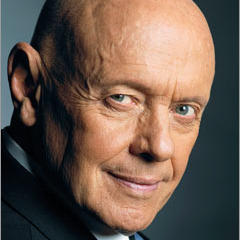
Stephen Covey

Stephen Covey Quotes

Author

Filter quotes by topic

Famous Stephen Covey Quotes

“The ability to subordinate an impulse to a value is the essence of the proactive person. Reactive people are driven by feelings, by circumstances, by conditions, by their environment. Proactive people are driven by values - carefully thought about, selected and internalized values.”

“To begin with the end in mind means to start with a clear understanding of your destination. It means to know where you're going so that you better understand where you are now and so that the steps you take are always in the right direction.”

“In a very real sense, there are only two roles in organisations: customers and suppliers. Everybody functions simultaneously in both roles, whether inside or outside the organisation the essence of good business, therefore, is the quality of the relationship between customer and supplier.”

“At the core, there is one simple, overarching reason why so many people remain unsatisfied in their work and why most organisations fail to draw out the greatest talent, ingenuity, and creativity of their people and never become truly great, enduring organisations. It stems from an incomplete paradigm of who we are - our fundamental view of human nature. The fundamental reality is, human beings are not things needing to be motivated and controlled; they are four-dimensional - body, mind, heart, and spirit.”

“Whatever your present situation, I assure you that you are not your habits. You can replace old patterns of self-defeating behavior with new patterns, new habits of the effectiveness, happiness and trust-based relationships.”

“We may find it convenient to live with the illusion that circumstances or other people are responsible for the quality of our lives, but the reality is that we are responsible-response-able-for our choices.”

“As a principle-centered person you try to stand apart from the emotion of the situation and from other factors that would act on you, and evaluate the options. Looking at the balanced whole-the work needs, the family needs, the other needs that may be involved, and the possible implications of the various alternatives - you'll try to come up with the best solution taking all factors into consideration. We are limited but we can push back the borders of our limitations.”

“If I were to summarize in one sentence the single most important principle I have learned in the field of interpersonal relations, it would be this: Seek first to understand, then to be understood. This principle is the key to effective interpersonal communication.”

“When trust is high, the dividend you receive is like a performance multiplier, elevating and improving every dimension of your organization and your life.... In a company, high trust materially improves communication, collaboration, execution, innovation, strategy, engagement, partnering, and relationships with all stakeholders.”

“Our struggle to put first things first can be characterized by the contrast between two powerful tools that direct us: the clock and the compass. The clock represents our commitments, appointments, schedules, goals, activities - what we do with, and how we manage our time. The compass represents our vision, values, principles, mission, conscience, direction - what we feel is important and how we lead our lives. In an effort to close the gap between the clock and the compass in our lives, many of us turn to the field of "time management."”

“Doing more things faster is no substitute for doing the right things.”

“We develop our character muscles by overcoming challenges and obstacles.”

“All things are created twice. There is a mental (first) creation, and a physical (second) creation. The physical creation follows the mental, just as a building follows a blueprint. If you don't make a conscious effort to visualize who you are and what you want in life, then you empower other people and circumstances to shape you and your life by default.”

“The leader is the one who climbs the tallest tree, surveys the entire situation, and yells, 'Wrong jungle!' ... Busy, efficient producers and managers often respond ... 'Shut up! We're making progress!'”

“Most people say their main fault is a lack of discipline. On deeper thought, I believe this is not the case. The basic problem is that their priorities have not become deeply planted in their hearts and minds.”

“Many people think in terms of either/or: either you're nice or you're tough. Win-win requires that you be both. It is a balancing act between courage and consideration. To go for win-win, you not only have to be empathic, but you also have to be confident. You not only have to be considerate and sensitive, you also have to be brave. To do that-to achieve that balance between courage and consideration-is the essence of real maturity and is fundamental to win-win.”