Quotessence
Home / Authors / Thomas Jefferson
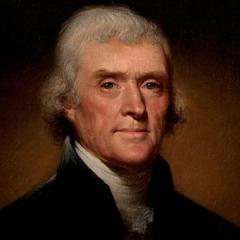
Thomas Jefferson

Thomas Jefferson Quotes

3rd U.S. President

Filter quotes by topic

Famous Thomas Jefferson Quotes

“A strict observance of the written laws is doubtless one of the highest virtues of a good citizen, but it is not the highest. The laws of necessity, of self-preservation, of saving our country when in danger, are of higher obligation. To lose our country by a scrupulous adherence to written law would be to lose the law itself, with life, liberty, property and all those who are enjoying them with us; thus absurdly sacrificing the end to the means.”

“Our country is too large to have all its affairs directed by a single government. Public servants at such a distance, and from under the eye of their constituents, must, from the circumstance of distance, be unable to administer and overlook all the details necessary for the good government of the citizens; and the same circumstance, by rendering detection impossible to their constituents, will invite public agents to corruption, plunder and waste.”

“Can the liberties of a nation be thought secure when we have remover their only firm basis, a conviction in the minds of the people that these liberties are the gift of God? That they are not to be violated but with His wrath? Indeed, I tremble for my country when I reflect that God is just; that His justice cannot sleep forever.”

“What country can preserve its liberties if its rulers are not warned from time to time that their people preserve the spirit of resistance? Let them take arms.”

“In every country where man is free to think and to speak, difference of opinion will arise from difference of perception, and the imperfection of reason; but these differences, when permitted, as in this happy country, to purify themselves by free discussion, are but as passing clouds overspreading our land transiently, and leaving our horizon more bright and serene.”

“Born in other countries, yet believing you could be happy in this, our laws acknowledge, as they should do, your right to join us in society, conforming, as I doubt not you will do, to our established rules. That these rules shall be as equal as prudential considerations will admit, will certainly be the aim of our legislatures, general and particular.”

“Whenever there are in any country uncultivated lands and unemployed poor, it is clear that the laws of property have been so far extended as to violate natural right. The earth is given as a common stock for man to labor and live on. The small landowners are the most precious part of a state”

“What country before ever existed a century and a half without a rebellion? And what country can preserve its liberties if their rulers are not warned from time to time that their people preserve the spirit of resistance? Let them take arms. The remedy is to set them right as to facts, pardon and pacify them. What signify a few lives lost in a century or two? The tree of liberty must be refreshed from time to time with the blood of patriots and tyrants. It is its natural manure.”

“In every country and every age, the priest has been hostile to liberty. He is always in alliance with the despot, abetting his abuses in return for protection to his own. It is easier to acquire wealth and power by this combination than by deserving them, and to effect this, they have perverted the purest religion ever preached to man into mystery and jargon, unintelligible to all mankind, and therefore the safer for their purposes.”

“The people cannot be all, and always, well informed. The part which is wrong will be discontented, in proportion to the importance of the facts they misconceive. If they remain quiet under such misconceptions, it is lethargy, the forerunner of death to the public liberty. And what country can preserve its liberties, if its rulers are not warned from time to time, that this people preserve the spirit of resistance? Let them take arms.”

“You have heard of the new chemical nomenclature endeavored to be introduced by Lavoisier, Fourcroy, &c. Other chemists of this country, of equal note, reject it, and prove in my opinion that it is premature, insufficient and false. These latter are joined by the British chemists; and upon the whole, I think the new nomenclature will be rejected, after doing more harm than good. There are some good publications in it, which must be translated into the ordinary chemical language before they will be useful.”

“I tremble for my country when I reflect that God is just: that his justice cannot sleep forever: that, considering numbers, nature, and natural means only, a revolution of the wheel of fortune, an exchange of situation, is among possible events: that it may become probable by supernatural interference! The Almighty has no attribute which can take side with us in such a contest.”

“To all of which is added a selection from the elementary schools of subjects of the most promising genius, whose parents are too poor to give them further education, to be carried at the public expense through the college and university. The object is to bring into action that mass of talents which lies buried in poverty in every country, for want of the means of development, and thus give activity to a mass of mind, which, in proportion to our population, shall be double or treble of what it is in most countries.”

“I have been long sensible that while I was endeavoring to render our country the greatest of all services, that of regenerating the public education, and placing our rising generation on the level of our sister states (which they have proudly held heretofore), I was discharging the odious function of a physician pouring medicine down the throat of a patient insensible of needing it.”

“Education is here placed among the articles of public care, not that it would be proposed to take its ordinary branches out of the hands of private enterprise, which manages so much better all the concerns to which it is equal, but a public institution can alone supply those sciences which, though rarely called for, are yet necessary to complete the circle, all the parts of which contribute to the improvement of the country, and some of them to its preservation.”

“There is a debt of service due from every man to his country, proportioned to the bounties which nature and fortune have measured to him.”

“I acknowledge that such a debt [of service to my fellow-citizens] exists, that a tour of duty in whatever line he can be most useful to his country, is due from every individual. It is not easy perhaps to say of what length exactly that tour should be, but we may safely say of what length it should not be. Not of our whole life, for instance, for that would be to be born a slave-not even of a very large portion of it.”

“The man who loves his country on its own account, and not merely for its trappings of interest or power, can never be divorced for it, can never refuse to come forward when he finds that she is engaged in dangers which he has the means of warding off.”

“The most effectual means of preventing the perversion of power into tyranny are to illuminate, as far as practicable, the minds of the people at large, and more especially to give them knowledge of those facts which history exhibits, that possessed thereby of the experience of other ages and countries, they may be enabled to know ambition under all its shapes, and prompt to exert their natural powers to defeat its purposes.”

“Most codes extend their definitions of treason to acts not really against one's country. They do not distinguish between acts against the government, and acts against the oppressions of the government. The latter are virtues, yet have furnished more victims to the executioner than the former. Real treasons are rare; oppressions frequent. The unsuccessful strugglers against tyranny have been the chief martyrs of treason laws in all countries.”

“I sincerely wish you may find it convenient to come here. the pleasure of the trip will be less than you expect, but the utility greater. it will make you adore your own country, it's soil, it's climate, it's equality, liberty, laws, people & manners. my god! how little do my countrymen know.”

“Such is the moral construction of the world that no national crime passes unpunished in the long run... Were present oppressors to reflect on the same truth, they would spare to their own countries the penalties on their present wrongs which will be inflicted on them in future times. The seeds of hatred and revenge which they sow with a large hand will not fail to produce their fruits in time. Like their brother robbers on the highway, they suppose the escape of the moment a final escape and deem infamy and future risk countervailed by present gain.”

“The Gothic idea that we were to look backwards instead of forwards for the improvement of the human mind, and to recur to the annals of our ancestors for what is most perfect in government, in religion and in learning, is worthy of those bigots in religion and government by whom it has been recommended, and whose purposes it would answer. But it is not an idea which this country will endure.”

“Men by their constitutions are naturally divided into two parties: 1. Those who fear and distrust the people, and wish to draw all powers from them into the hands of the higher classes. 2. Those who identify themselves with the people, have confidence in them, cherish and consider them as the most honest and safe, although not the most wise depositary of the public interests. In every country these two parties exist, and in every one where they are free to think, speak, and write, they will declare themselves.”

“To me... it appears that there have been differences of opinion and party differences, from the first establishment of government to the present day, and on the same question which now divides our own country; that these will continue through all future time; that every one takes his side in favor of the many, or of the few, according to his constitution, and the circumstances in which he is placed.”

“Believing that the happiness of mankind is best promoted by the useful pursuits of peace, that on these alone a stable prosperity can be founded, that the evils of war are great in their endurance, and have a long reckoning for ages to come, I have used my best endeavors to keep our country uncommitted in the troubles which afflict Europe, and which assail us on every side.”

“I shall rejoin myself to my native country, with new attachments, and with exaggerated esteem for its advantages; for though there is less wealth there, there is more freedom, more ease, and less misery.”

“The steady character of our countrymen is a rock to which we may safely moor; and notwithstanding the efforts of the papers to disseminate early discontents, I expect that a just, dispassionate and steady conduct, will at length rally to a proper system the great body of our country. Unequivocal in principle, reasonable in manner, we shall be able I hope to do a great deal of good to the cause of freedom & harmony.”

“If our country, when pressed with wrongs at the point of the bayonet, had been governed by its heads instead of its hearts, where should we have been now? Hanging on a gallows as high as Haman's.”

“I join cordially in admiring and revering the Constitution of the United States, the result of the collected wisdom of our country. That wisdom has committed to us the important task of proving by example that a government, if organized in all its parts on the Representative principle unadulterated by the infusion of spurious elements, if founded, not in the fears & follies of man, but on his reason, on his sense of right, on the predominance of the social over his dissocial passions, may be so free as to restrain him in no moral right, and so firm as to protect him from every moral wrong.”

“I have been happy . . . in believing that . . . whatever follies we may be led into as to foreign nations, we shall never give up our Union, the last anchor of our hope, and that alone which is to prevent this heavenly country from becoming an arena of gladiators.”

“With earnest prayers to all my friends to cherish mutual good will, to promote harmony and conciliation, and above all things to let the love of our country soar above all minor passions, I tender you the assurance of my affectionate esteem and respect.”

“We shall divert through our own Country a branch of commerce which the European States have thought worthy of the most important struggles and sacrifices, and in the event of peace on terms which have been contemplated by some powers we shall form to the American union a barrier against the dangerous extension of the British Province of Canada and add to the Empire of liberty an extensive and fertile Country thereby converting dangerous Enemies into valuable friends.”

“I agree with you that it is the duty of every good citizen to use all the opportunities, which occur to him, for preserving documents relating to the history of our country.”

“I have often thought that nothing would do more extensive good at small expense than the establishment of a small circulating library in every county, to consist of a few well-chosen books, to be lent to the people of the country under regulations as would secure their safe return in due time.”

“The trifling economy of paper, as a cheaper medium, or its convenience for transmission, weighs nothing in opposition to the advantages of the precious metals it is liable to be abused, has been, is, and forever will be abused, in every country in which it is permitted.”

“And even should the cloud of barbarism and despotism again obscure the science and libraries of Europe, this country remains to preserve and restore light and liberty to them.”

“The parties of Whig and Tory are those of nature. They exist in all countries, whether called by these names or by those of Aristocrats and Democrats, Cote Droite and Cote Gauche, Ultras and Radicals, Serviles and Liberals. The sickly, weakly, timid man fears the people, and is a Tory by nature. The healthy, strong and bold cherishes them, and is formed a Whig by nature.”

“Legislators cannot invent too many devices for subdividing property... Another means of silently lessening the inequality of property is to exempt all from taxation below a certain point, and to tax the higher portions of property in geometrical progression as they rise. Whenever there is in any country, uncultivated lands and unemployed poor, it is clear that the laws of property have been so far extended as to violate natural right.”