Quotessence
Home / Authors / Thomas Jefferson
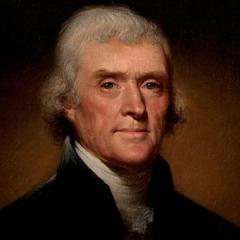
Thomas Jefferson

Thomas Jefferson Quotes

3rd U.S. President

Filter quotes by topic

Famous Thomas Jefferson Quotes

“It is left... to the juries, if they think the permanent judges are under any bias whatever in any cause, to take on themselves to judge the law as well as the fact. They never exercise this power but when they suspect partiality in the judges; and by the exercise of this power they have been the firmest bulwarks of English liberty.”

“If the question [before justices of the peace] relate to any point of public liberty, or if it be one of those in which the judges may be suspected of bias, the jury undertake to decide both law and fact.”

“[If a book were] very innocent, and one which might be confided to the reason of any man; not likely to be much read if let alone, but if persecuted, it will be generally read. Every man in the United States will think it a duty to buy a copy, in vindication of his right to buy and to read what he pleases.”

“No government can be maintained without the principle of fear as well as duty. Good men will obey the last, but bad ones the former only. If our government ever fails, it will be from this weakness.”

“It behooves our citizens to be on their guard, to be firm in their principles, and full of confidence in themselves. We are able to preserve our self-government if we will but think so.”

“Time indeed changes manners and notions, and so far we must expect institutions to bend to them. But time produces also corruption of principles, and against this it is the duty of good citizens to be ever on the watch, and if the gangrene is to prevail at last, let the day be kept off as long as possible.”

“A government regulating itself by what is wise and just for the many, uninfluenced by the local and selfish views of the few who direct their affairs, has not been seen, perhaps, on earth. Or if it existed for a moment at the birth of ours, it would not be easy to fix the term of its continuance. Still, I believe it does exist here in a greater degree than anywhere else; and for its growth and continuance... I offer sincere prayers.”

“Every society has a right to fix the fundamental principles of its association, and to say to all individuals, that if they contemplate pursuits beyond the limits of these principles and involving dangers which the society chooses to avoid, they must go somewhere else for their exercise; that we want no citizens, and still less ephemeral and pseudo-citizens, on such terms. We may exclude them from our territory, as we do persons infected with disease.”

“A noiseless course, not meddling with the affairs of others, unattractive of notice, is a mark that society is going on in happiness. If we can prevent the government from wasting the labors of the people under the pretense of taking care of them, they must become happy.”

“I discharge every person under punishment or prosecution under the Sedition Law, because I considered, and now consider, that law to be a nullity as absolute and palpable as if Congress had ordered us to fall down and worship a golden image.”

“If our country, when pressed with wrongs at the point of the bayonet, had been governed by its heads instead of its hearts, where should we have been now? Hanging on a gallows as high as Haman's.”

“I join cordially in admiring and revering the Constitution of the United States, the result of the collected wisdom of our country. That wisdom has committed to us the important task of proving by example that a government, if organized in all its parts on the Representative principle unadulterated by the infusion of spurious elements, if founded, not in the fears & follies of man, but on his reason, on his sense of right, on the predominance of the social over his dissocial passions, may be so free as to restrain him in no moral right, and so firm as to protect him from every moral wrong.”

“War is not the best engine for us to resort to; nature has given us one in our commerce, which if properly managed, will be a better instrument for obliging the interested nations of Europe to treat us with justice.”

“It has also been a great solace to me, to believe that you are engaged in vindicating to posterity the course we have pursued for preserving to them, in all their purity, the blessings of self-government, which we had assisted too in acquiring for them. If ever the earth has beheld a system of administration conducted with a single and steadfast eye to the general interest and happiness of those committed to it, one which, protected by truth, can never know reproach, it is that to which our lives have been devoted.”

“The instability of our laws is really an immense evil. I think it would be well to provide in our constitutions that there shall always be a twelve-month between the ingross-ing a bill & passing it: that it should then be offered to its passage without changing a word: and that if circum-stances should be thought to require a speedier passage, it should take two thirds of both houses instead of a bare majority.”

“If, then, the control of the people over the organs of their government be the measure of its republicanism, and I confess I know no other measure, it must be agreed that our governments have much less of republicanism than ought to have been expected; in other words, that the people have less regular control over their agents, than their rights and their interests require.”

“[T]o preserve the republican form and principles of our Constitution and cleave to the salutary distribution of powers which that [the Constitution] has established . . . are the two sheet anchors of our Union. If driven from either, we shall be in danger of foundering.”

“The principle of the Constitution is that of a separation of legislative, Executive and Judiciary functions, except in cases specified. If this principle be not expressed in direct terms, it is clearly the spirit of the Constitution, and it ought to be so commented and acted on by every friend of free government.”

“That peace, safety, and concord may be the portion of our native land, and be long enjoyed by our fellow-citizens, is the most ardent wish of my heart, and if I can be instrumental in procuring or preserving them, I shall think I have not lived in vain.”

“If [God] has made it a law in the nature of man to pursue his own happiness, He has left him free in the choice of place as well as mode, and we may safely call on the whole body of English jurists to produce the map on which nature has traced for each individual the geographical line which she forbids him to cross in pursuit of happiness.”

“If we are made in some degree for others, yet in a greater are we made for ourselves. It were contrary to feeling and indeed ridiculous to suppose that a man had less rights in himself than one of his neighbors, or indeed all of them put together. This would be slavery, and not that liberty which the bill of rights has made inviolable, and for the preservation of which our government has been charged.”

“The system of banking have[for]ever reprobated. I contemplate it as a blot left in all our Constitutions, which, if not covered, will end in their destruction, which is already hit by the gamblers in corruption, and is sweeping away in its progress the fortunes and morals of our citizens.”

“I have often thought that if heaven had given me choice of my position and calling, it should have been on a rich spot of earth, well watered, and near a good market for the productions of the garden. No occupation is so delightful to me as the culture of the earth, and no culture comparable to that of the garden. Such a variety of subjects, some one always coming to perfection, the failure of one thing repaired by the success of another, and instead of one harvest a continued one through the year.”

“But, you may ask, if the two departments [i.e., federal and state] should claim each the same subject of power, where is the common umpire to decide ultimately between them? In cases of little importance or urgency, the prudence of both parties will keep them aloof from the questionable ground; but if it can neither be avoided nor compromised, a convention of the States must be called to ascribe the doubtful power to that department which they may think best.”

“If NATURE has made any one thing less susceptible than all others of exclusive property, it is the action of the thinking power called an idea... No one possesses the less, because every other possess the whole of it. He who receives an idea from me, receives instruction himself without lessening mine; as he who lights his taper at mine, receives light without darkening me.”

“Up until the late unpleasantness of the Civil war, then, the right of secession was more or less taken for granted in many quarters, and there has never been any amendment or even a Supreme Court decision saying it's improper. - Samual Francis, Secession May Be Legal But Not Expedient, Conservative Chronicles If there be any among us who wish to dissolve the Union or to change its republican form, let them stand undisturbed, as monuments of the safety with which error of opinion may be tolerated where reason is left free to combat it.”

“The movements of nature are in a never ending circle. The animal species which has once been put into a train of motion, is still probably moving in that train. For if one link in nature's chain might be lost, another and another might be lost, till this whole system of things should evanish by piece-meal; a conclusion not warranted by the local disappearance of one or two species of animals, and opposed by the thousands and thousands of instances of the renovating power constantly exercised by nature for the reproduction of all her subjects, animal, vegetable, and mineral.”