Quotessence
Home / Authors / William Howard Taft Books
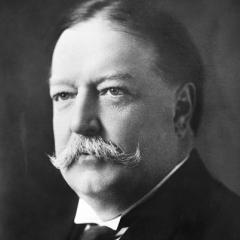
William Howard Taft

William Howard Taft Books

27th U.S. President

Related Quotes

“The development of the doctrine of international arbitration, considered from the standpoint of its ultimate benefits to the human race, is the most vital movement of modern times. In its relation to the well-being of the men and women of this and ensuing generations, it exceeds in importance the proper solution of various economic problems which are constant themes of legislative discussion and enactment.”

“Presidents may go to the seashore or to the mountains. Cabinet officers may go about the country explaining how fortunate the country is in having such an administration, but the machinery at Washington continues to operate under the army of faithful non-commissioned officers, and the great mass of governmental business is uninterrupted.”

“It is fitting that the Government of the United States should assume the obligation of the establishment and maintenance of a first-class university for the education of colored menand I wish to put in this caveatthat the colored race today, all of them, would be better off if they all had university education.... Of course, the basis of education of the colored people is in the primary schools and in industrial schools.... In those schools must be introduced teachers from such university institutions as this.”

“The Government is able to afford a suitable army and a suitable navy. It may maintain them without the slightest danger to the Republic or the cause of free institutions, and fear of additional taxation ought not to change a proper policy in this regard.”

“We should have an army so organized and so officered as to be capable in time of emergency, in cooperation with the National Militia, and under the provision of a proper national volunteer law, rapidly to expand into a force sufficient to resist all probable invasion from abroad and to furnish a respectable expeditionary force if necessary in the maintenance of our traditional American policy which bears the name of President Monroe.”

“Roosevelt could always keep ahead with his work, but I cannot do it, and I know it is a grievous fault, but it is too late to remedy it. The country must take me as it found me. Wasn't it your mother who had a servant girl who said it was no use for her to try to hurry, that she was a "Sunday chil" and no "Sunday chil" could hurry? I don't think I am a Sunday child, but I ought to have been; then I would have had an excuse for always being late.”

“I have an intense personal interest in making the use of American capital in the development of China an instrument for the promotion of the welfare of China, and an increase in her material prosperity without entanglements or creating embarrassment affecting the growth of her independent political power, and the preservation of her territorial integrity.”

“It is not impossible, of course, after such an administration as Roosevelt's and after the change in method that I could not but adapt in view of my different way of looking at things, that questions should arise as to whether I should go back on the principles of the Roosevelt administration.... I have a government of limited power under a Constitution, and we have got to work out our problems on the basis of law. Now, if that is reactionary, then I am a reactionary.”

“It gives me the greatest pleasure to say, as I do from the bottom of my heart, that never in the history of the country, in any crisis and under any conditions, have our Jewish fellow citizens failed to live up to the highest standards of citizenship and patriotism.”

“The admission of Oriental immigrants who cannot be amalgamated with our people has been made the subject either of prohibitory clauses in our treaties and statutes or of strict administrative regulations secured by diplomatic negotiations. I sincerely hope that we may continue to minimize the evils likely to arise from such immigration without unnecessary friction and by mutual concessions between self-respecting governments.”

“On the whole, yes, I would rather be the Chief Justice of the United States, and a quieter life than that which becomes at the White House is more in keeping with the temperament, but when taken into consideration that I go into history as President, and my children and my children's children are the better placed on account of that fact, I am inclined to think that to be President well compensates one for all the trials and criticisms he has to bear and undergo.”

“People run away from the name subsidy. It is a subsidy. I am not afraid to call it so. It is paid for the purpose of giving a merchant marine to the whole country so that the trade of the whole country will be benefitted thereby, and the men running the ships will of course make a reasonable profit.... Unless we have a merchant marine, our navy if called upon for offensive or defensive work is going to be most defective.”

“The truth is, the whole administration under Roosevelt was demoralized by the system of dealing directly with subordinates. It wasobviated in the State Department and the War Department under [Secretary of State Elihu] Root and me [Taft was the Secretary of War], because we simply ignored the interference and went on as we chose.... The subordinates gained nothing by his assumption of authority, but it was not so in the other departments.”

“I prefer an income tax, but the truth is I am afraid of the discussion which will follow and the criticism which will ensue if there is an other division in the Supreme Court on the subject of the income tax. Nothing has injured the prestige of the Supreme Court more than that last decision, and I think that many of the most violent advocates of the income tax will be glad of the substitution in their hearts for the same reasons. I am going to push the Constitutional amendment, which will admit an income tax without questions, but I am afraid of it without such an amendment.”

“I sincerely hope that the incoming Congress will be alive, as it should be, to the importance of our foreign trade and of encouraging it in every way feasible. The possibility of increasing this trade in the Orient, in the Philippines, and in South America is known to everyone who has given the matter attention.”

“Take away from the courts, if it could be taken away, the power to issue injunctions in labor disputes, and it would create a privileged class among the laborers and save the lawless among their number from a most needful remedy available to all men for the protection of their business interests against unlawful invasion.... The secondary boycott is an instrument of tyranny, and ought not to be made legitimate.”

“What I am anxious to do is to get the best bill possible with the least amount of friction.... I wish to avoid [splitting our party]. I shall do all in my power to retain the corporation tax as it is now and also force a reduction of the [tariff] schedules. It is only when all other efforts fail that I'll resort to headlines and force the people into this fight.”

“I do not allow myself to be moved by anything except the law. If there has been a mistake in the law, or if I think there has beenperjury or injustice, I will weigh the petition most carefully, but I do not permit myself to be moved by more harrowing details, and I try to treat each case as if I was reviewing it or hearing it for the first time from the bench.”

“There is not a subject in which I take a deeper interest than I do in the development of Alaska, and I propose, if Congress will follow by recommendations, to do something in that territory that will make it move on.”

“One of the reforms to be carried out during the incoming administration is a change in our monetary and banking laws, so as to secure greater elasticity in the forms of currency available for trade and to prevent the limitations of law from operating to increase the embarrassment of a financial panic.”

“That we can come here today and in the presence of thousands and tens of thousands of the survivors of the gallant army of Northern Virginia and their descendants, establish such an enduring monument by their hospitable welcome and acclaim, is conclusive proof of the uniting of the sections, and a universal confession that all that was done was well done, that the battle had to be fought, that the sections had to be tried, but that in the end, the result has inured to the common benefit of all.”

“I think it is a wise course for laborers to unite to defend their interests.... I think the employer who declines to deal with organized labor and to recognize it as a proper element in the settlement of wage controversies is behind the times.... Of course, when organized labor permits itself to sympathize with violent methods or undue duress, it is not entitled to our sympathy.”