Quotessence
Home / Authors / Francis Bacon
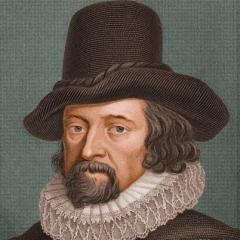
Francis Bacon

Francis Bacon Quotes

Former Lord Chancellor

Filter quotes by topic

Famous Francis Bacon Quotes

“To conclude, therefore, let no man upon a weak conceit of sobriety or an ill-applied moderation think or maintain that a man can search too far, or be too well studied in the book of God's word, or the book of God's works, divinity or philosophy; but rather let men endeavor an endless progress or proficience in both; only let men beware that they apply both to charity, and not to swelling; to use, and not to ostentation; and again, that they do not unwisely mingle or confound these learnings together.”

“The Idols of Tribe have their foundation in human nature itself, and in the tribe or race of men. For it is a false assertion that the sense of man is the measure of things. On the contrary, all perceptions as well of the sense as of the mind are according to the measure of the individual and not according to the measure of the universe. And the human understanding is like a false mirror, which, receiving rays irregularly, distorts and discolors the nature of things by mingling its own nature with it.”

“Truth is a naked and open daylight, that does not show the masques, and mummeries, and triumphs of the world, half so stately and daintily as candle-lights. . . A mixture of a lie doth ever add pleasure”

“Begin doing what you want to do now. We are not living in eternity. We have only this moment, sparkling like a star in our hand - and melting like a snowflake.”

“A man that is young in years may be old in hours if he have lost no time.”

“Great art is always a way of concentrating, reinventing what is called fact, what we know of our existence- a reconcentration… tearing away the veils, the attitudes people acquire of their time and earlier time. Really good artists tear down those veils”

“God Almighty first planted a Garden. And indeed it is the purest of human pleasures. It is the greatest refreshment to the spirits of man, without which buildings and palaces are but gross handiworks. And a man shall ever see, that when ages grow to civility and elegancy, men come to build stately sooner than to garden finely, as if gardening were the greater perfection.”

“For there is a great difference in delivery of the mathematics , which are the most abstracted of knowledges, and policy , which is the most immersed. And howsoever contention hath been moved , touching a uniformity of method in multiformity of matter, yet we see how that opinion, besides the weakness of it, hath been of ill desert towards learning, as that which taketh the way to reduce learning to certain empty and barren generalities; being but the very husks and shells of sciences, all the kernel being forced out and expulsed with the torture and press of the method.”

“For many parts of Nature can neither be invented with sufficient subtlety, nor demonstrated with sufficient perspicuity, nor accommodated unto use with sufficient dexterity, without the aid and intervening of the mathematics, of which sort are perspective, music, astronomy, cosmography, architecture, engineery, and divers others.”

“But by far the greatest hindrance and aberration of the human understanding proceeds from the dullness, incompetency, and deceptions of the senses; in that things which strike the sense outweigh things which do not immediately strike it, though they be more important. Hence it is that speculation commonly ceases where sight ceases; insomuch that of things invisible there is little or no observation.”

“I would by all means have men beware, lest Æsop's pretty fable of the fly that sate [sic] on the pole of a chariot at the Olympic races and said, 'What a dust do I raise,' be verified in them. For so it is that some small observation, and that disturbed sometimes by the instrument, sometimes by the eye, sometimes by the calculation, and which may be owing to some real change in the heaven, raises new heavens and new spheres and circles.”

“But the greatest error of all the rest is the mistaking or misplacing of the last or farthest end of knowledge: for men have entered into a desire of learning and knowledge, sometimes upon a natural curiosity and inquisitive appetite; sometimes to entertain their minds with variety and delight; sometimes for ornament and reputation; and sometimes to enable them to victory of wit and contradiction; and most times for lucre and profession; and seldom sincerely to give a true account of their gift of reason, to the benefit and use of men.”

“No one has yet been found so firm of mind and purpose as resolutely to compel himself to sweep away all theories and common notions, and to apply the understanding, thus made fair and even, to a fresh examination of particulars. Thus it happens that human knowledge, as we have it, is a mere medley and ill-digested mass, made up of much credulity and much accident, and also of the childish notions which we at first imbibed.”

“The partitions of knowledge are not like several lines that meet in one angle, and so touch not in a point; but are like branches of a tree, that meet in a stem, which hath a dimension and quantity of entireness and continuance, before it come to discontinue and break itself into arms and boughs.”