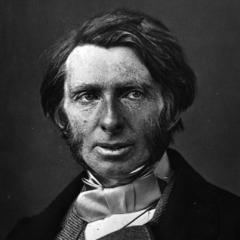
“Every human action gains in honor, in grace, in all true magnificence, by its regard to things that are to come. It is the far sight, the quiet and confident patience, that, above all other attributes, separate man from man, and near him to his Maker; and there is no action nor art, whose majesty we may not measure by this test.”
Source: The seven lamps of architecture
“Architecture is the art which so disposes and adorns the edifices raised by man, that the sight of them may contribute to his mental health, power, and pleasure.”
Source: The seven lamps of architecture
“Whether we force the man's property from him by pinching his stomach, or pinching his fingers, makes some difference anatomically; morally, none whatsoever.”
Source: The Two Paths: Being Lectures on Art, and Its Application to Decoration and Manufacture, Delivered in 1858-9
“Nobody cares much at heart about Titian, only there is a strange undercurrent of everlasting murmur about his name, which means the deep consent of all great men that he is greater than they.”
“There was always more in the world than men could see, walked they ever so slowly; they will see it no better for going fast. The really precious things are thought and sight, not pace.”
Source: Modern Painters: pt. 4. Of many things
“The great cry that rises from our manufacturing cities, louder than their furnace blast, is all in very deed for this, that we manufacture everything there except men; we blanch cotton, and strengthen steel, and refine sugar, and shape pottery; but to brighten, to strengthen, to refine, or to form a single living spirit, never enters into our estimate of advantages.”
Source: Selections From the Works of John Ruskin
“How false is the conception, how frantic the pursuit, of that treacherous phantom which men call Liberty.”
Source: Selections from the writings of John Ruskin ... With a portrait
“The word "Blue" does not mean the sensation caused by a gentian on the human eye; but it means the power of producing that sensation: and this power is always there, in the thing, whether we are there to experience it or not, and would remain there though there were not a man left on the face of the earth.”
Source: Selections and Essays
“And thus, in full, there are four classes: the men who feel nothing, and therefore see truly; the men who feel strongly, think weakly, and see untruly (second order of poets); the men who feel strongly, think strongly, and see truly (first order of poets); and the men who, strong as human creatures can be, are yet submitted to influences stronger than they, and see in a sort untruly, because what they see is inconceivably above them. This last is the usual condition of prophetic inspiration.”
Source: The Genius of John Ruskin: Selections from His Writings
“Other men used their effete faiths and mean faculties with a high moral purpose. The Venetian gave the most earnest faith, and the lordliest faculty, to gild the shadows of an antechamber, or heighten the splendours of a holiday.”
Source: Pt. 6-9 of leaf beauty. of cloud beauty. of ideas of relation
“We shall be remembered in history as the most cruel, and therefore the most unwise, generation of men that ever yet troubled the earth: the most cruel in proportion to their sensibility, the most unwise in proportion to their science. No people, understanding pain, ever inflicted so much: no people, understanding facts, ever acted on them so little.”
Source: The Eagle's Nest: Ten Lectures on the Relation of Natural Science to Art, Given Before the University of Oxford in Lent Term, 1872
“What do you suppose makes all men look back to the time of childhood with so much regret (if their childhood has been, in any moderate degree, healthy or peaceful)? That rich charm, which the least possession had for us, was in consequence of the poorness of our treasures.”
Source: Two paths. Lectures on art, delivered before the University of Oxford in Hilary Term, 1870. Aratra Pentelici. Time and tide. Pre-Raphaelitism. The eagle's nest. King of the Golden River. The relation between Michael Angelo and Tintoret
“He only is advancing in life whose heart is getting softer, whose blood warmer, whose brain quicker, whose spirit is entering into living peace. And the men who have this life in them are the true lords or kings of the earth they, and they only.”
Source: Sesame and Lilies: Three Lectures
“It ought to be quite as natural and straightforward a matter for a labourer to take his pension from his parish, because he has deserved well of his parish, as for a man in higher rank to take his pension from his country, because he has deserved well of his country.”
“When men are rightly occupied, their amusement grows out of their work, as the colour-petals out of a fruitful flower; when they are faithfully helpful and compassionate, all their emotions become steady, deep, perpetual, and vivifying to the soul as the natural pulse to the body. But now, having no true business, we pour our whole masculine energy into the false business of money-making; and having no true emotion, we must have false emotions dressed up for us to play with, not innocently, as children with dolls, but guiltily and darkly.”
Source: The Genius of John Ruskin: Selections from His Writings
“Multitudes think they like to do evil; yet no man ever really enjoyed doing evil since God made the world.”
Source: The Stones of Venice: The foundations
“The more readily we admit the possibility of our own cherished convictions being mixed with error, the more vital and helpful whatever is right in them will become; and no error is so conclusively fatal as the idea that God will not allow us to err, though He has allowed all other men to do so.”
Source: The Ethics of the Dust: Ten Lectures to Little Housewives on the Elements of Crystallisation
“Such help as we can give to each other in this world is a debt to each other; and the man who perceives a superiority or a capacity in a subordinate, and neither confesses nor assists it, is not merely the withholder of kindness, but the committer of injury.”
Source: The Two Paths: Being Lectures on Art, and Its Application to Decoration and Manufacture, Delivered in 1858-9
“It is a matter of the simplest demonstration, that no man can be really appreciated but by his equal or superior.”
Source: Pt. 1-2. of general principles and of truth
“I would have, then, our ordinary dwelling-houses built to last, and built to be lovely; as rich and full of pleasantness as may be within and without: . . . with such differences as might suit and express each man's character and occupation, and partly his history.”
Source: The True and the Beautiful in Nature, Art, Morals and Religion: Selected from the Works of John Ruskin...
“The power of painter or poet to describe what he calls an ideal thing depends upon its being to him not an ideal but a real thing. No man ever did or ever will work well but either from actual sight or sight of faith.”
Source: Modern Painters: (pt.4) Modern painters of many things
“Men say their pinnacles point to heaven. Why, so does every tree that buds, and every bird that rises as it sings. Men say their aisles are good for worship. Why, so is every mountain glen and rough sea-shore. But this they have of distinct and indisputable glory,--that their mighty walls were never raised, and never shall be, but by men who love and aid each other in their weakness.”
Source: The Two Paths: Being Lectures on Art, and Its Application to Decoration and Manufacture, Delivered in 1858-9
“Color is, in brief terms, the type of love. Hence it is especially connected with the blossoming of the earth; and again, with its fruits; also, with the spring and fall of the leaf, and with the morning and evening of the day, in order to show the waiting of love about the birth and death of man.”
Source: pt. VI: Of leaf beauty. pt. VII: Of cloud beauty. pts. VIII-IX: Of ideas of relation
“What is in reality cowardice and faithlessness, we call charity, and consider it the part of benevolence sometimes to forgive men's evil practice for the sake of their accurate faith, and sometimes to forgive their confessed heresy for the sake of their admirable practice.”
Source: The Stones of Venice
“Men are merely on a lower or higher stage of an eminence, whose summit is God's throne infinitely above all; and there is just as much reason for the wisest as for the simplest man being discontent with his position, as respects the real quantity of knowledge he possesses.”
Source: The fall
“The constant duty of every man to his fellows is to ascertain his own powers and special gifts, and to strengthen them for the help of others.”
Source: The Ethics of the Dust
“All are to be men of genius in their degree,--rivulets or rivers, it does not matter, so that the souls be clear and pure; not dead walls encompassing dead heaps of things, known and numbered, but running waters in the sweet wilderness of things unnumbered and unknown, conscious only of the living banks, on which they partly refresh and partly reflect the flowers, and so pass on.”
Source: The Stones of Venice...
“The whole difference between a man of genius and other men, it has been said a thousand times, and most truly, is that the first remains in great part a child, seeing with the large eyes of children, in perpetual wonder, not conscious of much knowledge--conscious, rather of infinite ignorance, and yet infinite power; a fountain of eternal admiration, delight, and creative force within him meeting the ocean of visible and governable things around him.”
Source: The Stones of Venice
“I believe that there is no test of greatness in periods, nations or men more sure than the development, among them or in them, of a noble grotesque, and no test of comparative smallness or limitation, of one kind or another, more sure than the absence of grotesque invention, or incapability of understanding it.”
Source: The Stones of Venice -: The Fall
“All men who have sense and feeling are being continually helped; they are taught by every person they meet, and enriched by everything that falls in their way. The greatest, is he who has been oftenest aided. Originality is the observing eye.”
“The art of nations is to be accumulative, just as science and history are; the work of living men not superseding, but building itself upon the work of the past.”
Source: The Political Economy of Art: Being the Substance (with Additions) of Two Lectures Delivered at Manchester, July 10th and 13th, 1857
“Race is precisely of as much consequence in man as it is in any animal.”
Source: Modern Painters: pt. 6. Of leaf beauty. pt. 7. Of cloud beauty. pt. 8-9. Of ideas of relation: Of invention formal. Of invention spiritual
“To yield reverence to another, to hold ourselves and our lives at his disposal, is not slavery; often, it is the noblest state in which a man can live in this world.”
Source: Selections and Essays
“A man is known to his dog by the smell, to his tailor by the coat, to his friend by the smile; each of these know him, but how little or how much depends on the dignity of the intelligence. That which is truly and indeed characteristic of the man is known only to God.”
Source: Modern Painters
“Men have commonly more pleasure in the criticism which hurts than in that which is innocuous, and are more tolerant of the severity which breaks hearts and ruins fortunes than of that which falls impotently on the grave.”
Source: pt. I. Of genral principles. pt. II. Of truth. v. 4. pt. v. Of mountain beauty
“Greatness is not a teachable nor gainable thing, but the expression of the mind of a God-made great man.”
Source: Selections from the Writings of John Ruskin
“But if, indeed, there be a nobler life in us than in these strangely moving atoms; if, indeed, there is an eternal difference between the fire which inhabits them, and that which animates us,--it must be shown, by each of us in his appointed place, not merely in the patience, but in the activity of our hope, not merely by our desire, but our labor, for the time when the dust of the generations of men shall be confirmed for foundations of the gates of the city of God.”
Source: The Ethics of the Dust: Ten Lectures to Little Housewives on the Elements of Crystallisation
“Now the basest thought possible concerning man is, that he has no spiritual nature; and the foolishest misunderstanding of him possible is, that he has, or should have, no animal nature. For his nature is nobly animal, nobly spiritual,--coherently and irrevocably so; neither part of it may, but at its peril, expel, despise, or defy the other.”
Source: The Genius of John Ruskin: Selections from His Writings
“Sky is the part of creation in which Nature has done more for the sake of pleasing man, more for the sole and evident purpose of talking to him and teaching him, than in any other of her works, and it is just the part in which we least attend to her.”
Source: Selections and Essays
“Superstition, in all times and among all nations, is the fear of a spirit whose passions are those of a man, whose acts are the acts of a man; who is present in some places, not in others; who makes no places holy and not others; who is kind to one person, unkind to another; who is pleased or angry according to the degree of attention you pay him, or praise you refuse to him; who is hostile generally to human pleasure, but may be bribed by sacrifice of a part of that pleasure into permitting the rest. This, whatever form of faith it colors, is the essence of superstition.”
Source: The Religion of Ruskin: The Life and Works of John Ruskin; a Biographical and Anthological Study
“No divine terror will ever be found in the work of the man who wastes a colossal strength in elaborating toys; for the first lesson that terror is sent to teach us is, the value of the human soul, and the shortness of mortal time.”
Source: The Stones of Venice: The fall
“There is rough work to be done, and rough men must do it; there is gentle work to be done, and gentlemen must do it.”
Source: The Crown of Wild Olive
“Why is one man richer than another? Because he is more industrious, more persevering and more sagacious.”
Source: The True and the Beautiful in Nature, Art, Morals, and Religion, Selected from the Works of John Ruskin
“There are, indeed, two forms of discontent: one laborious, the other indolent and complaining. We respect the man of laborious desire, but let us not suppose that his restlessness is peace, or his ambition meekness. It is because of the special connection of meekness with contentment that it is promised that the meek shall 'inherit the earth.' Neither covetous men, nor the grave, can inherit anything; they can but consume. Only contentment can possess.”
Source: Modern Painters: pt. 6. Of leaf beauty. pt. 7. Of Cloud beauty. pt. 8-9. Of ideas of relation
“The wisest men are wise to the full in death.”
Source: John Ruskin's Works
“That man is always happy who is in the presence of something which he cannot know to the full, which he is always going on to know.”
Source: Selections from the Writings of John Ruskin
“The man who accepts the laissez-faire doctrine would allow his garden to grow wild so that roses might fight it out with the weeds and the fittest might survive.”
“The man who says to one, go, and he goeth, and to another, come, and he cometh, has, in most cases, more sense of restraint and difficulty than the man who obeys him.”
Source: Selections and Essays
“I tell you (dogmatically, if you like to call it so, knowing it well) a square inch of man's engraving is worth all the photographs that were ever dipped in acid... Believe me, photography can do against line engraving just what Madame Tussaud's wax-work can do against sculpture. That and no more. (1865)”
“... Amongst all the mechanical poison that this terrible nineteenth century has poured upon men, it has given us at any rate one antidote - the Daguerreotype. (1845)”
Source: Ruskin, Turner and the Pre-Raphaelites