Quotessence
Home / Authors / John Steinbeck Books
John Steinbeck

John Steinbeck Books

Author

Flight

A source page for quotes linked to John Steinbeck.
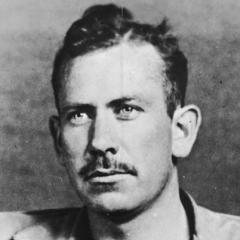
0 quotes

Steinbeck

A source page for quotes linked to John Steinbeck.

0 quotes

شرق بهشت

A source page for quotes linked to John Steinbeck.

0 quotes

Related Quotes

“Tom felt his darkness. His father was beautiful and clever, his mother was short and mathematically sure. Each of his brothers and sisters had looks or gifts or fortune. Tom loved all of them passionately, but he felt heavy and earth-bound. He climbed ecstatic mountains and floundered in the rocky darkness between the peaks. He had spurts of bravery but they were bracketed in battens of cowardice.”

“Consider the blundering anarchic system of the United States the stupidity of some of its lawmakers, the violent reaction, the slowness of its ability to change. Twenty-five key men destroyed could make the Soviet Union stagger, but we could lose our congress, our president, and our general staff and nothing much would have happened. We would go right on. In fact we might be better for it.”

“I remember clearly the deaths of three men. One was the richest man of the century, who, having clawed his way to wealth through the souls and bodies of men, spent many years trying to buy back the love he had forfeited and by that process performed great service to the world and, perhaps, had much more than balanced the evils of his rise. I was on a ship when he died. The news was posted on the bulletin board, and nearly everyone recieved the news with pleasure. Several said, "Thank God that son of a bitch is dead." Then there was a man, smart as Satan, who, lacking some perception of human dignity and knowing all too well every aspect of human weakness and wickedness, used his special knowledge to warp men, to buy men, to bribe and threaten and seduce until he found himself in a position of great power. He clothed his motives in the names of virtue, and I have wondered whether he ever knew that no gift will ever buy back a man's love when you have removed his self-love. A bribed man can only hate his briber. When this man died the nation rang with praise... There was a third man, who perhaps made many errors in performance but whose effective life was devoted to making men brave and dignified and good in a time when they were poor and frightened and when ugly forces were loose in the world to utilize their fears. This man was hated by few. When he died the people burst into tears in the streets and their minds wailed, "What can we do now?" How can we go on without him?" In uncertainty I am certain that underneath their topmost layers of frailty men want to be good and want to be loved. Indeed, most of their vices are attempted short cuts to love. When a man comes to die, mo matter what his talents and influence and genius, if he dies unloved his life must be a failure to him and his dying a cold horror....we should remember our dying and try so to live that our death brings no pleasure to the world.”

“I believe that there is one story in the world, and only one, that has frightened and inspired us, so that we live in a Pearl White serial of continuing thought and wonder. Humans are caught - in their lives, in their thoughts, in their hungers and ambitions, in their avarice and cruelty, and in their kindness and generosity too - in a net of good and evil. I think this is the only story we have and that it occurs on all levels of feeling and intelligence. Virtue and vice were warp and woof of our first consciousness, and they will be the fabric of our last, and this despite any changes we may impose on field and river and mountain, on economy and manners. There is no other story. A man, after he has brushed off the dust and chips of life, will have left only the hard, clean questions: Was it good or was it evil? Have I done well - or ill?”

“Cathy's lies were never innocent. Their purpose was to escape punishment, or work, or responsibility, and they were used for profit. Most liars are tripped up either because they forget what they have told or because the lie is suddenly faced with an incontrovertible truth. But Cathy did not forget her lies, and she developed the most effective method of lying. She stayed close enough to the truth so that one could never be sure. She knew two other methods also -- either to interlard her lies with truth or to tell a truth as though it were a lie. If one is accused of a lie and it turns out to be the truth, there is a backlog that will last a long time and protect a number of untruths.”

“...“I’m not being funny. He doesn’t think about me. He’s made someone up, and it’s like he put my skin on her. I’m not like that—not like the made-up one.” “What’s she like?” “Pure!” said Abra. “Just absolutely pure. Nothing but pure—never a bad thing. I’m not like that.” “Nobody is,” said Lee. “He doesn’t know me. He doesn’t even want to know me. He wants that—white—ghost.” Lee rubbled a piece of cracker. “Don’t you like him? You’re pretty young, but I don’t think that makes any difference.” “ ’Course I like him. I’m going to be his wife. But I want him to like me too. And how can he, if he doesn’t know anything about me? I used to think he knew me. Now I’m not sure he ever did”.”

“Her total intellectual association was the Bible, except the talk of Samuel and her children, and to them she did not listen. In that one book she had her history and her poetry, her knowledge of peoples and things, her ethics, her morals, and her salvation. She never studied the Bible or inspected it; she just read it. The many places where it seems to refute itself did not confuse her in the least. And finally she came to a point where she knew it so well that she went right on reading it without listening.”

“The greatest terror a child can have is that he is not loved, and rejection is the hell he fears. I think everyone in the world to a large or small extent has felt rejection. And with rejection comes anger, and with anger some kind of crime in revenge for the rejection, and with the crime guilt—and there is the story of mankind. I think that if rejection could be amputated, the human would not be what he is.”

“Adam said, “Just thinking.” And he was thinking with amazement, Why, I’m not afraid of my brother! I used to be scared to death of him, and I’m not any more. Wonder why not? Could it be the army? Or the chain gang? Could it be Father’s death? Maybe—but I don’t understand it. With the lack of fear, he knew he could say anything he wanted to, whereas before he had picked over his words to avoid trouble. It was a good feeling he had, almost as though he himself had been dead and resurrected.”

“Ma was heavy, but not fat; thick with child-bearing and work. She wore a loose Mother Hubbard of gray cloth in which there had once been colored flowers, but the color was washed out now, so that the small flowered pattern was only a little lighter gray than the background. The dress came down to her ankles, and he strong, broad, bare feet moved quickly and deftly over the floor. Her thin, steel-gray hair was gathered in a sparse wispy knot at the back of her head. Strong, freckled arms were bare to the elbow, and her hands were chubby and delicate, like those of a plump little girl. She looked out into the sunshine. Her full face was not soft; it was controlled, kindly. Her hazel eyes seemed to have experienced all possible tragedy and to have mounted pain and suffering like steps into a high calm and a superhuman understanding. She seemed to know, to accept, to welcome her position, the citadel of the family, the strong place that could not be taken. And since old Tom and the children could not know hurt or fear unless she acknowledged hurt and fear, she had practiced denying them in herself. And since, when a joyful thing happened, they looked to see whether joy was on her, it was her habit to build up laughter out of inadequate materials. But better than joy was calm. Imperturbability could be depended upon. And from her great and humble position in the family she had taken dignity and a clean calm beauty. From her position as healer, her hands had grown sure and cool and quiet; from her position as arbiter she had become as remote and faultless in judgment as a goddess. She seemed to know that if she swayed the family shook, and if she ever really deeply wavered or despaired the family would fall, the family will to function would be gone.”

“In our time mass or collective production has entered our economics, our politics, even our religion, so that some nations have substituted the idea collective for the idea God. This in my time is the danger. There is great tension in the world, tension toward a breaking point, and men are unhappy and confused. At such a time it seems natural and good to me to ask myself these questions. What do I believe in? What must I fight for and what must I fight against?”

“I believe that there is one story in the world, and only one, that has frightened and inspired us, so that we live in a Pearl White serial of continuing thought and wonder. Humans are caught—in their lives, in their thoughts, in their hungers and ambitions, in their avarice and cruelty, and in their kindness and generosity too—in a net of good and evil. I think this is the only story we have and that it occurs on all levels of feeling and intelligence. Virtue and vice were warp and woof of our first consciousness, and they will be the fabric of our last, and this despite any changes we may impose on field and river and mountain, on economy and manners. There is no other story. A man, after he has brushed off the dust and chips of his life, will have left only the hard, clean questions: Was it good or was it evil? Have I done well—or ill? [...] In uncertainty I am certain that underneath their topmost layers of frailty men want to be good and want to be loved. Indeed, most of their vices are attempted short cuts to love. When a man comes to die, no matter what his talents and influence and genius, if he dies unloved his life must be a failure to him and his dying a cold horror. It seems to me that if you or I must choose between two courses of thought or action, we should remember our dying and try so to live that our death brings no pleasure to the world. We have only one story. All novels, all poetry, are built on the never-ending contest in ourselves of good and evil. And it occurs to me that evil must constantly respawn, while good, while virtue, is immortal. Vice has always a new fresh young face, while virtue is venerable as nothing else in the world is.”

“Humans are caught -- in their lives, in their thoughts, in their hungers and ambitions, in their avarice and cruelty, and in their kindness and generosity too -- in a net of good and evil. I think this is the only story we have and that it occurs on all levels of feeling and intelligence. Virtue and vice were warp and woof of our first consciousness, and they will be the fabric of our last, and this despite any chances we may impose of field and river and mountain, on economy and manners. There is no other story. A man, after he has brushed off the dust and chips of his life, will have left only the hard, clean questions: Was it good or was it evil? Have I don well -- or ill?”

“It is argued that because they believed thoroughly in a just, moral God they could put their faith there and let the smaller securities take care of themselves. But I think that because they trusted themselves and respected themselves as individuals, because they know beyond doubt that they were valuable and potentially moral units - because of this they could give God their own courage and dignity and then receive it back.”

“Hm-m," he said. "Lookie, Ma. I been all day an' all night hidin' alone. Guess who I been thinkin' about? Casy! He talked a lot. Used ta bother me. But now I been thinkin' what he said, an' I can remember-all of it. Says one time he went out in the wilderness to find his own soul, an' he foun' he didn' have no soul that was his'n. Says he foun' he jus' got a little piece of a great big soul. Says a wilderness ain't no good, 'cause his little piece of a soul wasn't no good 'less it was with the rest, an' was whole. Funny how I remember. Didn't even think I was listenin'. But I know now a fella ain't no good alone.”

“The last clear definite function of man - muscles aching to work, minds aching to create beyond the single need - this is man. To build a wall, to build a house, a dam, and in the wall and house and dam to put something of Manself, and to Manself take back something of the wall, the house the dam; to take hard muscles from the lifring, to take the clear lines and form from conceiving. For man, unlike any other thing organic or inorganic in the universe, grows beyond work, walks up the stairs of his concepts, emerges ahead of his accomplishments.”